
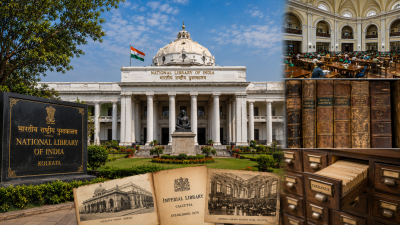
The National Library of India, located in Kolkata, is the largest library in the country by volume and public record. Its history is a confluence of two major colonial institutions: the Calcutta Public Library and the Imperial Library.
- Calcutta Public Library (1836): Formed as a non-government institution, it was the first of its kind in this part of the world. It was run on a proprietary basis and served as a major intellectual hub.
- Imperial Library (1891): Formed by combining several departmental libraries of the British Government.
- The Amalgamation (1903): Lord Curzon, the then Viceroy of India, merged the Calcutta Public Library with the Imperial Library. It was opened to the public at Metcalfe Hall on January 30, 1903.
- Post-Independence Transformation: Under the Imperial Library (Change of Name) Act, 1948, the institution was designated as the National Library. It was moved from Esplanade to its current location, the Belvedere Estate, and formally inaugurated by Maulana Abul Kalam Azad on February 1, 1953.
Administrative Framework and Statutory Status
The National Library functions as an Subordinate Office under the Ministry of Culture, Government of India.
- Delivery of Books and Newspapers (Public Libraries) Act, 1954: This is a crucial legislative mandate. Under this Act, every publisher in India is legally obligated to send one copy of every published book, periodical, and newspaper to the National Library (and three other recipient libraries) within 30 days of publication at their own expense.
- National Library Authority: It is governed by a Board that oversees its developmental policies and modernization efforts.
The Belvedere Estate: Architectural Significance
The library is housed in the historic Belvedere Estate, which was formerly the official residence of the Lieutenant Governor of Bengal and, for a period, the Viceroy of India.
- Location: Alipore, Kolkata.
- Architecture: The main building reflects Italianate style with wrap-around verandas and Corinthian columns, set amidst 30 acres of lush greenery.
Categorization of Holdings and Special Collections
The library’s collection exceeds 2.2 million books, along with manuscripts, maps, and periodicals.
| Collection Type | Key Highlights |
| Language Divisions | Books in all 22 scheduled languages of India, including a massive collection in Bengali, Hindi, and Sanskrit. |
| The Ashutosh Mukhopadhyay Collection | A personal collection of over 80,000 books gifted to the library, covering diverse subjects. |
| Rare Books & Manuscripts | Includes 18th-century Persian manuscripts and rare palm-leaf manuscripts. |
| The Buhar Collection | Significant for its rare Arabic and Persian manuscripts and printed books. |
| Official Documents | Acts as a repository for United Nations publications and Government of India gazettes. |
Key Divisions and Modernization Initiatives
To maintain its 360-degree role as a cultural repository, the library operates several specialized divisions:
- Conservation Division: Focuses on the chemical treatment and physical restoration of brittle and old documents. It includes a sophisticated laboratory for de-acidification and lamination.
- Reprography Unit: Engaged in microfilming and digitizing rare documents to ensure long-term preservation and easy access for scholars.
- Children’s Library: A dedicated section designed to foster a reading habit among younger generations.
- National Bibliographic Division: Responsible for compiling the Indian National Bibliography (INB), a monthly record of all books published in India in various languages.
Digital Presence and Global Access
In the era of information technology, the National Library has transitioned into a digital-friendly space:
- National Digital Library of India (NDLI) Integration: The library contributes significantly to the digital repository maintained by IIT Kharagpur under the Ministry of Education.
- OPAC (Online Public Access Catalogue): Allows users to search the library’s vast holdings remotely.
- Electronic Resources: Subscriptions to various international journals, e-books, and databases are available for registered members.
Significance for UPSC Prelims
- Parent Ministry: Ministry of Culture.
- Legislative Mandate: Delivery of Books and Newspapers (Public Libraries) Act, 1954.
- Historical Figure: Lord Curzon was the primary architect behind the “Imperial Library” concept.
- Designation: It is the premier library for the “National Bibliographic Agency” of India.
- Constitutional Provision: Under the Seventh Schedule of the Indian Constitution, the National Library is an item in the Union List (Entry 62).
Important Trivia
- The library holds the “Hibbert and Iggulden” collection, which is vital for European history research.
- It is one of the four “Deposit Libraries” in India; the others are the Connemara Public Library (Chennai), the Asiatic Society (Mumbai), and the Delhi Public Library.
- The library contains a “Ghost Room” legend associated with the residence of Lady Metcalfe, which remains a popular piece of local folklore.