
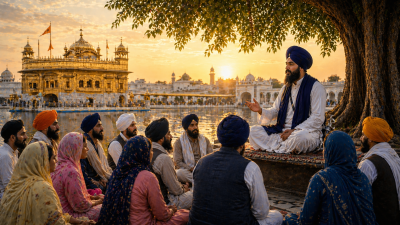
Sikhism is one of the youngest world religions, founded in the late 15th century in the Punjab region of the Indian subcontinent. It emerged as a distinct monotheistic faith that challenged the prevailing caste hierarchies and ritualistic complexities of both Hinduism and Islam. The term “Sikh” is derived from the Sanskrit word Shishya, meaning disciple.
The Ten Gurus: Evolution of the Faith
The spiritual and temporal foundation of Sikhism was laid by ten successive Gurus. Their contributions shaped the community’s identity and religious practices.
| Guru | Key Contribution |
| Guru Nanak Dev (1st) | Founded the faith; introduced the concept of Langar (community kitchen) and Ik Onkar (One God). |
| Guru Angad Dev (2nd) | Developed and standardized the Gurmukhi script; expanded the Langar system. |
| Guru Amar Das (3rd) | Established the Manji system (administrative seats) and advocated against Sati and Purdah. |
| Guru Ram Das (4th) | Founded the city of Amritsar (originally Ramdaspur) and started the construction of the Amrit Sarovar. |
| Guru Arjan Dev (5th) | Compiled the Adi Granth; built the Harmandir Sahib (Golden Temple); first Sikh Guru to be martyred. |
| Guru Hargobind (6th) | Introduced the concept of Miri (temporal power) and Piri (spiritual power); built the Akal Takht. |
| Guru Har Rai (7th) | Focused on social reform and healthcare; offered sanctuary to Dara Shikoh. |
| Guru Har Krishan (8th) | Known as the “Child Guru”; served the sick during a smallpox epidemic in Delhi. |
| Guru Tegh Bahadur (9th) | Martyred by Aurangzeb for protecting the religious freedom of Kashmiri Brahmins; known as Hind di Chadar. |
| Guru Gobind Singh (10th) | Founded the Khalsa Panth (1699); introduced the Five Ks; ended the line of human Gurus. |
Core Tenets and Doctrines
The Sikh philosophy is centered on the equality of all human beings and the rejection of idol worship.
- Ik Onkar: The belief in one supreme, formless reality (Nirguna) that is omnipresent and eternal.
- Three Pillars of Sikhism:
- Naam Japna: Meditating on God’s name to control the five inner vices (Lust, Anger, Greed, Attachment, Pride).
- Kirat Karni: Earning an honest living through hard work and physical/mental effort.
- Vand Chakna: Sharing the fruits of one’s labor with the community and the needy.
- Seva and Simran: The dual path of selfless service to humanity and spiritual remembrance of God.
The Khalsa Panth and the Five Ks
In 1699, Guru Gobind Singh created the Khalsa (the Pure), a community of initiated Sikhs committed to the highest code of conduct and bravery. Every Khalsa Sikh is mandated to wear five articles of faith, known as the Five Ks:
- Kesh: Uncut hair, representing holiness and strength.
- Kangha: A wooden comb, symbolizing cleanliness and order.
- Kara: An iron/steel bracelet, representing an unbreakable connection with God and a restraint from evil deeds.
- Kachera: Cotton undergarments, symbolizing chastity and self-control.
- Kirpan: A ceremonial sword, symbolizing the duty to protect the oppressed and uphold justice.
Sacred Scriptures: Guru Granth Sahib
The Guru Granth Sahib is the eternal living Guru of the Sikhs. It is a unique scripture because it contains the hymns (Gurbani) of not only the Sikh Gurus but also saints from different backgrounds.
- Compilation: It includes the teachings of Bhagat Kabir, Baba Farid, Bhagat Namdev, Ravidas, and others, highlighting the religion’s syncretic and inclusive nature.
- Language: Written primarily in Gurmukh script, it uses a variety of languages including Braj Bhasha, Punjabi, Khariboli, Sanskrit, and Persian.
- Structure: Organized according to 31 Ragas (musical measures), emphasizing the importance of kirtan (devotional singing).
Sikh Art and Architecture
Sikh architecture is a blend of Mughal and Rajput styles, characterized by domes, frescoes, and ornate marble work.
- Gurdwaras: The “Gateway to the Guru.” Every Gurdwara features the Nishan Sahib (a triangular saffron flag) and a Langar hall.
- Harmandir Sahib (Golden Temple): Features four entrances in all four directions, symbolizing that people from all walks of life and all religions are welcome.
- The Five Takhts: These are the seats of temporal authority in Sikhism:
- Akal Takht (Amritsar)
- Takht Sri Patna Sahib (Bihar)
- Takht Sri Kesgarh Sahib (Anandpur)
- Takht Sri Hazur Sahib (Nanded)
- Takht Sri Damdama Sahib (Talwandi Sabo)
Festivals and Religious Observances
- Gurpurab: Birth anniversaries of the Sikh Gurus, celebrated with Prabhat Pheris (early morning processions) and Akhand Path (continuous reading of the scripture).
- Vaisakhi: Marks the harvest festival and the anniversary of the formation of the Khalsa in 1699.
- Hola Mohalla: A day after Holi, established by Guru Gobind Singh to demonstrate Sikh martial arts (Gatka) and military exercises.
- Maghi: Commemorates the 40 “Immortals” (Chali Mukte) who fought for Guru Gobind Singh in the Battle of Muktsar.
Significant Trivia for UPSC Prelims
- Masand System: A system of provincial deputies established by Guru Amar Das to spread Sikhism and collect offerings, later abolished by Guru Gobind Singh due to corruption.
- Zafarnama: The “Epistle of Victory,” a defiant letter written in Persian by Guru Gobind Singh to Aurangzeb.
- Miri and Piri: Symbolized by two swords worn by Guru Hargobind; Miri represents political/temporal sovereignty and Piri represents spiritual authority.
- The Panj Pyare: The “Five Beloved Ones” who were the first to be initiated into the Khalsa Panth.
- UNESCO Intangible Heritage: While Sikhism itself is a religion, the traditional brass and copper craft of utensil making among the Thatheras of Jandiala Guru (Punjab) is closely linked to the community’s heritage.