
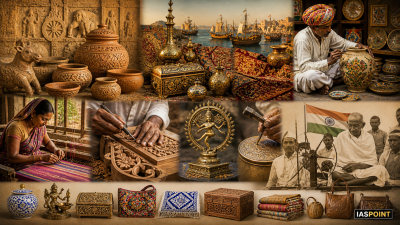
The evolution of Indian handicrafts is a testament to the country’s socio-economic and cultural transitions. From utilitarian items in ancient civilizations to luxury exports in the medieval era and a tool for self-reliance during the freedom struggle, handicrafts have remained central to the Indian identity.
Ancient Period: Foundations of Craftsmanship
The origins of Indian handicrafts date back to the Indus Valley Civilization (3300–1300 BCE), where urban planning was complemented by sophisticated artisanal skills.
- Harappan Terracotta: Crafting of seals, toys (the famous “dancing girl” bronze statue), and jewelry using the Cire Perdue (Lost Wax) technique.
- Vedic Era: References in the Rig Veda highlight specialized crafts like weaving, pottery (Painted Grey Ware), and metallurgy.
- Mauryan & Gupta Excellence: The development of stone carving, ivory work, and the growth of Srenis (Guilds), which regulated quality and training.
Medieval Period: Indo-Islamic Synthesis
The arrival of the Delhi Sultanate and the Mughal Empire introduced new aesthetics, materials, and techniques, leading to a “Golden Age” for luxury crafts.
- Persian Influence: Introduction of Zardozi (gold embroidery), Bidriware (zinc and copper inlay), and Meenakari (enameling).
- Royal Patronage: Emperors like Akbar and Shah Jahan established Karkhanas (royal workshops) to produce high-end silks, carpets, and inlaid marble (Pietra Dura).
- Regional Specialties: Development of Kalamkari in Andhra Pradesh and Chanderi weaving in Madhya Pradesh gained prominence through inter-regional trade.
Colonial Period: De-industrialization and Resistance
The British East India Company’s policies shifted India from an exporter of finished goods to a supplier of raw materials.
- Impact of Industrial Revolution: Machine-made British textiles led to the decline of indigenous weavers, famously termed “De-industrialization” by nationalist historians.
- The Swadeshi Movement: Handicrafts became a political tool. Mahatma Gandhi promoted Khadi as a symbol of self-reliance and resistance against colonial economic exploitation.
Post-Independence: Institutionalization and Revival
Recognizing handicrafts as a massive employment generator, the Government of India integrated the sector into the five-year plans.
- All India Handicrafts Board (1952): Formed under the leadership of Kamaladevi Chattopadhyay to advise the government on development and marketing.
- Handicrafts and Handlooms Export Corporation (HHEC): Established to tap into international markets and ensure fair pricing for artisans.
Geographical Indications (GI) and Intellectual Property
To protect the uniqueness and traditional knowledge of regional crafts, the GI tag system was introduced under the Geographical Indications of Goods (Registration and Protection) Act, 1999.
| State | Famous GI Tagged Handicraft | Key Features |
| Jammu & Kashmir | Pashmina Shawls | Made from the fine wool of Changthangi goats. |
| Odisha | Pattachitra | Traditional cloth-based scroll painting. |
| Rajasthan | Blue Pottery | Use of quartz instead of clay; Persian origin. |
| Uttar Pradesh | Chikankari | Delicate shadow-work embroidery from Lucknow. |
| Karnataka | Channapatna Toys | Lacquer-ware wooden toys made from Dhalhara wood. |
| Bihar | Madhubani Painting | Geometric patterns using natural dyes and twigs. |
Classification of Indian Handicrafts
Indian handicrafts are broadly categorized based on the material used and the technique applied:
Textile-Based Crafts
- Bandhani (Gujarat/Rajasthan): A tie-and-dye technique creating intricate patterns.
- Sambalpuri (Odisha): An Ikat weaving style where warp and weft are dyed before weaving.
- Phulkari (Punjab): Floral embroidery usually done on handspun khaddar.
Metal and Stone Crafts
- Dhokra: Non-ferrous metal casting using the lost-wax casting technique, predominantly by tribal communities in Chhattisgarh and West Bengal.
- Makrana Marble: Utilized for intricate lattice work (Jaali) and carving.
Wood and Cane Crafts
- Sandalwood Carving (Karnataka): Known for its fragrance and detailed religious figurines.
- Bamboo and Cane (Northeast India): Utilization of local forest produce for furniture, baskets, and mats.
Socio-Economic Significance and Government Initiatives
Handicrafts currently constitute a significant portion of India’s non-farm rural economy, employing over 7 million artisans.
- Ambedkar Hastshilp Vikas Yojana: Aims at the holistic development of artisans through cluster-based interventions.
- Pehchan Initiative: Issuance of identity cards to artisans to link them with national databases and social security schemes.
- National Handicraft Development Programme (NHDP): Focuses on design intervention, marketing assistance, and infrastructure support.
Important Facts for UPSC Aspirants
- UNESCO Creative Cities Network (UCCN): Srinagar (Crafts and Folk Arts) and Jaipur are members, recognizing their commitment to leveraging culture for development.
- Dilli Haat: A permanent craft bazaar established to provide a direct marketing platform for rural artisans.
- One District One Product (ODOP): A flagship scheme to transform every district into an export hub by promoting its indigenous craft (e.g., Terracotta in Gorakhpur).
- Export Data: India is one of the largest exporters of handicrafts globally, with major markets in the USA, UK, and UAE.