
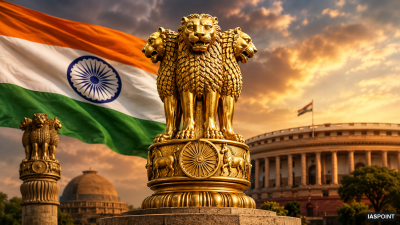
The State Emblem of India is an adaptation of the Sarnath Lion Capital of Ashoka, which dates back to 250 BCE. It was officially adopted by the Government of India on January 26, 1950, the day India became a Republic. The emblem represents the philosophical and constitutional values of the nation, bridging its ancient Mauryan heritage with modern democratic ideals.
Structural Components of the State Emblem
The emblem is a three-dimensional sculpture featuring four Asiatic lions standing back-to-back. In the two-dimensional representation used for official purposes, only three lions are visible, with the fourth hidden from view.
- The Lions: Symbolize power, courage, confidence, and pride.
- The Abacus: The circular base (abacus) features sculptures in high relief of an elephant, a galloping horse, a bull, and a lion, separated by intervening wheels (Dharmachakras).
- The Bell-shaped Lotus: In the original Sarnath capital, the abacus rests on an inverted bell-shaped lotus; however, this is omitted in the official State Emblem of India.
- The Motto: Inscribed below the abacus in Devanagari script is the phrase Satyameva Jayate.
Symbolic Significance of the Animals
The four animals depicted on the abacus represent different stages of Lord Buddha’s life or the four directions, though in the national context, they signify various Indian virtues.
| Animal | Symbolism/Representation |
| Elephant | Represents Buddha’s conception (the dream of Queen Maya). |
| Bull | Symbolizes the zodiac sign of Taurus, the month in which Buddha was born. |
| Horse | Represents Kanthaka, the horse Buddha used for leaving his palatial life. |
| Lion | Symbolizes the attainment of enlightenment and the roar of the Dhamma. |
Satyameva Jayate: The National Motto
The words Satyameva Jayate (Truth Alone Triumphs) are a crucial part of the State Emblem.
- Source: It is a mantra from the Mundaka Upanishad, a part of the Atharvaveda.
- Placement: Inscribed in Devanagari script at the base of the emblem.
- Legal Standing: It is an integral part of the emblem; using the emblem without the motto is considered an incomplete representation under the law.
The Ashoka Chakra: The Wheel of Law
The Wheel (Dharmachakra) appears in the center of the abacus, with the bull on the right and the horse on the left.
- Design: It features 24 spokes, which represent the 24 hours of the day and the concept of “Time” and “Progress.”
- Inspiration: Derived from the Buddhist concept of the “Wheel of Dharma” or the “Wheel of Law.”
- Integration: This wheel also occupies the central position in the National Flag of India.
Legal Framework: State Emblem of India (Prohibition of Improper Use) Act, 2005
The use of the State Emblem is strictly regulated to maintain its dignity and prevent misuse.
- Governing Law: The State Emblem of India (Prohibition of Improper Use) Act, 2005, and the State Emblem of India (Regulation of Use) Rules, 2007.
- Authorized Use: It is used by the Government of India, State Governments, and Union Territory administrations on official stationery, seals, and currency.
- Restricted Entities: Private individuals or organizations are prohibited from using the emblem for business, trade, or profession.
- Diplomatic Use: It is used on the diplomatic passports of the Republic of India and at Indian Embassies abroad.
Comparative Facts for UPSC Prelims
- The Sarnath Original: The original Sarnath Lion Capital is currently preserved in the Sarnath Museum in Uttar Pradesh.
- The New Parliament Installation: In 2022, a massive bronze version of the State Emblem, weighing 9,500 kg and standing 6.5 meters tall, was unveiled atop the New Parliament Building (Central Vista).
- The Fourth Lion: While the Sarnath Capital has four lions, the official State Emblem as viewed on paper shows only three.
- Designer: The design of the State Emblem for the original Constitution of India was sketched by Dinanath Bhargava, a student of Nandalal Bose at Shantiniketan.
Usage on Official Documents
The emblem serves as the official seal of the President of India and the Central and State Governments. It is featured prominently on:
- All Indian Currency (Notes and Coins).
- Passports of Indian Citizens.
- The Gazette of India.
- Letterheads of Government Ministries and Departments.
- The Ashoka Pillar at the entrance of various administrative buildings.