
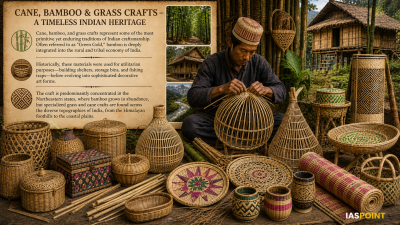
Cane, bamboo, and grass crafts represent some of the most primitive yet enduring traditions of Indian craftsmanship. Often referred to as “Green Gold,” bamboo is deeply integrated into the rural and tribal economy of India. Historically, these materials were used for utilitarian purposes—building shelters, storage bins, and fishing traps—before evolving into sophisticated decorative art forms. The craft is predominantly concentrated in the Northeastern states, where bamboo grows in abundance, but specialized grass and cane crafts are found across the diverse topographies of India, from the Himalayan foothills to the coastal plains.
Major Regional Clusters and Specialized Crafts
India’s geographic diversity has resulted in unique regional specializations based on the local availability of specific grass or bamboo species.
Northeastern Region: The Bamboo Heartland
The “Seven Sister States” account for nearly 60% of India’s bamboo resources, making this region the global hub for bamboo artistry.
- Assam: Famous for “Japi” (traditional conical hats), “Sitalpati” (cool mats made from Murta reed), and intricate bamboo furniture.
- Tripura: Renowned for “Mutra” cane weaving and the production of delicate bamboo screens and wall panels.
- Manipur: Specializes in “Kauna” (water reed) craft, where artisans create eco-friendly bags, mats, and cushions.
- Mizoram and Nagaland: Noted for sturdy bamboo baskets with distinct geometric weaves and bamboo drinking mugs used in tribal ceremonies.
Northern and Western India: The Grass Clusters
In the arid and semi-arid regions, hardy grasses are transformed into durable household items.
- Sarkanda Grass (Haryana & Punjab): Used to make “Mudhas” (traditional stools) and decorative screens.
- Munj Grass (Uttar Pradesh): Centered in Prayagraj and Amethi, where the wild Munj grass is coiled to make baskets and trays.
- Banni Grass (Gujarat): The Maldhari community in Kutch uses local grasses to thatch “Bhunga” huts and create vibrant baskets.
Southern and Eastern India: Reeds and Canes
- Sikkia Grass (Bihar): Known as “Golden Grass,” it is used to make beautiful figurines and containers, often dyed in bright colors.
- Korai Pai (Tamil Nadu): Fine mats woven from Korai grass, particularly the GI-tagged Pattamadai Mats.
- Sitalpati (West Bengal): Mats woven from the “Schumannianthus dichotomus” reed, known for their cooling effect and smooth texture.
Classification of Materials and Their Applications
| Material Category | Key Species Used | Primary Products | Notable Regions |
| Bamboo | Bambusa balcooa, Dendrocalamus | Furniture, Japis, Scaffolding, Baskets | Assam, Tripura, Kerala |
| Cane (Rattan) | Calamus rotang | High-end furniture, Walking sticks, Mats | Andaman & Nicobar, Arunachal Pradesh |
| Sikkia Grass | Chrysopogon zizanioides | Decorative figures, storage boxes | Bihar (Madhubani region) |
| Kauna Reed | Scirpus lacustris | Yoga mats, handbags, coasters | Manipur |
| Korai Grass | Cyperus corymbosus | Pattamadai Mats, ritual floor mats | Tamil Nadu |
| Sabai Grass | Eulaliopsis binata | Ropes, mats, wall hangings | Odisha, West Bengal |
Technical Processes in Cane and Bamboo Craft
The transformation of raw bamboo or cane into a finished product involves several traditional stages that ensure durability and aesthetics.
- Extraction and Seasoning: Bamboo is harvested during specific seasons to minimize starch content and prevent pest infestation. It is often treated with water or smoke for seasoning.
- Splitting and Splicing: Large bamboo poles are split into thin, uniform strips or “splints” using specialized knives like the “Dao” in the Northeast.
- Weaving Patterns: Common patterns include the “Check,” “Twilled,” and “Hexagonal” weaves. Each tribe or region often has a signature weave that identifies the origin of the craft.
- Smoking and Lacquering: Finished products may be smoked over a fire to achieve a rich brown hue and provide a natural protective coating.
GI-Tagged Grass and Bamboo Crafts of India
For UPSC Prelims, it is essential to note the specific handicrafts that have received Geographical Indication protection:
- Pattamadai Silk Mats (Tamil Nadu): Woven so finely from Korai grass that they can be folded like silk cloth.
- Sitalpati (West Bengal): Recognized for the intricate weaving of the “Murta” plant.
- Agartala Bamboo & Cane Craft (Tripura): Noted for its sophisticated screen and furniture work.
- Madur Kathi (West Bengal): Floor mats made from a rhizome-based grass.
- Kachchh Copper Bell & Grass Craft (Gujarat): Often sold as a combined heritage craft.
Institutional Support and Economic Impact
The Government of India has launched several initiatives to promote this sector, viewing it as a cornerstone for sustainable development.
- National Bamboo Mission (NBM): Launched to increase the area under bamboo plantation and promote post-harvest management and product development.
- SFURTI Scheme: The Scheme of Fund for Regeneration of Traditional Industries helps in setting up bamboo and cane clusters with modern machinery.
- Aatmanirbhar Bharat: Emphasis on reducing imports of bamboo incense sticks (Agarbatti) and promoting local production.
- KVIC: The Khadi and Village Industries Commission provides training and marketing support for grass-based handicrafts.
Facts and Trivia for Aspirants
- Taxonomic Change: In 2017, the Indian Forest Act was amended to remove bamboo grown in non-forest areas from the category of “trees,” allowing for its free felling and transit, which significantly boosted the handicraft sector.
- World Bamboo Day: Celebrated on September 18th annually to raise awareness about the potential of bamboo.
- Botanical Fact: Bamboo is technically a grass, not a tree, and it is the fastest-growing plant on Earth.
- Eco-Friendly Nature: Unlike plastic or metal, cane and bamboo crafts have a negligible carbon footprint and are completely biodegradable.
- The “Japi” Symbolism: In Assam, the Japi is not just a hat; it is a symbol of honor and is traditionally offered to guests and dignitaries.