
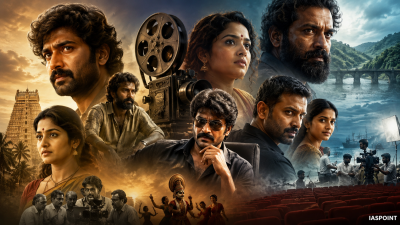
Regional cinema refers to films produced in Indian languages other than Hindi. While Hindi cinema (Bollywood) often dominates the national narrative, regional industries have historically been the cradle of technical innovation, social realism, and artistic excellence.
South Indian Cinema: The Four Pillars
The South Indian film industry is categorized into four distinct linguistic groups, each contributing uniquely to the Indian cinematic fabric.
Tamil Cinema (Kollywood)
- Origin: The first silent film in South India was Keechaka Vadham (1916) by R. Nataraja Mudaliar.
- Key Themes: Known for blending Dravidian politics with cinema. Figures like M.G. Ramachandran (MGR) and C.N. Annadurai used cinema as a tool for social reform and political mobilization.
- Notable Contributions: The “Grand Spectacle” tradition (e.g., Chandralekha, 1948) and the rise of globally acclaimed technicians like A.R. Rahman and Mani Ratnam.
Telugu Cinema (Tollywood)
- Origin: H.M. Reddy produced the first Telugu talkie, Bhakta Prahlada, in 1932.
- Key Themes: Historically dominated by mythological and devotional films. Mayabazar (1957) is considered a landmark for its visual effects and storytelling.
- Infrastructure: Hyderabad houses Ramoji Film City, the largest integrated film city in the world (Guinness World Record).
Malayalam Cinema (Mollywood)
- Origin: Vigathakumaran (1928) was the first silent film, while Balan (1938) was the first talkie.
- Key Themes: Renowned for “Parallel Cinema” and high literacy-driven narratives. It prioritizes social realism and minimal production costs over commercial gloss.
- Pioneers: Adoor Gopalakrishnan (Swayamvaram) and G. Aravindan are synonymous with the Indian New Wave.
Kannada Cinema (Sandalwood)
- Origin: Sati Sulochana (1934) was the first talkie.
- Key Themes: The 1970s saw a massive “New Wave” movement led by Girish Karnad, B.V. Karanth, and P. Lankesh.
- Fact: Samskara (1970) broke traditional barriers and won the National Award, setting a precedent for intellectual cinema in the region.
Bengali Cinema: The Intellectual Heartland
Bengali cinema, centered in Tollygunge (Tollywood), is credited with bringing international prestige to Indian films.
- Social Realism: Spearheaded by the “Big Three”—Satyajit Ray, Ritwik Ghatak, and Mrinal Sen.
- Literary Influence: Strong ties to Bengali literature, particularly the works of Rabindranath Tagore and Sarat Chandra Chattopadhyay.
- Technical Firsts: Hiralal Sen is often cited as one of India’s first filmmakers (Royal Bioscope Company).
Marathi and Gujarati Cinema: The Western Frontier
- Marathi Cinema: The birthplace of Indian cinema (Dadasaheb Phalke). It has seen a massive resurgence with films like Shwaas (2004) and Sairat (2016). Shyamchi Aai (1953) was the first film to win the National Film Award for Best Feature Film.
- Gujarati Cinema: Traditionally known for folklore and musical dramas. Bhavni Bhavai (1980) by Ketan Mehta is a landmark film that used folk theatre (Bhavai) to address untouchability.
Assamese and Odia Cinema: Eastern Perspectives
- Assamese Cinema: Jyoti Prasad Agarwala made the first Assamese film, Joymoti (1935). Recently, Rima Das (Village Rockstars) brought the industry back to the global spotlight.
- Odia Cinema: Sita Bibaha (1936) was the first talkie. The industry is noted for its adherence to classical music and local legends.
Comparative Overview of First Talkies by Language
| Language | First Talkie Film | Year | Director/Producer |
| Bengali | Jamai Sasthi | 1931 | Amar Choudhury |
| Telugu | Bhakta Prahlada | 1932 | H.M. Reddy |
| Tamil | Kalidas | 1931 | H.M. Reddy |
| Marathi | Ayodhyecha Raja | 1932 | V. Shantaram |
| Kannada | Sati Sulochana | 1934 | Y.V. Rao |
| Assamese | Joymoti | 1935 | Jyoti Prasad Agarwala |
| Odia | Sita Bibaha | 1936 | Mohan Sundar Deb Goswami |
| Malayalam | Balan | 1938 | S. Nottani |
Significant Regional Film Movements and Festivals
- The Madras Mowbray Road Movement: Early Tamil cinema’s shift from mythologicals to social drama.
- The Kerala New Wave: A 1970s movement that focused on the psychological and political landscape of the common man.
- International Film Festival of Kerala (IFFK) & Kolkata International Film Festival (KIFF): Major hubs for showcasing regional and global art cinema.
Fact Sheet and Trivia for UPSC Prelims
- First National Award Winner: Shyamchi Aai (Marathi, 1953).
- First Oscar for Lifetime Achievement: Satyajit Ray (Bengali, 1992).
- First Crowdfunded Film: Manthan (Hindi/Gujarati context, 1976), funded by 5 lakh milk farmers of Gujarat.
- Dadasaheb Phalke Award: Though a national award, it was first given to Devika Rani (1969), but many regional stalwarts like B.N. Sircar (Bengali) and L.V. Prasad (Telugu) have been recipients.
- Geographical Indication (GI) in Cinema: While not a GI, the “Mysore Studio” and “Chennai Film City” are considered cultural heritage hubs.
- Linguistic Diversity: India produces films in over 40 languages and dialects, including Tulu, Konkani, Monpa, and Santhali, many of which have won “Best Feature Film in Regional Language” at the National Awards.