
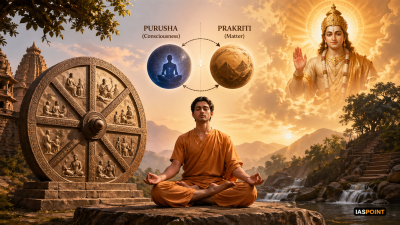
The Yoga school is one of the six orthodox (Astika) systems of Indian philosophy. While it is closely allied with the Samkhya school—accepting its dualistic metaphysics—Yoga focuses on the practical application of discipline to achieve the liberation of the soul (Purusha) from matter (Prakriti). It is often referred to as Seishvara Samkhya (Theistic Samkhya) because, unlike the original Samkhya, it acknowledges the existence of a personal God (Ishwara).
Foundational Text and Authorship
The systematic formulation of Yoga is credited to Sage Patanjali, who authored the Yoga Sutras around the 2nd century BCE. The text is divided into four chapters (Padas):
- Samadhi Pada: Deals with the nature and aims of concentration.
- Sadhana Pada: Focuses on the means to achieve Yoga.
- Vibhuti Pada: Describes the supernormal powers (Siddhis) acquired through practice.
- Kaivalya Pada: Discusses the nature of liberation.
Core Metaphysical Concepts
Yoga philosophy accepts the Samkhya premise that the universe is an interplay between two eternal entities:
- Purusha (Consciousness): The individual, eternal, and unchanging self.
- Prakriti (Matter/Nature): The manifest world composed of the three Gunas (Sattva, Rajas, and Tamas).
- Ishwara (The Supreme Being): In Yoga, Ishwara is a unique Purusha who is eternally free from afflictions, actions, and their results. He is the teacher of the ancient sages and is symbolized by the sacred syllable AUM.
Chitta-Vritti: The Psychology of Yoga
The primary objective of Yoga is defined as Chitta-Vritti-Nirodha (The cessation of the modifications of the mind). The mind (Chitta) is considered the first product of Prakriti and is prone to five types of fluctuations or Vrittis:
- Pramana: Valid knowledge (Perception, Inference, Testimony).
- Viparyaya: False knowledge or illusion.
- Vikalpa: Verbal delusion or imagination.
- Nidra: Sleep (absence of conscious thought).
- Smriti: Memory.
The Eight-Fold Path: Ashtanga Yoga
To still the mind and achieve liberation, Patanjali prescribed the Ashtanga (Eight-limbed) path. This path is divided into Bahiranga (External) and Antaranga (Internal) practices.
| Limb | Classification | Description and Purpose |
| Yama | External | Ethical restraints: Ahimsa (Non-violence), Satya (Truth), Asteya (Non-stealing), Brahmacharya (Continence), and Aparigraha (Non-possessiveness). |
| Niyama | External | Self-purification/Observances: Saucha (Purity), Santosha (Contentment), Tapas (Austerity), Svadhyaya (Self-study), and Ishwara-Pranidhana (Devotion). |
| Asana | External | Physical postures to ensure a steady and comfortable body for meditation. |
| Pranayama | External | Regulation of breath to control the flow of vital energy (Prana). |
| Pratyahara | External | Withdrawal of the senses from external objects. |
| Dharana | Internal | Fixing the mind on a single object or point of focus (Concentration). |
| Dhyana | Internal | Uninterrupted flow of thought toward the object of concentration (Meditation). |
| Samadhi | Internal | Total absorption where the distinction between the meditator and the object vanishes. |
Kleshas: The Five Afflictions
Yoga identifies five root causes of human suffering (Kleshas) that bind the soul to the cycle of rebirth:
- Avidya: Ignorance (the root of all other kleshas).
- Asmita: Egoism or false identification of the self with the mind-body.
- Raga: Attachment to pleasant experiences.
- Dvesha: Aversion to unpleasant experiences.
- Abhinivesha: Fear of death and the instinctive clinging to life.
Stages of Samadhi
The final goal of Yoga is Kaivalya (Isolation/Liberation), which is reached through various stages of absorption:
- Samprajnata Samadhi: A state of “distinguished” absorption where the mind remains aware of the object of meditation.
- Asamprajnata Samadhi: The highest state of “undistinguished” absorption where all mental modifications cease, and only the self remains in its pure form.
Facts and Trivia for UPSC Aspirants
- Hatha Yoga: A later development (c. 10th-11th century CE) by the Nath Siddhas like Gorakhnath, focusing more on physiological purification and energy channels (Nadis).
- UNESCO Recognition: “Yoga” was inscribed on the UNESCO Representative List of the Intangible Cultural Heritage of Humanity in 2016.
- International Yoga Day: Observed on June 21st following a United Nations General Assembly resolution in 2014.
- Commentaries: The most famous commentary on Patanjali’s Yoga Sutra is the Yoga Bhashya, attributed to Vyasa.
- Pramanas: Like Samkhya, the Yoga school accepts three Pramanas—Pratyaksha (Perception), Anumana (Inference), and Shabda (Reliable Testimony).
- Siddhis: While the Yoga Sutras mention supernatural powers like Anima (becoming small) or Laghima (becoming light), Patanjali warns that these are obstacles to the ultimate goal of Kaivalya.