
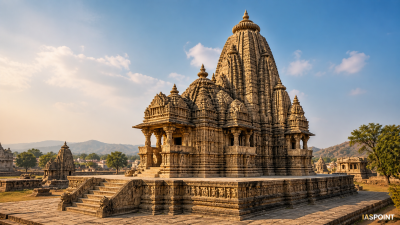
The Nagara style is the dominant temple architecture of North India, emerging during the late Gupta period and reaching its zenith between the 7th and 14th centuries CE. Unlike the South Indian Dravidian style, Nagara temples are characterized by the absence of massive boundary walls or elaborate gateways (Gopurams). They are typically built on high stone platforms called Jagati, with the temple tower following a curvilinear or pyramidal shape.
Core Structural Components of Nagara Temples
Standard Nagara temples follow a specific structural logic, moving from the public entry point to the most sacred inner sanctum.
- Garbhagriha (Sanctum Sanctorum): The small, square, cave-like room that houses the main deity. It is the most sacred part of the temple.
- Mandapa: The entrance hall or porch where devotees gather. Larger temples may feature multiple Mandapas, classified as Ardha-mandapa (entrance), Mandapa, and Maha-mandapa (great hall).
- Shikhara: The mountain-like spire located directly above the Garbhagriha. Its shape is usually curvilinear, symbolizing the cosmic mountain, Mount Meru.
- Amalaka: A stone disc with ribbed edges situated at the top of the Shikhara.
- Kalasha: A pot-like decorative element placed on top of the Amalaka, marking the highest point of the structure.
- Antarala (Vestibule): A small transition passage connecting the Mandapa to the Garbhagriha.
- Jagati: The elevated platform upon which the entire temple rests, often accessible by a flight of stairs.
Classification based on Shikhara Styles
Nagara temples are primarily categorized by the shape and design of their Shikharas.
- Rekha-Prasada (Latina): The most common type, featuring a simple curvilinear Shikhara with a square base and walls that curve inward toward the top.
- Phamsana: These Shikharas are broader and shorter than the Latina ones. They consist of several slabs that rise upwards in a slope, rather than a curve, meeting at a single point. They are typically used for Mandapas.
- Valabhi: A rectangular building with a roof that rises into a vaulted chamber, often called a “wagon-vaulted” roof. This style is influenced by early Buddhist rock-cut Chaitya halls.
- Bhumija: A subtype where the main Shikhara is surrounded by smaller miniature Shikharas (Urushringas) in rows, creating a grid-like effect.
Regional Sub-Schools of Nagara Architecture
As the style spread across North India, distinct regional variations emerged based on local materials and dynastic patronage.
Odisha School (Kalinga Architecture)
Centered in ancient Kalinga, this school is known for its towering Shikharas (called Deuls) and assembly halls (called Jagmohanas).
- Distinct Features: The exterior is often lavishly carved with intricate sculptures, while the interior of the sanctum remains plain.
- Examples: Lingaraja Temple (Bhubaneswar), Jagannath Temple (Puri), and the Konark Sun Temple.
Khajuraho School (Chandel School)
Developed by the Chandela rulers in Central India, these temples are famous for their aesthetic harmony and erotic sculptures.
- Distinct Features: Both the interior and exterior are intricately carved. The temples usually have three main compartments: Entrance, Mandapa, and Garbhagriha. The Shikharas feature multiple miniature towers (Urushringas) that lead the eye to the main spire.
- Examples: Kandariya Mahadev Temple, Lakshmana Temple, and Vishvanatha Temple.
Solanki School (Maru-Gurjara Architecture)
Developed in Gujarat and Rajasthan under the Solanki rulers, this school emphasizes the use of sandstone, basalt, and marble.
- Distinct Features: These temples often feature a massive ritual water tank (Surya-kund) at the entrance. The entrance arches are highly decorative and known as Toranas.
- Examples: Modhera Sun Temple (Gujarat) and Dilwara Temples (Mount Abu).
Comparative Analysis of Nagara Sub-Schools
| Feature | Odisha School | Khajuraho School | Solanki School |
| Main Tower | Called Deul; vertical focus. | Curvilinear with Urushringas. | Usually tiered or Phamsana style. |
| Mandapa | Called Jagmohana; square base. | Integrated with the main tower. | Detached or semi-detached. |
| Water Body | Separate temple tanks. | Generally absent inside complex. | Prominent stepped tanks (Kunds). |
| Carvings | Exterior focus only. | Both interior and exterior. | Emphasis on ceilings and pillars. |
Significant Nagara Temples and Geographic Distribution
The Nagara style spans from the foothills of the Himalayas to the Vindhya Range in Central India.
- Panchayatana Layout: A unique arrangement where the main shrine is located in the center, surrounded by four smaller subsidiary shrines. Example: Dashavatara Temple, Deogarh.
- Sun Temples: The Nagara style was preferred for Sun worship centers. Key sites include Martand (Kashmir), Katarmal (Uttarakhand), and Modhera (Gujarat).
- Himalayan Nagara: Found in Jago (Chamba) and Baijnath (Kangra), these often utilize wooden roofs or Pagoda styles due to heavy snowfall.
Key Facts and Trivia for Prelims
- The Pillar Factor: Unlike Dravidian temples, early Nagara temples did not emphasize massive pillared halls; these were added later as Mandapas evolved.
- The Vakataka Link: While primarily a Northern style, the Nagara influences are seen as far south as the Paunar and Ramtek temples in Maharashtra.
- Materials: Nagara temples predominantly used sandstone, though the Solanki school famously utilized white marble.
- Amalaka Symbolism: The Amalaka represents the Indian gooseberry, which is considered sacred in Hindu mythology and symbolizes the sun or the seat of the deity.
- Lack of Fortification: One of the most critical identifiers for UPSC Prelims is that Nagara temples generally do not have the high fortified walls characteristic of the Dravida style.