

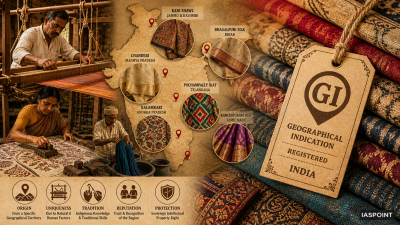
Geographical Indication (GI) is a sovereign intellectual property right granted to products originating from a specific geographical territory, possessing qualities or a reputation unique to that region. In India, GI tags are governed by the Geographical Indications of Goods (Registration and Protection) Act, 1999, and administered by the Controller General of Patents, Designs, and Trade Marks. Textiles form the largest category of GI-protected handicrafts in India, serving as a repository of indigenous weaving, dyeing, and printing traditions.
Statutory Framework and Significance
- Legal Protection: Prevents unauthorized use of a registered geographical indication by third parties, ensuring that only “authorized users” from the specific region can use the popular brand name.
- Duration: A GI registration is valid for 10 years, renewable indefinitely for subsequent periods of 10 years.
- Economic Impact: Boosts exports and provides a premium price to rural artisans by establishing “brand authenticity” in global markets.
- Socio-Cultural Preservation: Safeguards traditional knowledge (TK) and prevents the “commodification” of heritage by mass-produced machine imitations.
Leading GI Textiles by Region (360° Overview)
| State | Prominent GI Textiles | Unique Feature for UPSC Prelims |
| Uttar Pradesh | Banarasi Brocade, Lucknow Chikankari | Banarasi: Uses “Jhallar” (fringe) motifs; Chikankari: Traditional shadow work embroidery. |
| Tamil Nadu | Kanchipuram Silk, Madurai Sungudi | Kanchipuram: Requires 57% silver and 0.6% gold in Zari; known for “Temple Borders.” |
| Andhra Pradesh | Uppada Jamdani, Ponduru Khadi | Uppada: Woven with a wooden needle; Ponduru: Spun using the jawbone of the Valuga fish. |
| Telangana | Pochampally Ikat, Gadwal Saree | Pochampally: “Double Ikat” (tie-dyeing both warp and weft); Gadwal: Silk pallu joined to cotton body. |
| Gujarat | Patan Patola, Kutch Ajrakh | Patola: Highly complex double ikat; identical on both sides. |
| Odisha | Sambalpuri Bandha, Kotpad Fabric | Kotpad: Dyed using Aal (madder) roots; purely organic tribal textile. |
| West Bengal | Baluchari Saree, Dhaniakhali Saree | Baluchari: Pallus depict mythological scenes from Ramayana and Mahabharata. |
| Assam | Muga Silk, Eri Silk | Muga: Naturally golden silk, exclusive to Assam; Eri: Also called “Ahimsa Silk” (non-violent). |
| J&K | Kashmir Pashmina, Kani Shawl | Pashmina: Made from the undercoat of Changthangi goats; Kani: Woven using “Tujis” (wooden needles). |
Latest GI Additions (2024–2026)
The GI registry has recently expanded to include several niche tribal and regional weaves, reflecting a push for inclusive heritage documentation.
- Rignai Pachara (Tripura, 2024): A traditional hand-woven attire worn by Tripuri women, characterized by unique geometric patterns and indigenous materials.
- Woraiyur Cotton Saree (Tamil Nadu, 2026): Known for its “fine count” cotton and traditional weaving methods that date back to the Chola period.
- Arunachal Idu Mishmi Textiles: Recently recognized for their intricate patterns and use of natural dyes by the Idu Mishmi tribe.
- Majuli Manuscript Painting on Cloth (Assam): A unique blend of textile and traditional art where religious scriptures are painted on treated cloth.
Specialized Weaving Techniques and Facts
- Double Ikat Centers: India has only three major double ikat centers—Pochampally (Telangana), Patan (Gujarat), and Sambalpur (Odisha).
- The Matchbox Saree: The Gadwal Saree is historically famous for being so fine that a full-length saree could be folded to fit into a matchbox.
- Temple Influence: Kanchipuram and Maheshwari sarees draw their border designs directly from the architectural motifs of local temples.
- Animal-Based Processing: The cleaning of cotton for Ponduru Khadi uses the abrasive jawbone of the Valuga fish, a technique unique to the Srikakulam district.
Institutional Support for GI Textiles
- National Institute of Design (NID): Acts as a consultant for documenting the technical specifications required for GI applications.
- UNCTAD & WIPO: International bodies that coordinate with the Indian government to ensure GI protection under the TRIPS Agreement of the WTO.
- Geographical Indications Registry (Chennai): The centralized body where all GI applications in India are processed and stored.
Key Comparison: GI Tag vs. Trademark
- Ownership: GI is a collective right (owned by the community/region); Trademark is a private right (owned by a specific company/individual).
- Origin: GI is inextricably linked to a territory; a Trademark can be used for products made anywhere by the brand owner.
- Purpose: GI signifies quality and reputation based on origin; Trademark distinguishes the commercial source of a product.