
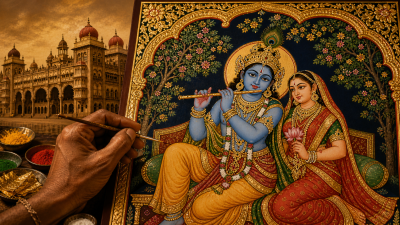
The Mysore School of Painting is a major South Indian classical art form that originated in the kingdom of Mysore, Karnataka. While it shares a common ancestry with Tanjore painting—both emerging from the artistic vacuum created by the fall of the Vijayanagara Empire in 1565—it evolved into a distinct style under the patronage of the Wodeyar dynasty.
Evolution and Patronage
- Post-Vijayanagara Transition: Following the Battle of Talikota, artists migrated to Mysore, bringing the Vijayanagara tradition of mural painting.
- Wodeyar Dynasty: The school flourished under Raja Wodeyar I. It received a significant boost during the reign of Maharaja Krishnaraja Wodeyar III (1799–1868), who was a prolific patron and revived the arts by commissioning numerous manuscripts and murals.
- Literary Influence: The Sritattvanidhi, a monumental illustrated manuscript compiled under Krishnaraja Wodeyar III, serves as the definitive encyclopedia of Mysore iconography.
Technical Process and Materials
The preparation of a Mysore painting is a meticulous multi-stage process that emphasizes delicacy over the heavy relief work seen in other South Indian styles.
- Base Preparation: The artist traditionally used paper, wood, or cloth. The surface was treated with a paste of lead white (Safeda), gamboge (yellow), and gum to create a smooth texture.
- Gesso Work: Unlike the thick relief of Tanjore art, Mysore paintings use “Low Relief” gesso work. A paste made of zinc oxide and Arabic gum is used to create subtle elevations for jewelry and drapery.
- Gold Foil Application: Thin 24-carat gold foils are pasted over the gesso work. The gold is then “burnished” with a special stone to achieve a soft, lasting luster.
- Pigmentation: Historically, colors were derived from minerals and plants. The final details were executed using brushes made of squirrel hair for extreme precision.
Distinctive Stylistic Features
The Mysore School is recognized for its sophistication, muted colors, and realistic portrayal of figures.
- Subtle Relief: The embossing is far less pronounced than in Tanjore paintings, giving the work a flatter, more detailed appearance.
- Muted Palette: While gold is used, the background colors are generally softer and more varied, avoiding the stark, high-contrast backgrounds of Tanjore art.
- Iconographic Accuracy: Figures are characterized by graceful postures, delicate facial expressions, and anatomically accurate proportions as dictated by the Shilpa Shastra.
- Intricate Detailing: Every element, from the folds of the saree to the patterns on the floor, is rendered with microscopic detail.
Primary Themes and Iconography
The subject matter is predominantly Hindu and follows the traditional South Indian devotional aesthetic.
- Pauranic Deities: Popular depictions include Goddess Saraswati, Lakshmi, and various forms of Vishnu and Shiva.
- Dashavatara: The ten incarnations of Vishnu are a recurring motif.
- Rajarajeshwari: The depiction of the Goddess in her regal form is a hallmark of the Mysore school.
- Durbar Scenes: Later paintings occasionally depicted royal processions and the Mysore Dasara celebrations.
Comparison: Mysore Painting vs. Tanjore Painting
| Feature | Mysore Painting | Tanjore Painting |
| Relief / Embossing | Low Relief (Subtle and delicate) | High Relief (Thick and heavy) |
| Gold Usage | Thin gold foil; burnished for a soft glow | Heavy 22K gold leaf; bright and opaque |
| Embellishments | Rarely uses stones or glass beads | Extensive use of glass, mirrors, and semi-precious stones |
| Base Material | Primarily paper or cloth pasted on wood | Primarily solid wooden planks (Jackfruit/Teak) |
| Artistic Feel | Lyrical, detailed, and realistic | Iconic, grand, and formal |
Notable Manuscripts and Works
- Sritattvanidhi: A massive 19th-century work containing instructions on the proportions of deities and thousands of illustrations.
- Jaganmohan Palace Murals: The walls of this palace in Mysore house some of the finest surviving examples of this tradition, depicting historical scenes and the genealogy of the Wodeyars.
- Ramayana and Mahabharata: Extensive sets of miniatures depicting epic battles and courtly life.
Fact Sheet for UPSC Prelims
- Gesso Paste: In Mysore painting, this is called ‘Lippan’ or ‘Gesso’ but is chemically distinct from Western gesso, using local ingredients like zinc oxide.
- The Mysore Dasara: The school played a vital role in documenting the cultural history of the Dasara festival through its paintings.
- Geographical Identity: While Tanjore has a GI tag, Mysore painting is specifically protected under the Intellectual Property Rights of the State of Karnataka.
- Traditional Artists: The ‘Chitrakars’ or ‘Raju’ community were the traditional practitioners of this art form.
- Color Symbolism: Each deity followed a specific color code; for instance, Lord Rama was often painted in green or blue, while the Goddess Lakshmi was depicted in a golden-yellow hue.
Trivia: The Burnishing Secret
The soft, ethereal glow of Mysore gold work is achieved by rubbing the gold foil with a “Hematite” stone or a highly polished agate. This process, known as burnishing, ensures that the gold leaf sticks perfectly to the gesso and acquires a mirror-like finish without losing its delicate texture.
Last Modified: May 5, 2026