
The Rashtrakutas (8th–10th Century CE) were the successors of the Badami Chalukyas in the Deccan. Their architectural legacy represents the high-water mark of Indian rock-cut architecture, primarily concentrated in the Ellora and Elephanta complexes. Under rulers like Krishna I, the dynasty moved beyond mere excavation to “sculpting” entire mountain ranges into monolithic structures. Their style is characterized by massive scale, dramatic storytelling through high-relief sculpture, and a synthesis of Nagara and Dravidian elements.
The Ellora Complex: A Tri-Religious Marvel
Ellora (ancient Elapura) is a UNESCO World Heritage site comprising 34 caves. Unlike Ajanta, which is purely Buddhist, Ellora is secular and multi-religious, reflecting the Rashtrakuta policy of religious tolerance.
Buddhist Caves (1–12)
- Mostly belong to the Vajrayana sect.
- Cave 10 (Vishvakarma Cave): A famous Chaitya hall with a multi-storied facade and a large seated Buddha.
- Cave 11 & 12 (Do Thal and Tin Thal): Unique three-storied monasteries (Viharas) showcasing the mastery over multi-level rock excavation.
Brahmanical/Hindu Caves (13–29)
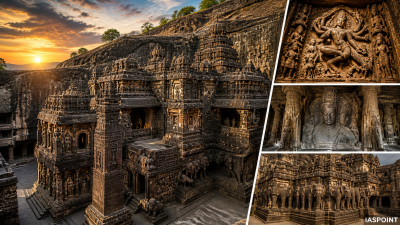
- The Kailasanathar Temple (Cave 16): Built by King Krishna I in the 8th century, this is the world’s largest monolithic structure.
- Construction Technique: Carved from top to bottom from a single basalt cliff; approximately 200,000 tonnes of rock were removed.
- Layout: Includes a gateway (Gopuram), a Nandi pavilion, a pillared hall (Mandapa), and the main shrine (Vimana) rising to 30 meters.
- Iconography: Famous panels include “Ravana Shaking Mount Kailasa,” which is celebrated for its sense of movement and intense drama.
Jain Caves (30–34)
- Excavated later in the 9th century, showing Digambara influence.
- Indra Sabha (Cave 32): A two-storied cave known for its extremely fine and intricate carvings, particularly the monolithic pillar and the shrine of Mahavira.
- Jagannatha Sabha (Cave 33): Noted for its elaborate ceiling paintings and carvings of Tirthankaras.
The Elephanta Caves: The Gharapuri Heritage
Located on an island off the coast of Mumbai, the Elephanta complex is dedicated primarily to Lord Shiva.
- Main Cave: Features a massive pillared hall and the world-famous Trimurti (Maheshmurti) sculpture—a 20-foot high bust representing Shiva as Creator (Brahma), Preserver (Vishnu), and Destroyer (Bhairava).
- Sculptural Panels: Includes monumental depictions of Ardhanarishvara, Gangadhara, and Shiva as Nataraja.
Structural Architecture and Other Centers
While primarily known for rock-cut wonders, the Rashtrakutas also contributed to structural temple building.
- Navalinga Temples (Kukkanur): A group of nine temples showing a transition toward the later Kalyani Chalukya style.
- Jain Narayana Temple (Pattadakal): Built by Amoghavarsha I or Krishna II, this structural temple at the Chalukyan site of Pattadakal follows the Dravidian style with a distinct stepped Shikhara.
- Kashivishvanatha Temple (Pattadakal): Another structural masterpiece credited to the Rashtrakutas.
Comparative Features of Rashtrakuta Architecture
| Feature | Rock-Cut (Kailasa) | Structural (Pattadakal/Kukkanur) |
| Material | Monolithic Basalt rock | Sandstone blocks |
| Pillars | Massive, often with “Purna-Ghata” (pot and foliage) motifs | Slender, evolving toward lathe-turned shapes |
| Style | Influenced by Dravidian (Pallava) Vimana shapes | Blend of Nagara and Dravida (Vesara precursors) |
| Sculpture | High relief, larger-than-life figures | Medium relief, more ornamental and repetitive |
Key Artistic Elements
- The Massive Plinth: In the Kailasa temple, the entire structure stands on a high plinth featuring life-sized elephants and lions, appearing to “carry” the weight of the temple.
- Cylindrical Pillars: The use of massive fluted pillars with capital cushions (amalaka type) became a hallmark.
- Integration of Nature: The design often incorporated natural water cisterns and courtyards within the rock-cut layout.
- Ceiling Art: Rashtrakuta caves often contained murals (fragments still visible at Ellora) that bridge the gap between Ajanta and the later medieval painting traditions.
Fact-File for UPSC Prelims
- Amoghavarsha I: Known as the “Ashoka of the South,” he was a great patron of Jainism and literature; he contributed significantly to the Jain caves at Ellora.
- Vimana Design: The Shikhara of the Kailasa temple is Dravidian, closely resembling the Virupaksha temple of Pattadakal and the Kailasanathar of Kanchipuram.
- UNESCO Inscription: Ellora was inscribed in 1983; Elephanta in 1987.
- Dhumar Lena (Cave 29): One of the earliest and largest Hindu caves at Ellora, sharing a striking architectural resemblance to the main cave at Elephanta.
- Terminology: The term “Kailasa” refers to the mythical abode of Shiva; the temple was intended to be a terrestrial representation of the celestial mountain.