
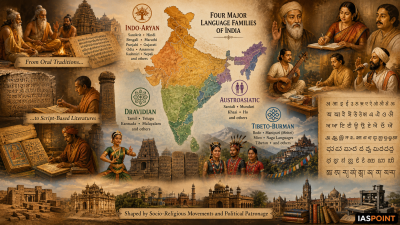
The linguistic landscape of India is a complex tapestry evolving over millennia, primarily categorized into four major language families: Indo-Aryan, Dravidian, Austroasiatic, and Tibeto-Burman. The evolution is characterized by a transition from oral traditions to sophisticated script-based literatures, heavily influenced by socio-religious movements and political patronage.
The Indo-Aryan Language Family
The Indo-Aryan group is a branch of the Indo-Iranian subfamily of the Indo-European family. It accounts for approximately 74% of the Indian population’s speech.
- Old Indo-Aryan (1500 BCE – 600 BCE): This period is dominated by Sanskrit. Vedic Sanskrit (used in the Vedas) evolved into Classical Sanskrit after the refinement by grammarians like Panini (author of Ashtadhyayi).
- Middle Indo-Aryan (600 BCE – 1000 CE): This stage saw the rise of Prakrit and Pali. Pali was the liturgical language of Theravada Buddhism, while various forms of Prakrit (Magadhi, Sauraseni, Maharashtri) were used in Jain texts and Ashokan inscriptions.
- Apabhramsha: Representing the transitional phase between Middle and Modern Indo-Aryan languages, it began appearing around the 6th century CE, eventually giving birth to regional languages like Hindi, Bengali, Gujarati, and Marathi.
The Dravidian Language Family
The Dravidian languages are indigenous to South Asia and are distinct from the Indo-European group. They are characterized by agglutinative grammar and a rich classical heritage.
- Classical Status: All four major Dravidian languages (Tamil, Telugu, Kannada, and Malayalam) hold “Classical Language” status in India.
- Tamil: The oldest among the group, with a literary history dating back over 2,000 years, beginning with the Sangam literature.
- Kannada and Telugu: These languages branched out later; Kannada’s earliest inscription is the Halmidi inscription (450 CE), while Telugu’s earliest is the Erragudipadu inscription (575 CE).
- Malayalam: The youngest of the four, it emerged as a distinct language from Tamil around the 9th century CE, influenced significantly by Sanskrit.
Other Minor Language Families
- Austroasiatic: Primarily spoken by tribal groups in Central India and the Northeast (e.g., Santhali, Khasi, Munda).
- Tibeto-Burman: Found in the Himalayan fringes and the Northeast (e.g., Manipuri, Bodo).
- Sino-Tibetan: Includes languages of the North-Eastern borderlands.
Comparative Classification of Indian Languages
| Language Family | Percentage Coverage | Key Languages | Primary Regions |
| Indo-Aryan | ~74% | Hindi, Bengali, Marathi, Punjabi, Gujarati | North, West, and East India |
| Dravidian | ~24% | Tamil, Telugu, Kannada, Malayalam | Southern India |
| Austroasiatic | ~1.2% | Santhali, Mundari, Khasi | Central India, Meghalaya |
| Tibeto-Burman | ~0.6% | Manipuri, Bodo, Ladakhi | North-East, Himalayas |
The Concept of Classical Languages in India
The Government of India grants the status of “Classical Language” to those that have high antiquity, a valuable heritage of ancient literature, and an original literary tradition.
- Criteria: The recorded history must span 1,500–2,000 years; the literature must be considered a heritage by generations of speakers.
- List of Classical Languages:
- Tamil (Declared in 2004)
- Sanskrit (2005)
- Kannada (2008)
- Telugu (2008)
- Malayalam (2013)
- Odia (2014)
- Marathi, Bengali, Pali, Prakrit, and Assamese (Added in 2024)
Constitutional Provisions for Languages
The Constitution of India provides a robust framework for linguistic diversity, ensuring protection for minority languages and promotion of official communication.
- Eighth Schedule: Lists 22 official languages. Originally, there were 14; subsequent amendments added others:
- 21st Amendment (1967): Added Sindhi.
- 71st Amendment (1992): Added Konkani, Manipuri, and Nepali.
- 92nd Amendment (2003): Added Bodo, Dogri, Maithili, and Santhali.
- Article 343: Declares Hindi in Devanagari script as the Official Language of the Union.
- Article 350A: Mandates facilities for instruction in mother-tongue at the primary stage.
- Article 351: Directs the Union to develop and promote the Hindi language to serve as a medium of expression for the composite culture of India.
Script Evolution: From Brahmi to Modern Derivatives
Most modern Indian scripts are descendants of the ancient Brahmi script, which appeared during the 3rd century BCE (Ashokan era).
- Brahmi Script: The mother of most Indian scripts. It evolved into two main branches: Northern (Nagari, Gurmukhi, Bengali) and Southern (Grantha, Telugu-Kannada, Malayalam).
- Kharosthi Script: Used in North-West India (Gandhara region); written from right to left, unlike Brahmi.
- Devanagari: Emerging from the Gupta script, it is currently used for Hindi, Sanskrit, Marathi, and Konkani.
Essential Trivia for Aspirants
- First Grammar Book: Ashtadhyayi by Panini is the foundational text for Sanskrit grammar.
- Father of Telugu Cinema/Literature: While many are credited, Nannaya is traditionally regarded as the Adi Kavi (First Poet) of Telugu.
- Amir Khusrau: Often cited for his contribution to the development of Hindavi, the precursor to modern Hindi and Urdu.
- Linguistic Survey of India: Conducted by Sir George Abraham Grierson, it remains the most comprehensive study of Indian languages to date.
- Official Languages Act, 1963: This act allowed for the continued use of English for official purposes alongside Hindi indefinitely.