
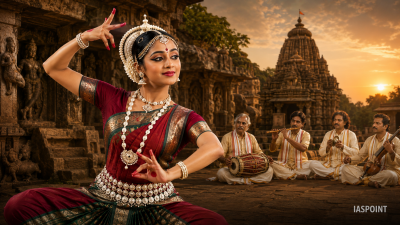
Odissi, originating from the state of Odisha, is one of the eight classical dance forms of India. It is considered the oldest surviving dance form based on archaeological evidence, primarily found in the Udayagiri and Khandagiri Caves near Bhubaneswar, dating back to the 2nd century BCE.
The Mahari and Gotipua Traditions
The dance form evolved through two distinct lineages:
- Maharis: These were temple dancers (devadasis) who performed in the sanctum sanctorum of the Jagannath Temple at Puri. They were the primary repositories of the ritualistic dance form.
- Gotipuas: Since women were eventually restricted from performing in public, young boys dressed as females (Gotipuas) began performing outside the temple precincts. This tradition introduced more athletic and acrobatic elements to the dance.
Philosophical and Technical Fundamentals
Odissi is deeply rooted in the Natyashastra and the Abhinaya Darpana. It is predominantly a dance of devotion (Bhakti) and is inextricably linked to the cult of Lord Jagannath.
The Concept of Tribhanga and Chowk
The unique aesthetic of Odissi is defined by two fundamental postures:
- Chowk: A masculine, stable position where the body weight is equally distributed, and limbs form a square shape. It symbolizes the all-pervading nature of Lord Jagannath.
- Tribhanga: A feminine, graceful posture where the body is deflected at three points—the neck, torso, and knees. This creates an “S” curve and is considered the most distinctive feature of Odissi.
Mudras and Expressions
Odissi utilizes about 50 Asamyukta (single-hand) and Samyukta (double-hand) mudras to convey complex narratives. The dance alternates between Nritta (pure dance with rhythmic footwork) and Nritya (expressive dance using Abhinaya or facial expressions).
Sequence of a Classical Odissi Performance
A standard Odissi recital follows a specific chronological order, transitioning from invocation to spiritual liberation.
| Sequence | Description |
| Mangalacharan | The opening piece where the dancer invokes God (usually Ganesha or Jagannath) and seeks blessings from the Guru and the audience. |
| Battu Nrutya | A pure dance piece dedicated to Batuk Bhairav (Lord Shiva). It highlights the sculptural poses of the dance. |
| Pallavi | A technical item where a melody (Raga) is visually elaborated through graceful movements and complex rhythmic patterns. |
| Abhinaya | The enactment of a song or poem, usually based on the Gita Govinda by Jayadeva, focusing on the Radha-Krishna theme. |
| Moksha | The concluding item signifying spiritual liberation and the union of the soul with the divine. |
Music, Costume, and Instruments
Odissi is accompanied by Odissi Music, which is a distinct system of Indian classical music, separate from Hindustani and Carnatic styles.
The Ornaments and Attire
- Saree: Dancers wear the traditional Sambalpuri or Bomkai silk sarees, draped in a unique way that allows for a wide range of leg movements.
- Jewelry: The jewelry is made of Tarakasi (silver filigree work) from Cuttack. It includes the Alaka (headpiece), Bengapatia (waist belt), and Kapa (earrings).
- Headgear: The Mahakuta or Gopapura is a pith (shola) crown worn around the hair bun, representing a temple spire.
Orchestral Accompaniment
The primary instruments used in an Odissi ensemble include:
- Mardala: A two-headed pakhawaj-style drum (the primary rhythmic accompaniment).
- Manjira: Cymbals used for maintaining the Tala.
- Flute (Bansi): Provides the melodic backdrop.
- Violin or Harmonium: Often used for additional melodic support.
Key Personalities and Revivalism
During the British Raj, Odissi faced a decline due to the “Anti-Nautch” movement. It was revived in the mid-20th century through the efforts of the “Jayantika” group.
- The Trinity of Odissi: Kelucharan Mohapatra, Pankaj Charan Das, and Deba Prasad Das are credited with systematizing the contemporary Odissi repertoire.
- Guru Kelucharan Mohapatra: The first person from Odisha to receive the Padma Vibhushan; he is instrumental in the global spread of the dance.
- Significant Exponents: Sonal Mansingh, Sanjukta Panigrahi, Kumkum Mohanty, and Madhavi Mudgal.
Facts for UPSC Prelims
- Geographical Indication (GI): The Odissi Gara (Saree) and the silver filigree (Cuttack Rupa Tarakasi) are significant cultural markers of the region.
- Literary Source: The Gita Govinda of Jayadeva (12th Century) is the primary thematic source for the Abhinaya section of Odissi.
- Sculptural Connection: Odissi is often called “mobile sculpture” because many of its poses are direct replicas of sculptures found on the walls of the Konark Sun Temple and Brahmeswara Temple.
- Nartaki: The Abhinaya Chandrika by Maheshwar Mahapatra is a key 15th-century text that provides detailed instructions on Odissi techniques.