
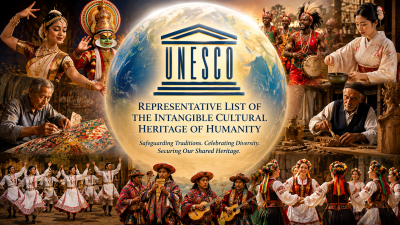
The UNESCO Representative List of the Intangible Cultural Heritage of Humanity was established to ensure better protection of important intangible cultural heritages worldwide and the awareness of their significance.
Criteria for Inscription
To be inscribed on the list, an element must satisfy specific criteria:
- It must be transmitted from generation to generation and constantly recreated by communities.
- It must provide a sense of identity and continuity.
- It must promote respect for cultural diversity and human creativity.
Indian Performance Arts on the UNESCO ICH List
India currently has 15 elements on the UNESCO ICH list (as of early 2026), several of which are purely dance-based or contain significant dance and theatrical components.
| Element | State/Region | Year of Inscription | Primary Nature |
| Koodiyattam | Kerala | 2008 | Sanskrit Theatre/Dance |
| Ramlila | North India | 2008 | Traditional Performance |
| Ramman | Uttarakhand | 2009 | Ritual Theatre/Dance |
| Chhau Dance | WB, Odisha, Jharkhand | 2010 | Tribal/Martial Dance |
| Kalbelia | Rajasthan | 2010 | Folk Song and Dance |
| Sankirtana | Manipur | 2013 | Ritual Singing/Drumming/Dance |
| Garba | Gujarat | 2023 | Ritualistic Folk Dance |
Detailed Analysis of Performance-Based Elements
Koodiyattam (Sanskrit Theatre of Kerala)
Koodiyattam is the oldest existing classical theatre form in India, performed in temple theatres called Koothambalams.
- The Chakyars and Nangyars: Traditionally performed by the Chakyar community (male) and Nangyar community (female).
- Vidhushaka: A unique feature where a comic character explains the Sanskrit verses in Malayalam for the common audience.
- Technicality: It emphasizes Netrabhinaya (eye expressions) and complex hand gestures. A single act can take several nights to complete.
Chhau Dance (Masked Dance of Eastern India)
Chhau is a tradition that blends movements from martial arts, acrobatics, and athletics with themes of Shaivism, Shaktism, and Vaishnavism.
- Three Styles:
- Seraikella Chhau (Jharkhand): Uses masks; highly symbolic and sophisticated.
- Purulia Chhau (West Bengal): Uses large, heavy masks; known for vigorous jumps and flips.
- Mayurbhanj Chhau (Odisha): Does not use masks; focuses on technical body control.
- Themes: Depicts episodes from the Ramayana, Mahabharata, and the Puranas.
Kalbelia (Folk Songs and Dances of Rajasthan)
Performed by the Kalbelia tribe, who were traditionally professional snake handlers.
- Movement: The dance movements mimic the slithering of a cobra.
- Attire: Dancers wear “Angrakha” and “Odhani” in black, heavily embroidered with silver thread and mirrors.
- Improvisation: There is no written script or manual; the dance is passed down orally through the “Guru-Shishya” tradition.
Sankirtana (Ritual Performance of Manipur)
Sankirtana encompasses a set of arts performed to mark religious occasions and various stages in the life of the Vaishnava people of the Manipur plains.
- The Pung: The central rhythmic instrument is the Pung (drum).
- Performance: It involves two main components: the Sankirtana (singing and dancing) and the Dhol Cholom (drum dance).
- Social Function: It is considered an essential medium for the attainment of spiritual salvation and is performed at weddings and birth ceremonies.
Ramman (Religious Festival and Ritual Theatre of Garhwal)
Performed in the Saloor-Dungra villages of Uttarakhand in honor of the local deity, Bhumiyal Devta.
- Masks: It features highly stylized masks representing various deities and animals.
- Performative Rituals: It involves the recitation of the Jagar (local epics) and the performance of various dances like the Mhaal Nritya, which depicts the battle between the local people and the Gorkhas.
Garba (Ritualistic Folk Dance of Gujarat)
The most recent addition to the list, Garba is performed during the nine-day Navratri festival.
- Symbolism: The dance revolves around a “Garbha Deep” (perforated earthen lamp) representing the womb and the beginning of life.
- Inclusivity: While traditionally a female dance, modern Garba is inclusive of all genders and social strata, emphasizing community unity.
Facts for UPSC Prelims
- Sangeet Natak Akademi: The nodal agency in India for coordinating nominations for the UNESCO ICH list.
- Intangible vs. Tangible: While the Taj Mahal is a Tangible World Heritage site, the dance performed in its vicinity or the craft of its marble inlay is Intangible.
- First Inscriptions: Koodiyattam, Ramlila, and Vedic Chanting were the first Indian elements to be recognized in 2008.
- The Ministry of Culture: Manages the “Scheme for Safeguarding the Intangible Cultural Heritage and Diverse Cultural Traditions of India.”
Trivia: The “Global” Status of Indian Performance
- Chhau Masks: In Purulia, the masks are made using a unique blend of paper pulp, clay, and cloth, creating a distinct geographical marker for the art form.
- The “Nattuvanar” equivalent: In Koodiyattam, the rhythmic control is maintained by the Mizhavu, a large copper drum, which is treated with temple sanctity.
- UNESCO Gender Focus: The recognition of Kalbelia and Garba highlights UNESCO’s focus on community-led, gender-inclusive cultural expressions.