
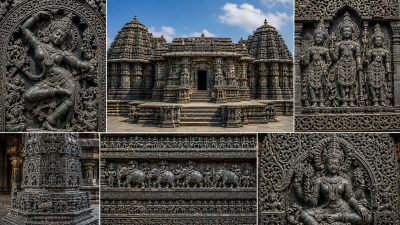
The Hoysala dynasty, ruling the Mysore plateau between the 11th and 14th centuries, fostered a unique sculptural idiom that marked the transition from the Later Chalukyan style to a more ornate, localized expression. Primarily concentrated in the Malnad region of Karnataka, Hoysala sculpture is renowned for its departure from the traditional sandstone to Chloritic Schist (Soapstone). This material, being soft when quarried and hardening upon exposure to air, allowed artisans to achieve an unprecedented level of intricate detail, comparable to the work of a goldsmith or a sandalwood carver.
Distinctive Features of Hoysala Sculptural Art
Hoysala sculpture is characterized by its “Baroque” nature—dense, ornate, and highly sophisticated. Unlike the subtle elegance of Gupta art, Hoysala art thrives on crowded compositions and exuberant decoration.
- Jagati (Raised Platform): Temples are built on high platforms that follow the star-shaped (stellate) ground plan of the sanctum, providing a long circumambulatory path adorned with horizontal sculptural friezes.
- Horizontal Friezes (Parikrama): The exterior walls are not plain but divided into several horizontal bands. These bands follow a specific hierarchy from bottom to top:
- Elephants: Symbolizing strength and stability.
- Lions/Simhas: Representing courage and the royal emblem of the Hoysalas (the Sala-Tiger myth).
- Floral Motifs: Creepers and vines.
- Horsemen: Indicating speed and military prowess.
- Puranic Scenes: Depictions from the Ramayana, Mahabharata, and Bhagavata Purana.
- Makaras and Hamsas: Mythical beasts and celestial swans.
- Madanikas (Salabhanjikas): These are bracket figures placed under the eaves of the temple. They depict feminine beauty in various poses—dancing, grooming, or playing musical instruments—and are considered the pinnacle of Hoysala aesthetic finesse.
- Star-shaped (Stellate) Plan: The projection and recession of the walls create a play of light and shadow, making the sculptures appear dynamic throughout the day.
Major Centers and Masterpieces
The architectural and sculptural output was concentrated in three primary sites, now recognized as UNESCO World Heritage Sites (Sacred Ensembles of the Hoysalas).
| Temple Name | Location | Primary Deity | Key Sculptural Highlight |
| Chennakeshava Temple | Belur | Vishnu | The 42 Madanika figures and the ornate Darpana Sundari (Lady with the Mirror). |
| Hoysaleswara Temple | Halebidu | Shiva | The massive monolithic Nandi and the intricate “Garuda Pillar.” |
| Keshava Temple | Somanathapura | Vishnu (Trikuta) | Perfectly symmetrical stellate plan and ceiling panels depicting lotus blooms. |
Iconography and Religious Themes
The Hoysalas were secular patrons, supporting Shaivism, Vaishnavism, and Jainism. This diversity is reflected in their sculptural themes.
Vaishnava and Shaiva Iconography
The sculptures frequently depict the Dashavatara (ten incarnations of Vishnu). The Hoysaleswara temple features elaborate depictions of Shiva in various forms, such as Gajasurasamhara (slayer of the elephant demon) and Natya Shiva. The presence of complex Tandava poses highlights the influence of contemporary dance forms on sculpture.
Jain Basadis
Hoysala patronage extended to Jainism, particularly in Shravanabelagola. The sculptures here are characterized by their austerity and “Kayotsarga” (standing meditation) poses. The most famous is the Bahubali (Gommateshwara) statue, which, though pre-dating the peak Hoysala architectural style, influenced the scale of later Jain monolithic works in the region.
Technical Trivia and Administrative Facts
- Artisan Signatures: Unique to Hoysala art, sculptors often signed their works. Names like Ruvari Mallitamma (who worked on Somanathapura) and Dasoja are found inscribed at the base of statues, providing rare historical evidence of individual craftsmanship in ancient India.
- The Sala Myth: Many temples feature the sculpture of a young man (Sala) slaying a tiger, which serves as the dynastic emblem, representing the origin of the Hoysala name (Hoy Sala – “Strike, Sala”).
- Turning Technique: The massive stone pillars inside the temples were often “lathe-turned.” These pillars exhibit sharp, circular grooves and a polished finish that suggests the use of sophisticated mechanical rotation during the carving process.
Comparison: Hoysala vs. Chola Sculpture
Understanding the regional variations is crucial for Prelims-level distinction.
- Medium: Cholas primarily used granite (hard) and bronze (lost-wax process); Hoysalas used soapstone (soft).
- Focus: Chola sculpture emphasizes fluid motion and anatomical perfection (e.g., Nataraja); Hoysala sculpture emphasizes jewelry, ornamentation, and crowded detail.
- Setting: Chola sculptures are often housed in deep niches; Hoysala sculptures are part of a continuous, wraparound narrative frieze.