
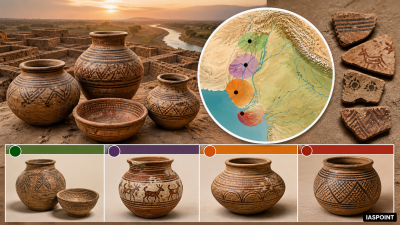
Pre-Harappan pottery refers to the ceramic traditions that flourished in the northwestern part of the Indian subcontinent (roughly 4000 BCE to 2600 BCE) before the emergence of the mature Harappan urbanization. This phase is crucial for UPSC aspirants as it represents the “Formative Age,” where regional diversity in pottery styles eventually converged into the standardized Harappan script and culture. These traditions are primarily categorized into the Sothi-Siswal, Amri-Nal, Kot Diji, and Hakra Ware cultures.
Key Regional Ceramic Traditions
The Pre-Harappan landscape was a mosaic of distinct “ceramic provinces,” each defined by specific fabric, color, and decorative motifs.
| Tradition | Geographic Core | Notable Features |
| Hakra Ware | Ghaggar-Hakra River valley (Cholistan) | Earliest phase; characterized by “mud-appliqúe” (applying a coating of liquid clay mixed with sand) to the outer surface. |
| Amri-Nal | Sindh and Balochistan | Thin-walled, wheel-made pottery. Amri ware features bichrome (two-color) geometric designs, while Nal ware is known for polychrome (multi-color) animal motifs like fish and ibex. |
| Kot Diji | Upper Sindh (East bank of Indus) | Known for the “Short-necked Jar” and the use of a dark wavy line or “Fish-scale” pattern. It shows the first signs of the “Horned Deity” motif. |
| Sothi-Siswal | Rajasthan (Kalibangan) and Haryana | Defined by “Fabric A to F” classification. Includes plain, painted, and incised wares with motifs like pipal leaves and fish scales. |
Classification of Sothi-Siswal Pottery (The Kalibangan Fabrics)
Archaeologist B.B. Lal identified six distinct “Fabrics” at Kalibangan (Period I), which serve as a benchmark for Pre-Harappan studies.
- Fabric A: Carelessly potted, dull red to pinkish color with black paintings (mostly geometric).
- Fabric B: Distinguished by a “rusticated” lower body (sanded surface) and a smooth, slipped upper body.
- Fabric C: Fine-textured red ware with a smooth plum or red slip.
- Fabric D: Characterized by heavy jars with thick walls, often used for storage.
- Fabric E: Buff-colored or yellowish ware, often featuring white paintings alongside black.
- Fabric F: Grey Ware, typically comprising bowls and dishes.
Evolution of Decorative Motifs and Symbols
The transition from Neolithic to Pre-Harappan pottery saw a shift from simple impressions to complex symbolic representations.
- Geometric Patterns: Triangles, checkerboards, and lozenges were ubiquitous across all regional styles.
- Naturalistic Motifs: The “Pipal leaf” and “Fish-scale” patterns, which later became hallmarks of Mature Harappan pottery, originated in the Sothi and Kot Diji traditions.
- Faunal Imagery: Representation of the humped bull (Zebu), horned deities, and birds became common, reflecting the religious and pastoral life of the era.
- Technological Markers: The widespread use of the fast-spinning potter’s wheel replaced the slow-turn tables of the Neolithic era, leading to thinner and more symmetrical vessels.
Technical Features of Pre-Harappan Pottery
Kiln Technology and Firing
Unlike the open-pit firing of the Neolithic, Pre-Harappan potters developed up-draught kilns. This allowed for higher temperatures and better control over the atmosphere, resulting in the characteristic sturdy Red Ware.
Surface Treatment
- Bichrome Effect: The use of two colors (usually black and white) on a red background was a sophisticated technique seen prominently in the Amri-Nal and Sothi traditions.
- Incised Designs: Deep grooves or combed patterns were often made on the interior of large basins or the exterior of jars for better grip and decoration.
Trivia and Facts for UPSC Prelims
- The “Horned Deity” Link: The earliest depiction of a horned figure (proto-Shiva/Pashupati concept) appears on a Kot Dijian pot, proving that Harappan religious iconography had Pre-Harappan roots.
- The “Sothi-Siswal” Controversy: While once considered a separate culture, many archaeologists now view Sothi (Rajasthan) and Siswal (Haryana) as the same cultural complex that laid the foundation for the Harappan urbanization in the Saraswati-Ghaggar valley.
- Potter’s Marks: Pre-Harappan pottery often bears “Graffiti marks” or early signs that resemble the Indus Script, suggesting the evolution of a writing system through ceramic identification.
- Kunal (Haryana): This site is famous for “Bi-chrome” pottery (Red and White) and has yielded some of the earliest silver ornaments, bridging the gap between ceramic and metallurgical advancement.
- Standardization: While regional variations existed, the gradual standardization of pot shapes (like the perforated jar and the dish-on-stand) during the late Pre-Harappan phase indicates increasing inter-regional trade and cultural integration.