
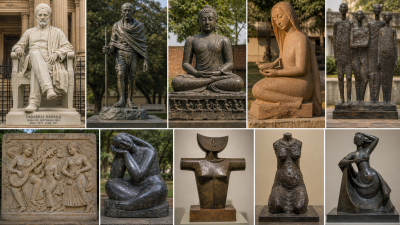
Modern Indian sculpture emerged in the late 19th and early 20th centuries as a reaction against the academic realism imposed by British colonial art schools. This period marked a transition from “Imperial Art”—characterized by neoclassical marble busts and bronze monuments of British officials—to a “Nationalist Aesthetic” that sought to redefine Indian identity. The evolution can be divided into the Academic Realism phase, the Santiniketan Experimentation, and the Post-Independence Avant-Garde movement.
The Academic Phase and Early Pioneers
Initially, Indian sculptors were trained in the Western academic tradition, focusing on anatomical precision and lifelike portraiture. The Sir J.J. School of Art in Mumbai and the Government College of Fine Arts in Chennai were the primary centers for this pedagogical shift.
- V.P. Karmarkar: Known for his mastery over bronze and clay, his works often depicted rural life and historical figures with a Western sense of proportion but Indian themes.
- M.S. Nagappa: A prominent artist from the South who mastered the art of monumental statuary, bridging the gap between traditional craftsmanship and modern portraiture.
- The Transition: Artists began moving away from “official” commissions to explore personal and social narratives, laying the groundwork for the modern movement.
The Santiniketan Revolution and Ramkinkar Baij
The real departure from colonial influence occurred at Kala Bhavana, Santiniketan. Under the guidance of Nandalal Bose and the visionary genius of Ramkinkar Baij, sculpture became an expression of the soil and the common man.
- Ramkinkar Baij (The Father of Modern Indian Sculpture): He was the first to use modern materials like cement, sand, and laterite pebbles. His work was characterized by rugged textures, dynamic energy, and a focus on subaltern subjects.
- Masterpiece: Santhal Family (1938): The first public outdoor modern sculpture in India, depicting a tribal family migrating with their belongings.
- Masterpiece: Yaksha and Yakshini: Located at the Reserve Bank of India, New Delhi, these colossal figures blend traditional iconography with a modern, earthy monumentality.
- Devi Prasad Roy Chowdhury: While retaining academic vigor, his works moved toward social realism.
- Triumph of Labour: A powerful bronze installation at Marina Beach, Chennai, depicting four men moving a massive rock, symbolizing the dignity of manual labor.
- Martyrs’ Memorial (Patna): A commemorative installation depicting seven young men who fell during the Quit India Movement.
Post-Independence Modernism and Global Influence
After 1947, Indian sculpture entered a phase of intense experimentation with abstraction, geometry, and industrial materials like steel, aluminum, and scrap metal. This era was influenced by global movements such as Cubism and Minimalism but remained rooted in Indian philosophy.
- Sankho Chaudhuri: Known for his elegant, flowing abstract forms in wood and metal. His works often emphasize negative space and the inherent rhythm of the material.
- Satish Gujral: A multidisciplinary artist who utilized burnt wood, glass, and industrial hardware to create sculptures that reflected the trauma of the Partition and the complexity of modern life.
- Meera Mukherjee: She revolutionized the traditional Dhokra (lost-wax) casting method of the Bastar tribes to create large-scale modern bronze figures that celebrate the everyday life of artisans and commoners.
- Pradosh Das Gupta: A founder of the Calcutta Group, his work focused on the “volume” and “mass” of the human form, often simplified into smooth, rounded shapes.
Contemporary Trends and Material Diversity
Contemporary Indian sculpture has expanded into installations, site-specific art, and the use of unconventional mediums like found objects and digital interfaces.
- Subodh Gupta: Famous for using stainless steel tiffins and milk pails to create massive installations that comment on globalization and Indian middle-class identity.
- Anish Kapoor: An Indian-born British sculptor known for his use of reflective surfaces and “voids” (e.g., Cloud Gate), exploring the metaphysics of space.
- Nek Chand: The creator of the Rock Garden of Chandigarh, he utilized domestic and industrial waste (broken bangles, tiles, ceramics) to create a sprawling landscape of folk-inspired sculptures.
Comparative Summary: Traditional vs. Modern Sculpture
| Feature | Traditional Indian Sculpture | Modern Indian Sculpture |
| Primary Goal | Spiritual, Didactic, Ritualistic | Aesthetic, Individualistic, Social |
| Material | Stone, Bronze (Classical), Wood | Cement, Steel, Scrap, Fiberglass |
| Subject | Deities, Kings, Mythical Beasts | Common Man, Abstraction, Social Issues |
| Technique | Silpa Shastra canons | Experimental, Global techniques |
| Setting | Temples, Palaces, Stupas | Galleries, Public Squares, Museums |
Fact-File for UPSC Aspirants
- The National Gallery of Modern Art (NGMA): Established in 1954 in New Delhi, it is the premier repository of modern Indian sculptural works.
- Lalit Kala Akademi: Founded in 1954, it provides a national platform for modern sculptors through the National Exhibition of Art.
- Dhanraj Bhagat: A significant modernist known for his “Spirit of Work” series, which used wood and copper to depict the synergy between man and machine.
- Somnath Hore: Known for his “Wounds” series, his sculptures in bronze reflected his deep anguish over the Bengal Famine and human suffering.
- Sarbari Roy Chowdhury: Noted for integrating the rhythm of Hindustani classical music into the visual language of his sculptures.
Key Sculptural Landmarks of Modern India
- Statue of Unity (Gujarat): At 182 meters, it is the world’s tallest statue, depicting Sardar Vallabhbhai Patel. While a modern engineering feat, it represents the continuation of monumental commemorative sculpture.
- Buddha Statue (Hussain Sagar, Hyderabad): A massive monolithic granite statue, carved by contemporary traditionalists led by S.M. Ganapathi Sthapati, blending modern scale with ancient aesthetics.
- The Ashoka Pillar (Sarnath) Adaptations: Modern replicas used in the State Emblem represent the bridge between ancient sculptural heritage and modern national identity.