
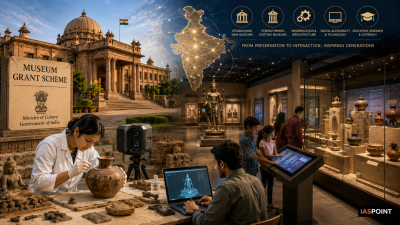
The Museum Grant Scheme was launched by the Ministry of Culture, Government of India, to provide financial assistance for the establishment of new museums and the strengthening of existing ones. It aims to modernize museums to international standards, fostering a culture of preservation and digital accessibility. The scheme operates under the broader umbrella of “Development of Museums,” shifting the focus from simple storage to interactive, educational, and research-oriented spaces.
Core Objectives and Strategic Mandate
The scheme is designed to create a sustainable ecosystem for museums across the country, focusing on both physical infrastructure and technological integration.
- Modernization: Strengthening existing museums through better displays, lighting, and climate-controlled galleries.
- Infrastructure Development: Establishing new museums at the Regional and District levels to showcase local heritage.
- Digitization: Promoting the digital documentation of museum artifacts to create a National Database of collections.
- Public Engagement: Developing “Museum Schools” and visitor-friendly amenities like cafeterias, braille signage, and interpretation centers.
- Capacity Building: Training museum professionals in curation, conservation, and museum management.
Component-wise Classification of the Scheme
The Museum Grant Scheme is divided into three distinct components to cater to different levels of museum development.
| Component | Target Audience | Primary Focus |
| Establishment of New Museums | State Govts, Statutory bodies, NGOs, Trusts | Setting up museums in locations with no existing heritage storage. |
| Development of Existing Museums | Existing Museums (State/Private/Society) | Renovation, climate control, and modernizing display galleries. |
| Digitization of Museum Collections | All Museums with significant collections | Cataloging and creating 2D/3D digital archives of artifacts. |
Eligibility and Funding Pattern
The scheme provides financial aid to various entities, provided they are registered and have a clear mandate for cultural preservation.
- Eligible Entities: State Governments, Autonomous bodies, Local bodies, Societies, and Trusts registered under the Societies Registration Act, 1860.
- Funding Ratio:
- North-Eastern States and Himalayan States: The Central Government provides 90% of the project cost.
- Other States/Entities: The Central Government provides 80% of the project cost.
- Maximum Ceiling: The grant for a Regional Level Museum can go up to ₹15 Crore, while District Level Museums can receive up to ₹5 Crore.
Key Features of Modernization and Digitization
To ensure museums align with global standards, the scheme emphasizes specific technical upgrades.
- Jatan: Virtual Museum Builder: Under this scheme, the Ministry promotes the use of JATAN software, a virtual museum builder and database management system developed by C-DAC, Pune.
- Museum on Wheels: A specialized initiative to take museum exhibits to rural areas and schools via mobile vans.
- Conservation Labs: Financial assistance is provided for setting up in-house labs to treat and restore deteriorating artifacts.
- Accessibility: Mandatory provisions for “Divyang-friendly” (disabled-friendly) infrastructure, including ramps and tactile paths.
Administrative Oversight and Implementation
The scheme is governed by a structured committee system to ensure transparency and merit-based fund allocation.
- Expert Advisory Committee (EAC): A committee of experts in archaeology, museology, and art history reviews the proposals submitted by various organizations.
- Financial Audit: Beneficiaries must provide “Utilization Certificates” and are subject to audits by the CAG (Comptroller and Auditor General) to ensure funds are used for the designated conservation purpose.
- Nodal Agency: The Ministry of Culture acts as the direct implementing body, often coordinating with the National Museum, New Delhi, for technical guidance.
Facts and Trivia for UPSC Prelims
- International Museum Day: Celebrated on May 18, which often sees major announcements and inaugurations under this scheme.
- First Site Museum: The Archaeological Survey of India (ASI) established its first site museum at Sarnath in 1904; the Museum Grant Scheme now extends this philosophy to state and private sectors.
- National Portal and Digital Repository: The Ministry has launched a “National Portal and Digital Repository for Indian Museums” which hosts digitized collections from 10 major museums under the Ministry’s control.
- Identity-based Museums: The scheme has recently prioritized the establishment of Tribal Museums and museums dedicated to the Freedom Struggle (e.g., the Biplobi Bharat Gallery in Kolkata).
- Public-Private Partnership (PPP): The scheme encourages the “Adopt a Heritage” model, where private entities can contribute to museum development through CSR (Corporate Social Responsibility) funds.
Strategic Importance in Heritage Conservation
The Museum Grant Scheme serves as the logistical backbone for the Antiquities and Art Treasures Act, 1972. By providing safe, climate-controlled environments, it ensures that recovered or registered antiquities are not lost to environmental decay or theft. It transforms static collections into dynamic “Cultural Hubs,” bridging the gap between academic archaeology and public history.
Last Modified: May 8, 2026