
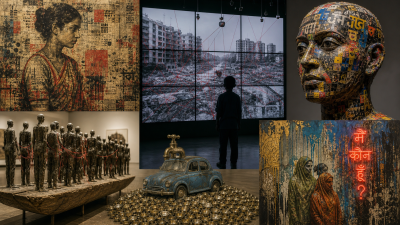
Contemporary Indian art (post-1970s to the present) marks a significant departure from the post-independence “Modernism” of the Progressive Artists’ Group. While Modernism focused on establishing a national identity and formal experimentation, Contemporary art is characterized by Post-Modernism, globalization, and the use of diverse media beyond the traditional canvas. It is deeply rooted in social critique, identity politics, and the intersection of technology with tradition.
Shift from Modernism to Contemporaneity
The transition into contemporary practice was marked by a shift from the “universal” to the “particular.” Artists began to move away from pure abstraction to engage with the immediate socio-political environment of India.
- Diverse Media: Evolution from oil and watercolor to “New Media,” including digital art, video installations, found objects, and site-specific performance art.
- Political Engagement: Art became a tool to address issues such as gender inequality, environmental degradation, caste dynamics, and the effects of liberalization (post-1991).
- Globalization: The opening of the Indian economy allowed Indian artists to participate in global biennials (Venice, Gwangju), blending local Indian narratives with international aesthetic standards.
Major Movements and Artist Collectives
Several groups and movements provided the structural backbone for the contemporary era, moving the focus from Bombay and Calcutta to a more decentralized landscape.
- Group 1890: Formed in 1962 but influential in the contemporary shift, led by J. Swaminathan. It rejected the “Western-influenced” modernism of the PAG and sought a “natural” or “indigenous” modernism.
- The Radical Painters and Sculptors Association: A Kerala-based collective in the 1980s that brought a strong Marxist and socio-political critique into the mainstream art discourse.
- Baroda School (MS University): Became a pivotal center for “Narrative Figurative” art, emphasizing storytelling and the human condition.
Leading Figures of Contemporary Indian Art
Contemporary artists often work across multiple disciplines, blending traditional painting with sculptural or digital elements.
| Artist | Style/Medium | Notable Contribution/Themes |
| Subodh Gupta | Installations / Sculpture | Known as the “Damien Hirst of Delhi”; uses stainless steel tiffins and milk pails to explore rural-urban migration. |
| Bharti Kher | Mixed Media | Renowned for her use of the Bindi as a central motif to discuss domesticity and the “third eye.” |
| Anish Kapoor | Large-scale Installations | Explores “void” and “reflexivity” using materials like stainless steel and wax (e.g., Cloud Gate). |
| Atul Dodiya | Narrative Painting | Blends popular culture, Bollywood, and Mahatma Gandhi’s imagery to comment on Indian history. |
| Nalini Malani | Video & Shadow Play | A pioneer in installation art, focusing on themes of violence, displacement, and feminist narratives. |
| Anju Dodiya | Figurative / Self-portraiture | Explores the interior world of the artist through theatrical and introspective imagery. |
New Media and Installation Art
Contemporary Indian art is defined by its refusal to be confined to a flat surface. The “installation” became a dominant form for addressing complex national narratives.
- Site-Specific Works: Art created to exist in a specific location, often using local materials or addressing local history (e.g., works at the Kochi-Muziris Biennale).
- Digital and Video Art: Artists like Shilpa Gupta use interactive digital technology to explore themes of borders, security, and censorship.
- Environmental Art: Addressing the climate crisis, artists use biodegradable materials or found waste to create “Ecological Art.”
The Kochi-Muziris Biennale: A Milestone
The establishment of the Kochi-Muziris Biennale in 2012 marked a turning point for contemporary art in India.
- Decentralization: Shifted the art capital from the gallery-centric Delhi and Mumbai to the historical landscape of Kerala.
- Public Engagement: It made high-concept contemporary art accessible to the general public, moving it out of elite private collections.
- Global Platform: It became the largest contemporary art festival in Asia, facilitating a South-South dialogue between artists from the Global South.
Comparison: Modern vs. Contemporary Indian Painting
| Feature | Modern Painting (1947–1970) | Contemporary Painting (1970–Present) |
| Central Focus | Formalism and National Identity | Identity Politics and Globalization |
| Primary Media | Oil on Canvas, Bronze | Multimedia, Video, Digital, Found Objects |
| Subjectivity | Artist-centric (Personal Expression) | Audience-centric (Interactive/Public) |
| Context | Post-Independence Hope | Post-Liberalization Critique |
| Space | Galleries and Museums | Public Spaces and Digital Platforms |
Fact Sheet for UPSC Prelims: Vital Data
- Kochi-Muziris Biennale Founders: Bose Krishnamachari and Riyas Komu.
- Subodh Gupta’s “Very Hungry God”: A giant skull made of stainless steel utensils, symbolizing the hunger of the consumerist world.
- J. Swaminathan’s Contribution: He was instrumental in establishing Bharat Bhavan in Bhopal, which aimed to bring tribal and contemporary art onto the same platform.
- The “Bindu” Evolution: While S.H. Raza started the Bindu as a modernist motif, contemporary artists have re-interpreted such symbols through digital and kinetic art.
- Auction Records: Contemporary Indian art has seen a massive surge in valuation, with artists like Amrita Sher-Gil (a precursor to modernism) and Anish Kapoor reaching record prices at Sotheby’s and Christie’s.
- Geographical Hubs: Beyond the metros, Baroda (Gujarat) and Santiniketan (West Bengal) remain the most significant academic training grounds for contemporary practitioners.
- Public Art Districts: The Lodhi Art District in Delhi is India’s first open-air public art gallery, showcasing the contemporary shift toward street art and murals.