

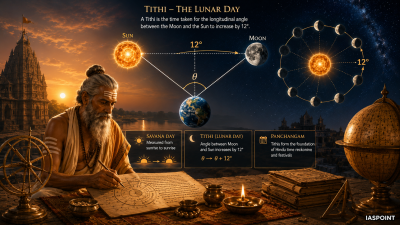
In Indian astronomy and the Panchangam system, a Tithi is defined as a lunar day, representing the time it takes for the longitudinal angle between the Moon and the Sun to increase by exactly 12 degrees. Unlike a civil day (Savana day) which is measured from sunrise to sunrise, a Tithi is determined strictly by the relative positions of these two celestial bodies.
- Calculation: A complete lunar orbit of 360° is divided into 30 Tithis (360 ÷ 12 = 30).
- Variable Duration: Because the Moon’s orbital velocity is not constant (Kepler’s laws), the duration of a Tithi varies. It can range from approximately 19 to 26 hours.
- Auspiciousness: The Tithi is the primary element used to determine the timing of Hindu festivals, fasts (Vratas), and rituals.
Classification: Shukla Paksha and Krishna Paksha
The 30 Tithis of a lunar month are divided into two fortnights or Pakshas, each containing 15 Tithis.
Shukla Paksha (Bright/Waxing Fortnight)
This period begins after the New Moon (Amavasya) and ends with the Full Moon (Purnima).
- Pratipada (1st)
- Dwitiya (2nd)
- Tritiya (3rd)
- Chaturthi (4th)
- Panchami (5th)
- Shashti (6th)
- Saptami (7th)
- Ashtami (8th)
- Navami (9th)
- Dashami (10th)
- Ekadashi (11th)
- Dwadashi (12th)
- Trayodashi (13th)
- Chaturdashi (14th)
- Purnima (15th – Full Moon)
Krishna Paksha (Dark/Waning Fortnight)
This period begins after the Full Moon and ends with the New Moon. The names of the first 14 Tithis remain the same as the Shukla Paksha, but the 15th Tithi is called Amavasya.
Temporal Anomalies: Kshay and Vriddhi Tithis
Because Tithis do not align perfectly with the 24-hour solar day, two specific phenomena occur in the calendar:
- Vriddhi Tithi (Adhika Tithi): If a Tithi starts before one sunrise and ends after the following sunrise, it spans two sunrises. In the calendar, this Tithi is repeated for two consecutive days.
- Kshaya Tithi (Lupta Tithi): If a Tithi starts after one sunrise and ends before the next sunrise, it does not “touch” a sunrise. Consequently, this Tithi is skipped or “lost” in the civil calendar.
Classification by Nature (Nanda to Rikta)
Tithis are further categorized into five groups based on their perceived influence and the type of activities recommended during them.
| Category | Tithis (Both Pakshas) | Nature/Meaning | Recommended Activities |
| Nanda | 1, 6, 11 | Joyous/Prosperous | Farming, house-building, festivities. |
| Bhadra | 2, 7, 12 | Lucky/Good | Marriages, starting education, arts. |
| Jaya | 3, 8, 13 | Victorious | Conflict resolution, legal matters, sports. |
| Rikta | 4, 9, 14 | Empty/Hollow | Generally avoided for new beginnings; good for occult or cleansing. |
| Purna | 5, 10, 15 | Full/Complete | All auspicious works, long-term investments. |
Crucial Festivals and Associated Tithis
The Tithi is the fundamental unit for dating historical and religious events in India.
- Mahashivratri: Magha/Phalguna Krishna Chaturdashi.
- Janmashtami: Shravana/Bhadrapada Krishna Ashtami.
- Ram Navami: Chaitra Shukla Navami.
- Ganesh Chaturthi: Bhadrapada Shukla Chaturthi.
- Diwali: Karthika Amavasya.
- Holi: Phalguna Purnima.
Fact File for UPSC Aspirants
- Udaya Tithi: In Hindu tradition, a festival is generally celebrated on the day the specific Tithi prevails at the time of sunrise, even if the Tithi ends shortly after.
- Suryodayam calculation: The Panchangam defines the day’s Tithi based on the longitude of the Sun and Moon at the precise moment of local sunrise.
- Amavasya vs. Purnima: Amavasya is the 30th Tithi of the month in the Amanta system (common in South India) but falls in the middle of the month in the Purnimanta system (common in North India).
- Karana Connection: A Tithi is divided into two Karanas. There are 11 Karanas in total (4 fixed and 7 rotating), which provide further micro-details for astrological timing.
- Tithi Gandanta: The junction points between certain Tithis (specifically the end of Purna Tithis and start of Nanda Tithis) are considered spiritually sensitive or “knotted” periods.