
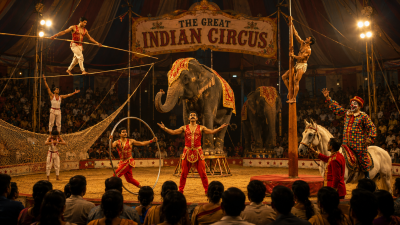
The modern Indian circus owes its inception to Vishnupant Chatre, often hailed as the “Father of Indian Circus.” While traditional performing arts like Mallakhamba (pole gymnastics) and Nut (tightrope walking) existed for centuries, the organized circus format emerged in the late 19th century as a response to Western influence.
- The Chhatre’s Circus (1880): Following a challenge by the Director of the visiting Italian Chiarini Circus, Vishnupant Chatre, the stable master for the Raja of Kurundwad, established the Great Indian Circus in 1880. This marked the transition from unorganized street performances to a structured ring-based format.
- The Royal Connection: Early circuses received significant patronage from princely states like Kolhapur and Sangli, which viewed the circus as a medium to showcase indigenous physical prowess and equestrian skills.
The Thalassery Revolution and Keeleri Kunhikannan
If Chatre was the visionary, Keeleri Kunhikannan was the architect who institutionalized circus training in India. He is known as the “Father of Kerala Circus,” turning the town of Thalassery in the Kannur district into the “Circus Capital of India.”
- Circus Academy (1901): Kunhikannan established the first circus school in Thalassery. He integrated Kerala’s traditional martial art, Kalaripayattu, with Western gymnastics and acrobatics.
- The Kannur Legacy: Most of India’s legendary circus performers and owners, including those of the Gemini, Great Bombay, and Amar Circuses, trace their lineage back to the Thalassery school of training.
Evolution of Key Performance Elements
The Indian circus evolved as a syncretic art form, blending indigenous physical culture with global entertainment standards.
Physical Feats and Acrobatics
- Mallakhamba and Yoga: Early troupes incorporated traditional strength-based performances. The use of the vertical wooden pole (Mallakhamba) was adapted into aerial acts.
- Trapeze and High-Wire: Influenced by European styles, Indian troupes mastered the flying trapeze, often adding a layer of risk and complexity that became a hallmark of the Indian style.
The Role of Animals
- Indigenous and Exotic Wildlife: Historically, Indian circuses were famous for their menageries, including Asiatic lions, Royal Bengal tigers, elephants, and bears.
- Training Traditions: Animal training was often a hereditary craft, with specific families specializing in elephant “mahout” techniques adapted for the ring.
Regulatory Milestones and Legislative Shifts
The evolution of the Indian circus cannot be understood without the legal frameworks that eventually transformed its structure.
| Year | Milestone/Act | Impact on Indian Circus |
| 1960 | Prevention of Cruelty to Animals Act | Introduced initial regulations on the treatment of performing animals. |
| 1991 | MoEF Notification | Banned the training and exhibition of five species: bears, monkeys, tigers, panthers, and lions. |
| 2001 | Educational Mandates | Stricter enforcement on the schooling of children born into circus families, impacting the traditional apprenticeship model. |
| 2011 | Supreme Court Ruling | Banned the employment of children in circuses to prevent exploitation and ensure Right to Education (RTE). |
| 2013 | CZA Ban | The Central Zoo Authority (CZA) banned the use of elephants in circuses, leading to a shift toward purely human-centric performances. |
Major Circus Troupes and Their Contributions
Several troupes played a pivotal role in popularizing the medium across the Indian subcontinent and abroad.
- Great Rayman Circus: Founded by Kallan Gopalan, a disciple of Kunhikannan, it was one of the first to tour internationally.
- Gemini Circus: Established in 1951 by M.V. Shankaran, it became iconic for its massive scale and was the filming site for Raj Kapoor’s Mera Naam Joker.
- The Great Bombay Circus: One of the oldest surviving troupes, it was a pioneer in merging multiple smaller troupes to survive economic downturns.
Socio-Cultural Significance and Trivia
- Social Inclusion: The circus was one of the few historical spaces where caste and religious barriers were secondary to physical skill. Troupes were often melting pots of diverse regional identities.
- The Women of Circus: Traditionally, the circus provided a rare professional avenue for women in physical performing arts, though it remained a grueling and precarious career.
- Global Recognition: In the mid-20th century, Indian circus artists were highly sought after in Soviet Russia and Europe for their flexibility and balance-based acts.
Transition to Contemporary Formats
In the 21st century, the “Traditional Circus” is undergoing a metamorphosis into “New Circus” (Cirque-style).
- Human-Centric Shows: With the ban on wild animals, the focus has shifted to high-tech lighting, synchronized choreography, and narrative-driven performances.
- Economic Challenges: Rising costs of land for tents (tents/pandal), competition from digital entertainment, and the loss of the “animal magnet” have led to a decline in the number of active touring companies.
- Government Intervention: Recent years have seen calls for the “Circus” to be recognized under the Ministry of Culture to provide artists with pensions and social security benefits, similar to other folk artists.