
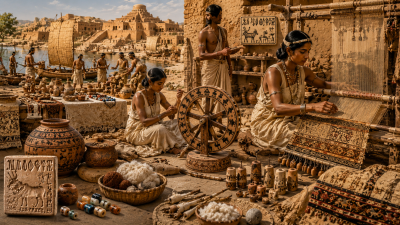
The Harappan Civilization (c. 3300–1300 BCE) represents the earliest known evidence of organized textile production in the Indian subcontinent. The mastery over spinning and weaving was not merely a functional necessity but a sophisticated industry that supported both domestic needs and international trade with Mesopotamia and Egypt.
Raw Materials and Fiber Technology
The Indus Valley people were pioneers in the cultivation and processing of natural fibers.
Cotton (Gossypium arboreum)
The Indus Valley is credited with being the first civilization to cultivate cotton. Archaeological evidence from Mohenjo-daro includes fragments of woven cotton cloth recovered from a silver vase, which were preserved through the process of mineralization. Scientific analysis confirms these fibers were dyed with madder, indicating advanced knowledge of chemical mordants.
Wool and Silk
Apart from cotton, the inhabitants utilized wool from domesticated sheep and goats. Recent microscopic studies of ornaments from Harappa and Chanhu-daro have also revealed the presence of wild silk (Antheraea spp.), suggesting that the Harappans were harvesting silk from indigenous silkworms long before the traditional “Silk Road” era.
Archaeological Evidences of Textile Tools
The prevalence of textile manufacturing is corroborated by the recovery of numerous artifacts across various sites.
Spindle Whorls
A vast number of spindle whorls made of terracotta, frit, and expensive materials like faience have been unearthed. The presence of both small and large whorls indicates the spinning of both fine and coarse threads.
Needles and Buttons
Needles made of copper and bone, featuring functional eyes, have been found at Mohenjo-daro. Steatite buttons, often circular or heart-shaped with two holes for attachment, suggest that garments were not only draped but sometimes fastened or tailored.
Weaving and Dyeing Techniques
The Harappans displayed a high degree of technical competence in the aesthetic treatment of cloth.
Dyeing and Mordants
The discovery of a “Dyeing Vat” at Mohenjo-daro suggests a centralized facility for coloring fabrics. The use of natural dyes like Indigo and Madder (Manjistha) provided a vibrant palette of blues and reds. The ability to fix these colors indicates an understanding of the chemistry of metal-based mordants.
Patterns and Embroidery
The famous “Priest-King” statue from Mohenjo-daro provides a visual blueprint of Harappan textile aesthetics. He is depicted wearing a shawl draped over the left shoulder, featuring a distinct Trefoil Pattern (three-leaf design). This pattern was often filled with red pigment, suggesting either block printing or sophisticated embroidery techniques.
Clothing Styles and Social Stratification
While the harsh climate led to the decay of most organic fabrics, terracotta figurines provide a clear picture of Harappan attire.
| Category | Men’s Attire | Women’s Attire |
|---|---|---|
| Lower Garment | A short cloth resembling a modern dhoti, secured by a waistband. | A short skirt or loincloth held by a girdle (girdles were often made of beads). |
| Upper Garment | Usually bare-chested or draped with a shawl over the left shoulder (leaving the right arm free). | Occasionally a cloak or wrap, but primarily characterized by elaborate fan-shaped headdresses. |
| Status Markers | Finer cotton and complex patterns like the Trefoil. | Heavy jewelry including necklaces, bangles of shell/terracotta, and gold ornaments. |
Trade and Global Impact
Textiles were a primary export commodity for the Indus Valley Civilization. Cuneiform inscriptions from Mesopotamia refer to a land called ‘Meluha’ (identified as the Indus region) as a source of cotton. The Greeks later referred to cotton as Sindon, a name derived from the word ‘Sindhu’ (Indus), highlighting the geographical origin of the fabric in antiquity.
Key Facts for UPSC Prelims
- Earliest Cotton: The oldest sample of cotton thread in the world was found at Mehrgarh, dated to approximately 5000 BCE.
- Lothal Dockyard: Excavations at the port city of Lothal revealed terracotta sealings with cloth impressions, proving that bales of textiles were packaged and exported.
- The Spindle Material: While commoners used terracotta spindles, the elite used faience (a glazed ceramic), indicating social hierarchy in textile tools.
- Natural Colors: Use of mineral and plant-based dyes was standardized; there is no evidence of silk-screen printing, but block printing is hypothesized based on geometric patterns on pottery.