
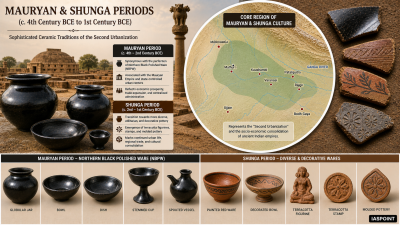
The Mauryan and Shunga periods (c. 4th century BCE to 1st century BCE) represent a sophisticated era in Indian ceramic history. While the Mauryan period is synonymous with the perfection of the Northern Black Polished Ware (NBPW), the Shunga period reflects a transition toward more diverse, utilitarian, and decorative forms. These pottery traditions serve as primary archaeological markers for the “Second Urbanization” and the socio-economic consolidation of ancient Indian empires.
Mauryan Pottery: The Era of Perfection
Mauryan pottery is characterized by its “deluxe” nature, emphasizing technical mastery over simple ornamentation. The state-controlled economy of the Mauryas likely facilitated the wide distribution of standardized ceramic types across the subcontinent.
Northern Black Polished Ware (NBPW)
- Technological Pinnacle: NBPW is the hallmark of the Mauryan era. It is distinguished by a mirror-like luster and a metallic ring when struck.
- Chemical Composition: The glossy finish was achieved through a specialized slip consisting of highly ferruginous (iron-rich) clay and perhaps organic matter, fired in a reducing atmosphere (oxygen-deprived) at high temperatures.
- Elite Usage: Due to its labor-intensive production, it was primarily used by the royalty and merchant classes as luxury tableware.
- Repair Evidence: Archaeologists have found NBPW fragments joined by copper rivets, indicating that these vessels were highly valued and not easily discarded.
Utilitarian and Plain Wares
- Plain Grey Ware: A simpler, non-polished version of grey pottery used for daily household tasks.
- Red Ware: The most common type of pottery found at Mauryan sites, used for storage, cooking, and coarse transport vessels.
- Ring Wells: A distinct Mauryan innovation, these were terracotta rings stacked to line wells for water or soak pits for drainage, reflecting advanced urban sanitation.
Shunga Pottery: Transition and Decoration
Following the decline of the Mauryas, the Shunga period (c. 185 BCE – 73 BCE) saw a shift in ceramic aesthetics. While NBPW continued in a degraded form, there was an increase in the variety of red wares and the use of molded decorations.
Key Characteristics of Shunga Ceramics
- Prevalence of Red Ware: Unlike the Mauryan preference for black and grey, the Shunga period saw a dominance of bright red slips.
- Stamped and Molded Designs: Shunga potters began using stamps and molds to create intricate patterns including floral motifs, geometric shapes, and occasionally human or animal figures.
- Terracotta Articulation: The Shunga period is famous for its prolific production of terracotta figurines (mostly Yakshas, Yakshinis, and Mother Goddesses) made from molds, which influenced the styles found on contemporary pottery.
Comparative Features of Mauryan and Shunga Pottery
| Feature | Mauryan Pottery | Shunga Pottery |
| Primary Fabric | Fine, thin-walled NBPW; Grey Ware | Coarser Red Ware; Degraded NBPW |
| Surface Treatment | High-gloss, metallic luster | Stamped, incised, and molded designs |
| Color Palette | Jet black, silvery, or golden | Bright red, dull red, and brown |
| Primary Shapes | Hemispheroidal bowls, flat dishes | Bowls with tapered sides, sprinkler-neck jars |
| Decorative Focus | Technical finish and texture | Relief work and figurative motifs |
360° Archaeological and Cultural Insights
Major Archaeological Sites
- Pataliputra (Bihar): The Mauryan capital, providing the richest yield of high-quality NBPW and ring wells.
- Kaushambi (UP): A crucial site showing the transition from NBPW to the decorated wares of the Shunga-Kushana phases.
- Tamralipti (West Bengal): Evidence of Mauryan pottery reaching maritime trade hubs.
- Bhita and Ahichchhatra: Known for Shunga-era terracotta and stamped pottery.
Technical Trivia for Aspirants
- Reducing Atmosphere: This firing technique limits oxygen, turning the iron oxides in the clay black. If oxygen were present (oxidizing atmosphere), the pottery would turn red.
- The “Lustre” Mystery: For decades, the NBPW shine was thought to be a glaze, but it is technically a “slip”—a liquid mixture of clay and water applied before firing.
- Fossil Guide: In Indian archaeology, NBPW is considered a “diagnostic ware” or “fossil guide,” meaning its presence immediately allows archaeologists to date a stratum to the mid-to-late 1st millennium BCE.
- Social Indicator: The transition from the rural Painted Grey Ware (PGW) to the urban NBPW mirrors the shift from the tribal chiefdoms of the Later Vedic period to the organized Mahajanapadas and Empires.
Summary of Forms and Functions
- Tableware: Bowls, dishes, and lids (predominantly NBPW).
- Storage: Large jars with thick walls (Red Ware).
- Sanitation: Terracotta ring wells and drainage pipes.
- Ritual: Small lamps and votive plaques, often found in Shunga levels.