
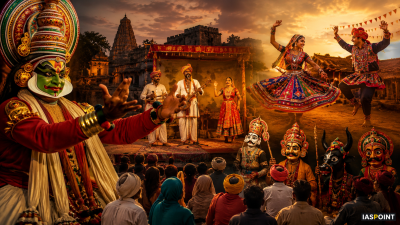
Indian folk theatre represents the transition from the classical Sanskrit tradition to a more vibrant, regional, and accessible form of expression. Emerging primarily during the medieval period (15th–19th centuries), these forms shifted focus from elite courtly themes to the struggles, joys, and spiritual lives of the common populace.
- Regional Diversity: Unlike the standardized rules of the Natyashastra, folk theatre is deeply rooted in local dialects, customs, and social issues.
- Performance Space: Most forms are performed in open-air spaces like village squares (Maach), courtyards, or temporary platforms, breaking the “fourth wall” between the audience and the performer.
- Thematic Depth: While many forms are devotional (Bhakti), others are secular, utilizing satire, slapstick humor, and social commentary to critique local administration or caste hierarchies.
- Integrated Arts: It is a synthesis of the Geet (song), Nritya (dance), and Vadya (instrumental music), where the narrator often plays a pivotal role in linking scenes.
Classification of Indian Folk Theatre
Folk theatre in India is broadly categorized based on its thematic intent and regional origin.
Ritualistic and Devotional Theatre
These forms are primarily associated with religious festivals and the spread of the Bhakti movement.
- Ankia Naat (Assam): Introduced by Sankaradeva, it utilizes the language Brajavali. It is performed in Sattras (monasteries) and features the Sutradhar as a constant presence on stage.
- Ramlila (North India): A dramatic folk re-enactment of the life of Rama based on Tulsidas’s Ramcharitmanas. It was recognized by UNESCO in 2008.
- Rasleela (Braj Region): Focuses on the life of Krishna and the Gopis. It is highly musical and relies on the emotional concept of Bhakti.
- Bhagavata Mela (Tamil Nadu): Performed in the Tanjore district, it is a ritualistic theatre dedicated to Lord Vishnu, traditionally performed by male members of the Brahmin community.
Secular and Entertainment-Oriented Theatre
These forms focus on folklore, historical legends, and social satire.
- Nautanki (Uttar Pradesh): Known for its loud drumming (Naggada) and high-pitched singing. It often depicts historical romances like Laila-Majnu or social themes.
- Tamasha (Maharashtra): Evolved from the nomadic tribes, it is characterized by the Lavani dance and the presence of a female lead. The Kolhati community is traditionally associated with this form.
- Bhavai (Gujarat): A high-energy form where performers balance multiple pots on their heads. It relies on the Bhungal (a long pipe instrument) and addresses social evils through humor.
- Jatra (Bengal/Odisha): Originally a musical procession of Krishna devotees, it evolved into a secular form of theatre performed on open stages without curtains or scenery.
Regional Distribution of Major Folk Theatre Forms
| Theatre Form | State of Origin | Key Characteristic | Notable Fact |
| Koodiyattam | Kerala | Sanskrit tradition blend | India’s first UNESCO Intangible Heritage entry. |
| Yakshagana | Karnataka | Elaborate headgear & makeup | Derived from the Vaishnavite movement. |
| Maach | Madhya Pradesh | Performed on a raised stage | The name is derived from the Hindi word Manch. |
| Swang | Haryana/Punjab | Mimicry and dialogue | Relies heavily on the Ektara and Dholak. |
| Bhand Pather | Jammu & Kashmir | Satirical and secular | Performed by the Bhand (folk entertainers) community. |
| Bayanata | Karnataka | Open-air theatre | Primarily performed in the North Karnataka region. |
| Dashavatar | Konkan Region | Ten incarnations of Vishnu | Performers wear wooden masks representing deities. |
| Therukoothu | Tamil Nadu | “Street Play” | Performed during the annual temple festival of Mariamman. |
Structural Elements of Folk Performances
The architecture of a folk play typically follows a set sequence that ensures both ritualistic sanctity and audience engagement.
- The Sutradhara (Narrator): In folk traditions like Ankia Naat and Bhaona, the narrator remains on stage to guide the audience, providing a bridge between the mythological past and the contemporary present.
- The Vidushaka (Clown): A staple in forms like Bhavai and Koodiyattam, the clown provides comic relief and often voices the grievances of the common man against the authorities.
- Musical Accompaniment: Instruments are usually regional, such as the Chenda in Kerala, Khol in Assam, and the Duff in Maharashtra.
- Improvisation: Unlike Sanskrit theatre, folk scripts are often fluid, allowing actors to improvise based on the audience’s reaction or current local events.
Critical UPSC Trivia for Prelims
- UNESCO Recognition: Currently, Koodiyattam (Kerala), Ramlila (North India), and Mudiyettu (Kerala) are the theatrical forms inscribed on the UNESCO Representative List of Intangible Cultural Heritage.
- Vidhushaka’s Role: In Bhavai, the lead character is often called the Nayaka, while the comic relief is provided by characters like Ranglo.
- The Use of Masks: While masks are common in Chhau (a dance-drama), they are also central to Bhaona (Assam) and Krishnanattam (Kerala).
- Traditional Venues: The Namghar in Assam and the Koothambalam (temple theatres) in Kerala are specific architectural spaces dedicated to these folk and semi-classical performances.
- Patronage: While classical theatre received royal patronage, folk theatre was historically sustained by the Gram Panchayat (village councils) and the local community through collective funding.