
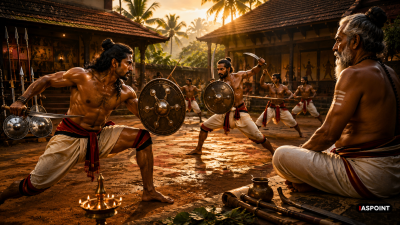
Kalaripayattu is widely acknowledged as the oldest surviving martial art in the world, with its roots tracing back over 3,000 years to the state of Kerala. The term is derived from two Malayalam words: Kalari (threshing floor or battlefield/training school) and Payattu (training or practice of martial arts).
- Vedic Foundations: It finds its philosophical and technical basis in the Dhanurveda, the Upaveda of the Yajur Veda.
- Mythological Origin: Traditional lore attributes the creation of Kalaripayattu to Lord Parashurama, the sixth avatar of Vishnu, who is said to have established 108 Kalaris across the reclaimed land of Kerala.
- Sangam Era Evidence: Early Tamil Sangam literature (3rd century BCE to 3rd century CE) describes the use of spears, swords, and shields in warfare, indicating the proto-forms of this art existed in the ancient Chera kingdom.
Institutional Structure: The Kalari
The Kalari is not merely a gymnasium but a sacred space designed according to Vastu Shastra.
- Physical Orientation: The Kalari is typically rectangular, dug five feet into the ground to maintain a cool temperature for rigorous training. It always faces East.
- The Poothara: In the southwest corner sits the Poothara, a seven-tiered stepped platform representing the guardian deity and the seven strengths (Dhatus).
- The Gurukkal: The chief instructor or Master is known as the Gurukkal, representing the unbroken Guru-Shishya tradition.
Four Stages of Training (Pattayappu)
The training follows a rigorous pedagogical progression, moving from external physical mastery to internal energy control.
| Stage | Name | Focus and Description |
| Stage 1 | Meythari | Physical body exercises. Includes complex jumps, leg extensions (Chuvadu), and stances (Vadivu) named after animals. |
| Stage 2 | Kolthari | Training with wooden weapons. Practitioners use the Kettukari (long staff), Cheruvadi (short stick), and Otta (curved stick). |
| Stage 3 | Ankathari | Training with sharp metal weapons. Includes the Val (sword), Paricha (shield), Kuntham (spear), and the deadly Urumi (flexible sword). |
| Stage 4 | Verumkai | Unarmed combat techniques. Focuses on grips, throws, and strikes to neutralize armed or unarmed opponents. |
Anatomy and Healing: Marma Vidya and Ayurveda
A distinguishing feature of Kalaripayattu is its profound integration with traditional medicine.
- Marmas: The art identifies 107 vital points (Marmas) in the human body. Knowledge of these points is used for both lethal combat strikes and therapeutic healing (Marmachikitsa).
- Uzhichil: This refers to the traditional system of oil massage. The Gurukkal uses medicinal oils to increase the flexibility of the student’s body and treat muscular or skeletal injuries.
- Animal Stances (Vadivus): Movements are modeled after the strength and agility of eight animals, including the Lion (Simha), Elephant (Gaja), Tiger (Vyaghran), and Cobra (Sarpa).
Regional Variants of Kalaripayattu
While the core principles remain consistent, geographical variations have led to different styles:
- Northern Style (Vadakkan Pattayappu): Primarily practiced by the Nairs and Chekavars. It emphasizes graceful, fluid movements, high leaps, and extensive weapon training.
- Southern Style (Thekkan Pattayappu): Rooted in the Siddha tradition and often linked to Sage Agastya. It focuses on Adi Murai (striking) and is more grounded, emphasizing hand-to-hand combat and pressure point strikes.
- Central Style (Madhya Kalari): A composite style that incorporates elements of both Northern and Southern techniques, focusing on heavy footwork and floor patterns.
Decline, Suppression, and Modern Revival
The art faced significant existential threats during the colonial era but has seen a massive resurgence in the 21st century.
- British Ban: Following the Pazhassi Raja rebellions, the British colonial government banned the practice of Kalaripayattu and the carrying of arms in 1804 to prevent local uprisings.
- Secret Preservation: The art was kept alive in rural pockets through clandestine training until the nationalist movement in the 1920s led to its public revival by pioneers like C.V. Narayanan Nair.
- Global Influence: It is frequently cited as the precursor to Zen Buddhism’s martial traditions. Legend holds that Bodhidharma, a Buddhist monk, traveled from India to the Shaolin Temple in China, carrying the physical discipline of Kalaripayattu which evolved into Kung Fu.
Fact File for Competitive Examinations
- Khelo India Youth Games: In 2021, the Ministry of Youth Affairs and Sports inducted Kalaripayattu into the Khelo India Youth Games to promote traditional sports.
- The Urumi: Known as the “coiled sword,” it is considered one of the most dangerous weapons in the world, requiring years of training to master without self-injury.
- Relationship with Performing Arts: Many classical dance forms of Kerala, such as Kathakali and Theyyam, borrow their physical vocabulary and training regimens from Kalaripayattu.
- The Kadathanad Tradition: North Malabar remains the historical heartland of the Vadakkan style, famously immortalized in the Vadakkan Pattukal (Ballads of the North).