
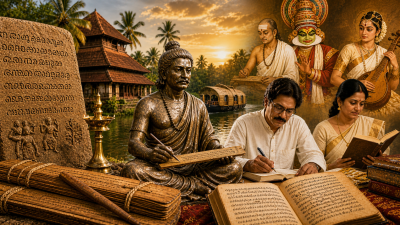
Malayalam, a member of the Dravidian language family, was officially granted Classical Language status by the Government of India in 2013. Its literary journey is characterized by a unique synthesis of indigenous folk traditions, Sanskrit scholarship, and Tamil influences, eventually evolving into a vibrant modern literary landscape.
The Formative Stage: Early Traditions (Up to 13th Century)
The origins of Malayalam literature are rooted in three distinct streams: the indigenous folk songs (Pattu), the Sanskrit-influenced scholarship (Manipravalam), and the Tamil-influenced compositions.
The Pattu School
This tradition followed indigenous meters and utilized a vocabulary largely free of Sanskrit.
- Ramacharitam (12th Century): Composed by Cheeraman, this is considered the earliest significant literary work in Malayalam. It retells the Yuddha Kanda of the Ramayana using a blend of old Malayalam and Tamil phonology.
- Folk Songs: Various forms like Bhadrakali Pattu (religious) and Vanchippattu (boat songs) formed the grassroots of the language.
The Manipravalam School
This style involved the blending of Malayalam (the “ruby”) and Sanskrit (the “coral”).
- Lilatilakam (14th Century): An anonymous treatise on grammar and poetics that codified the Manipravalam style. It provides crucial insights into the linguistic transition of the period.
- Sandesa Kavyas: Message poems modeled after Kalidasa’s Meghaduta, such as Unnunili Sandesam, which offer vivid descriptions of the geography and social life of medieval Kerala.
The Medieval Transition and the “Father of Malayalam”
During the 15th and 16th centuries, Malayalam moved away from the heavy influence of Tamil and Sanskrit to find its own distinct voice.
Thunchaththu Ezhuthachan (16th Century)
Ezhuthachan is revered as the Father of Modern Malayalam. He revolutionized the language by adopting the Kilippattu (bird song) format, where a parrot narrates the story.
- Major Works: Adhyatmaramayanam and Mahabharatam.
- Impact: His works democratized spiritual knowledge by making epics accessible to the common man in a refined, standardized Malayalam script (Aryaezhuthu).
The Niranam Poets
Also known as the Kannassa Panikkars, this group of three poets (Madhava, Sankara, and Rama) translated the Ramayana, Mahabharata, and Bhagavad Gita into Malayalam, further strengthening the linguistic identity.
Classical Performance Arts and Literature
Literature in Kerala has always been inextricably linked to performing arts, which catalyzed the development of specific literary genres.
- Champus: Narratives written in a mixture of prose and verse, often performed as Koothu and Pathakam in temples.
- Attakkatha: The literary text used for Kathakali. Notable contributors include Kottayathu Thampuran and Unnayi Warrier, the latter being the author of Nalacharitham, a masterpiece of Kerala’s dramatic literature.
- Thullal: Created by Kunchan Nambiar in the 18th century, this art form used simple, rhythmic Malayalam to satirize social evils and the arrogance of the upper classes.
The Renaissance and Modern Era (19th Century – Present)
The 19th century marked the beginning of the Western influence, leading to the birth of prose, novels, and romantic poetry.
The Modern Triumvirate (Kavithrayam)
Three poets are credited with ushering in the “Golden Age” of modern Malayalam poetry:
- Kumaran Asan: Known for his revolutionary and philosophical poems like Veena Poovu (The Fallen Flower) and Karuna.
- Vallathol Narayana Menon: Established the Kerala Kalamandalam and wrote nationalist poetry. He is famous for Mahamagham.
- Ulloor S. Parameswara Iyer: A scholar-poet known for his epic Umakeralam and his monumental work on the history of Malayalam literature, Kerala Sahitya Charitram.
Development of the Novel and Short Story
- Indulekha (1889): Written by O. Chandu Menon, it is considered the first major modern novel in Malayalam, addressing themes of social reform and the clash between tradition and Western education.
- Marthandavarma: Written by C.V. Raman Pillai, this is a foundational historical novel.
- Vaikom Muhammad Basheer: Known as the “Sultan of Beypore,” he introduced a colloquial and deeply humanistic style in works like Balyakalasakhi and Pathummayude Adu.
Malayalam Jnanpith Laureates
Malayalam literature has consistently been recognized at the national level, securing six Jnanpith Awards to date.
| Year | Recipient | Notable Contribution |
| 1965 | G. Sankara Kurup | Odakkuzhal (The Flute) – The first-ever Jnanpith recipient. |
| 1980 | S.K. Pottekkatt | Oru Desathinte Katha (The Story of a Locale). |
| 1984 | Thakazhi Sivasankara Pillai | Kayar and Chemmeen (Realistic fiction). |
| 1995 | M.T. Vasudevan Nair | Naalukettu and Randamoozham. |
| 2007 | O.N.V. Kurup | Lyricism and social consciousness in poetry. |
| 2019 | Akkitham Achuthan Namboothiri | Proponent of “meaningful silence” and philosophical depth. |
Key Facts and Trivia for UPSC Aspirants
- Classical Language Status: Malayalam was the fifth Indian language to be designated a Classical Language.
- G. Sankara Kurup: His win in 1965 established the prestige of Malayalam literature in the post-independence era.
- Hortus Malabaricus: While technically a botanical treatise (17th century), its prefaces contain some of the earliest printed Malayalam scripts.
- Vazhakkula: A famous poem by Changampuzha Krishna Pillai, which became a symbol of social protest and the romantic movement (Samastha Kerala Sahitya Parishad).
- Contemporary Trends: Post-modern Malayalam literature is marked by the works of M. Mukundan, O.V. Vijayan (Khasakkinte Ithihasam), and Arundhati Roy (though writing in English, her work The God of Small Things is deeply rooted in the Kerala landscape and linguistic nuances).