
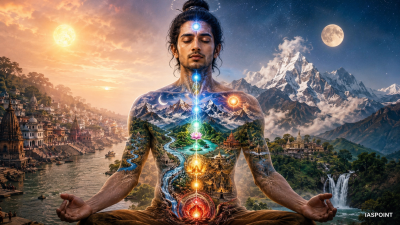
In Indian sacred geography and cultural landscapes, the human body is not viewed merely as a biological entity but as a microcosm of the universe (Pindande Brahmanande). This concept posits that the physical landscape—rivers, mountains, and celestial bodies—exists internally within the human anatomy. This “interiorization of geography” is a cornerstone of Tantric, Yogic, and Puranic traditions, bridging the gap between the individual (Jivatma) and the cosmic (Paramatma).
Philosophical Foundations: Macrocosm and Microcosm
The core philosophy dictates that whatever exists in the external world (Brahmanda) has a corresponding presence in the internal body (Pinda). This creates a “Sacred Anatomy” where the practitioner maps the external sacred landscape onto their own physical form.
- Mount Meru and the Spine: In Indian cosmology, Mount Meru is the Axis Mundi or the center of the universe. In the human body, the vertebral column (Brahmadanda or Merudanda) is identified as Mount Meru, serving as the central axis for spiritual energy.
- The Three Sacred Rivers: The external confluence (Sangam) of the Ganga, Yamuna, and Saraswati is mapped onto the three primary Nadis (energy channels):
- Ida: Corresponds to the Moon and the river Ganga.
- Pingala: Corresponds to the Sun and the river Yamuna.
- Sushumna: Corresponds to the hidden river Saraswati, located within the central spinal canal.
Mapping the Internal Sacred Landscape
The human body is conceptualized as a landscape filled with “internal Tirthas” (sacred crossing places). Practitioners believe that visiting these internal sites through meditation is as meritorious as physical pilgrimage.
The Six Chakras as Sacred Sites
Each energy center or Chakra is associated with specific elements and often mapped to external geographic locations or divine abodes:
| Chakra Name | Element | Body Location | Sacred Association |
| Muladhara | Earth | Base of Spine | The Foundation; associated with Ganesha. |
| Svadhishthana | Water | Sacrum | The seat of the Self; associated with the primordial waters. |
| Manipura | Fire | Navel | The City of Jewels; internal sacrificial fire (Agni). |
| Anahata | Air | Heart | The “unstruck” sound; associated with the vastness of space. |
| Vishuddha | Ether | Throat | The center of purity and cosmic vibration. |
| Ajna | Mind | Between Eyebrows | The internal Kashi (Varanasi); the meeting point of Ida, Pingala, and Sushumna. |
| Sahasrara | Consciousness | Crown of Head | The Thousand-Petal Lotus; the abode of Shiva/Pure Consciousness. |
Body as a Temple (Kaya-Sadhana)
The “Body as Geography” concept is best exemplified in the South Indian Bhakti movement and Tantric rituals, where the body is treated as a living shrine.
- Temple Architecture: The Vastu Purusha Mandala, the foundational grid for Hindu temples, represents the cosmic man. The temple’s parts correspond to the human body: the Garbhagriha (sanctum sanctorum) is the head or heart, the Gopuram (gateway) represents the feet, and the Shikhara (spire) represents the crown.
- Nyasa Rituals: In various Hindu rituals, the practitioner performs Nyasa, which involves touching different parts of the body while chanting mantras to “place” deities, stars, or sacred geography onto their physical limbs.
- Kaya-Sadhana: In Nath Siddha and Sahajiya traditions, the body is the primary laboratory. They believe the “Nectar of Immortality” (Amrita) is stored in the moon (the head) and must be preserved from the sun (the navel/digestive fire).
Geographic Equivalents in Indian Traditions
Various texts provide direct correlations between specific Indian regions and the human anatomy, reinforcing the idea of India as a sacred, living body (Bharat Mata).
- Varanasi (Kashi): Traditionally identified with the Ajna Chakra. The city itself is bounded by the rivers Varuna and Asi, which are seen as the Ida and Pingala of the city’s “body.”
- The Shakti Peethas: According to the Puranic myth of Sati, her body parts fell across the subcontinent, transforming the physical geography into a goddess’s anatomy. For example, Kamakhya (Assam) represents the womb (Yoni), while Jwalamukhi (Himachal) represents the tongue.
- Sri Chakra: In Sri Vidya traditions, the complex geometric Sri Yantra is mapped both onto the cosmos and the human body, making the body a residence for the Goddess Lalita Tripurasundari.
Significance for UPSC Aspirants
- Cultural Continuity: This concept explains why pilgrimage (Tirthayatra) is often paired with internal meditation; the external journey is a reflection of the internal ascent of Kundalini.
- Art and Iconography: Understanding the body as geography is essential to interpreting Indian sculpture and dance (like Bharatanatyam or Odissi), where the body’s geometry mirrors cosmic order.
- Environmental Ethics: By viewing the earth’s rivers and mountains as extensions of one’s own body, traditional Indian thought fostered a deep-seated ecological sanctity.
Trivia: The Internal Pilgrimage
- The Kashi of the Head: Many Yogic texts state that if one cannot travel to the physical city of Varanasi, meditating on the space between the eyebrows (the Bhru-madhya) provides the same spiritual benefit, as this is the “Internal Kashi.”
- Rivers in the Limbs: Ancient Ayurvedic and Yogic texts claim there are 72,000 Nadis in the human body, often described with the same terminology used for the river systems of the Indian subcontinent.