
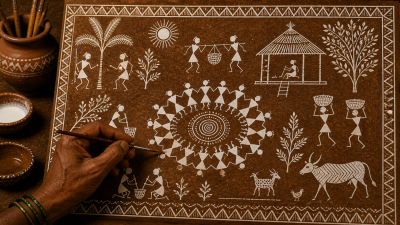
Warli painting is a vivid expression of tribal heritage, originating from the North Sahyadri Range in Maharashtra. Practiced primarily by the Warli tribe, one of India’s largest scheduled tribes, this art form dates back to the 10th century AD, though it only gained international recognition in the 1970s through the efforts of Jivya Soma Mashe. Unlike the courtly arts of the Mughal or Rajput traditions, Warli is a rudimentary, folk-style wall painting (Bhitti Chitra) that eschews mythological narratives in favor of daily life, social rituals, and the tribe’s deep-seated animistic beliefs.
The Geometry of Nature: Artistic Elements
The fundamental philosophy of Warli art is rooted in the observation of nature. The artists utilize basic geometric shapes to represent the world around them, creating a sophisticated visual language through simplicity.
- The Circle: Representing the sun and the moon, symbolizing the cyclical nature of time and life.
- The Triangle: Derived from the shape of mountains and pointed trees. In human figures, two inverted triangles represent the torso and the lower body, joined at the tip to symbolize the precarious balance of the universe.
- The Square: Unlike the circle and triangle, the square is considered a human invention. It represents a piece of land or a sacred enclosure (Chauk).
Materials and Traditional Techniques
The authenticity of Warli art is defined by its austere palette and organic materials. Traditionally, these paintings were executed by women (Suhasinis) during wedding ceremonies.
- The Canvas: The background is prepared using a mixture of mud, cow dung, and red clay (Geru), providing a dark, earthy ochre base.
- The Pigment: Only one color is used—white. This paste is created by grinding rice into a fine powder and mixing it with water and a binding agent like gum.
- The Tools: Instead of synthetic brushes, artists use chewed bamboo twigs (Baharu) to achieve the characteristic textured line work.
Iconic Themes and Symbols
Warli art acts as a communal record of the tribe’s history and relationship with the environment. It rarely depicts religious deities, focusing instead on the “Great Mother” and communal harmony.
- The Tarpa Dance: This is the most recognizable Warli motif. Men and women hold hands and move in a spiral formation around a musician playing the Tarpa (a wind instrument). The spiral represents the circle of life with no beginning and no end.
- The Chauk (Sacred Square): Predominantly seen in Lagna Chauk (wedding paintings). Inside the square is the Goddess Palaghata, the goddess of fertility.
- Agricultural Cycles: Detailed depictions of sowing, harvesting, and hunting, showing a rhythmic movement of figures.
- Flora and Fauna: Snakes, birds, and trees like the Peepal are frequently illustrated, signifying the tribe’s respect for all living beings.
Comparison: Warli vs. Other Tribal Traditions
| Feature | Warli Art (Maharashtra) | Saura Art (Odisha) | Madhubani (Bihar) |
| Primary Shapes | Geometric (Triangles/Circles) | Geometric (Similar to Warli) | Elaborate, curved lines |
| Color Palette | Monochromatic (White on Red) | Monochromatic (White on Red) | Multi-colored (Natural dyes) |
| Key Distinction | Two triangles joined at a point | Figures have less defined “waists” | Intricate double borders |
| Themes | Social life and Nature | Religious and Idital (Icons) | Mythological and Ritualistic |
Evolution and Contemporary Status
While traditionally a mural art, Warli has transitioned to paper, cloth, and various lifestyle products to meet modern demand.
- Jivya Soma Mashe: Known as the father of modern Warli art, he shifted the medium from ritualistic wall paintings to a form of personal artistic expression on paper and canvas, receiving the Padma Shri for his contribution.
- Geographical Indication (GI): Warli Painting was granted the GI tag in 2014, recognizing the Intellectual Property rights of the tribal practitioners in Maharashtra.
- Modern Utility: Today, Warli motifs are extensively used in the textile industry, particularly in the “Warli Silk” sarees, and in modern architecture as decorative installations.
Fact Sheet for UPSC Prelims
- Tribal Identification: Primarily the Warli, Malkhar Koli, Kathodi, and Kokana tribes.
- Regional Hubs: Palghar, Dahanu, Talasari, and parts of Nashik and Dhule districts in Maharashtra.
- Concept of Palaghata: Unlike mainstream Hinduism, the central deity in Warli art is a fertility goddess, not a Vedic god.
- Lack of Perspective: Warli art is two-dimensional; there is no use of shadows or linear perspective to create depth.
- Social Awareness: Modern Warli artists often include contemporary themes such as school buses, bicycles, and environmental conservation in their traditional style to reflect changing times.