
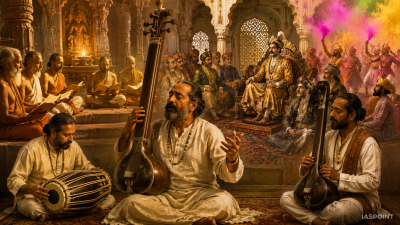
Dhrupad is the oldest surviving form of Hindustani classical music, tracing its roots to the Vedic period through the chanting of Samaveda. Its name is derived from the Sanskrit words Dhruva (fixed) and Pada (text/verse), signifying a rigid structural discipline. While it originated in temples as a form of worship (Haveli Sangeet), it reached its zenith in the Mughal courts, particularly under Emperor Akbar. Dhamar is a closely related style, often considered a rhythmic and thematic variation of Dhrupad, specifically associated with the Holi festival and the Braj region.
Core Characteristics of Dhrupad
Dhrupad is characterized by its somber, majestic, and deeply meditative quality. Unlike Khayal, it avoids intricate flourishes like Taans or Murkis, focusing instead on the purity of the Swaras (notes).
- Structure: A standard Dhrupad performance consists of two main parts: the Alap (unaccompanied, slow invocation) and the Bandish (the composed poem).
- Compositional Parts: The composition is typically divided into four parts: Sthayi (first verse), Antara (second verse), Sanchari (third verse), and Abhoga (concluding verse).
- Language: Most compositions are written in Braj Bhasha, Sanskrit, or medieval Hindi.
- Accompaniment: Traditionally, Dhrupad is accompanied by the Pakhawaj (a two-sided barrel drum) rather than the Tabla. The Tanpura provides the melodic drone.
The Four Vanis (Styles) of Dhrupad
During the reign of Akbar, Dhrupad was categorized into four distinct Vanis or stylistic lineages, based on the specific aesthetic and regional influences of the performers.
| Vani | Founder | Characteristics |
| Gauhar Vani | Tansen | Emphasizes melody and the use of the Shuddha (pure) notes. It is known for its graceful and fluid transitions. |
| Khandar Vani | Raja Samokhan Singh | Known for its robust and forceful style, with a heavy emphasis on rhythm and complex ornamentation. |
| Nauhar Vani | Srichand | Characterized by quick, jumping movements of notes and a vigorous melodic structure. |
| Dagur Vani | Brajchand | Focuses on delicacy, intricate Alap, and a highly refined, meditative approach to melody. |
Dhamar: The Rhythmic Counterpart
Dhamar is a distinct genre that shares the structural DNA of Dhrupad but differs in its rhythmic cycle and thematic content.
- Thematic Focus: Dhamar compositions predominantly describe the Leela (play) of Krishna and Radha, specifically the celebrations of Holi.
- Rhythmic Cycle: It is performed exclusively in the Dhamar Taal, which consists of 14 beats arranged in a unique 5+2+3+4 pattern.
- Performance Style: While Dhrupad is rigid, Dhamar allows for more rhythmic playfulness (Layakari) and syncopation, reflecting the joyous nature of the spring festival.
Prominent Gharanas and Lineages
The tradition of Dhrupad is preserved today by a few dedicated lineages.
- Dagar Gharana: The most prominent surviving lineage today, known for its emphasis on the long, elaborate Alap. Major proponents include the Dagar Brothers and Ustad Wasifuddin Dagar.
- Bishnupur Gharana: Originating in West Bengal, this school maintained the purity of Dhrupad even as Khayal became popular elsewhere.
- Darbhanga Gharana: A major school from Bihar (Mallick family) that emphasizes the Layakari (rhythmic improvisation) and the vigorous use of the Pakhawaj.
- Betiya Gharana: Another significant tradition from Bihar, known for its extensive repertoire of compositions.
Technical Comparison: Dhrupad vs. Khayal
| Feature | Dhrupad | Khayal |
| Origin | Ancient/Temple (Vedic) | Medieval/Courtly (Persian influence) |
| Mood | Solemn, Spiritual, Heroic | Romantic, Emotional, Decorative |
| Percussion | Pakhawaj | Tabla |
| Improvisation | Linear, structured Alap | Complex Taans and Sargams |
| Structure | 4-part composition | 2-part composition (Sthayi and Antara) |
Essential Facts for UPSC Prelims
- Tansen’s Contribution: Tansen was a master of the Gauhar Vani and is credited with creating several Ragas specifically suited for the Dhrupad style, such as Miyan ki Malhar.
- Haveli Sangeet: This is a form of Dhrupad practiced in the temples of the Vallabh Sampradaya (Nathdwara, Rajasthan), where music is offered as Seva (service) to the deity.
- Instruments: Apart from the Pakhawaj, the Rudra Veena is the primary melodic instrument associated with the Dhrupad tradition.
- UNESCO Recognition: While Dhrupad itself is not on the Intangible Cultural Heritage list, it is considered the foundational bedrock of all North Indian classical music traditions recognized globally.
- Language Shift: Over centuries, Dhrupad transitioned from Sanskrit hymns to Braj Bhasha poetry, making it more accessible to the courtly audiences of the medieval era.