
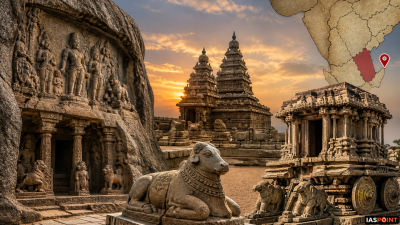
The Pallava dynasty (6th to 9th century CE) marked a transition in South Indian temple architecture from ephemeral materials like wood and clay to permanent stone. This era is divided into two distinct phases: the Rock-cut phase (Mahendra and Mamalla groups) and the Structural phase (Rajasimha and Nandivarman groups). The rock-cut sculptures are primarily concentrated in the Tondaimandalam region, specifically at Mahabalipuram (Mamallapuram).
The Mahendra Group (600–630 CE)
This initial stage, pioneered by Mahendravarman I, introduced the concept of “Mandapas” or pillared halls excavated into hill faces.
- Key Characteristics: These structures are characterized by their simplicity and lack of intricate external ornamentation. The focus was on the internal pillars.
- Pillar Design: The pillars are typically massive, square at the top and bottom with an octagonal shaft in the middle.
- Major Examples:
- Mandagapattu: Home to the famous inscription where Mahendravarman I claims to have built a temple without brick, timber, metal, or mortar.
- Mahendravadi: A single-cell Vishnu temple excavated from a free-standing boulder.
- Trichy Rock-cut Temple: Notable for the “Gangadhara” relief, depicting Shiva receiving the River Ganga.
The Mamalla Group (630–668 CE)
Under Narasimhavarman I (Mamalla), the architecture evolved from simple caves to monolithic “Rathas” and sophisticated bas-reliefs.
- The Five Rathas (Pancha Pandava Rathas): These are monolithic shrines carved out of a single granite boulder. Despite the name, they have no historical link to the Mahabharata but represent various styles of temple roofs.
- Arjuna’s Penance / Descent of the Ganges: This is one of the largest open-air bas-reliefs in the world. It depicts two interpretations: Arjuna performing penance to obtain the Pasupata weapon or Bhagiratha’s effort to bring the Ganges to Earth.
| Ratha Name | Architectural Style | Notable Features |
| Dharmaraja Ratha | Square (Vimana) | Largest Ratha; features three tiers and early representations of Somaskanda. |
| Bhima Ratha | Rectangular (Gabled) | Modeled after a Buddhist Chaitya hall; notable for its longitudinal roof. |
| Arjuna Ratha | Square | Similar to Dharmaraja Ratha but smaller; decorated with fine carvings of gods and humans. |
| Sahadeva Ratha | Gajaprishtakara | Elephant-back shaped (apsidal) design; stands next to a life-size stone elephant. |
| Draupadi Ratha | Kutagara | Simplest form; resembles a village thatched hut with a square plan. |
Iconography and Sculptural Style
Pallava sculptures are distinguished by their slender forms, elongated limbs, and restrained ornamentation compared to later Chola art.
- Somaskanda Panels: A recurring motif depicting Shiva, Parvati, and the infant Skanda. This became a hallmark of Pallava religious art.
- Dvarapalas: The “Gatekeepers” are depicted in various poses, often resting on massive clubs, showing a transition from two-armed to four-armed figures.
- Animal Statuary: The Pallavas were masters at depicting animals with realism. The Mahabalipuram complex features life-size elephants, monkeys picking lice, and a cow being milked (Krishna Mandapa).
Significant Sculptural Reliefs
The Mamallapuram site hosts several masterpieces that are crucial for UPSC Prelims understanding of iconographic details.
- Mahishasuramardini Mandapa: Features a dynamic relief of Goddess Durga sitting on a lion, battling the buffalo-demon Mahishasura. It is praised for its sense of movement and “Chiaroscuro” (play of light and shadow).
- Varaha Mandapa: Contains four major panels: Varaha lifting Bhu Devi, Vamana (Trivikrama), Gaja Lakshmi, and Durga.
- Krishna Mandapa: Houses a massive relief depicting Krishna lifting Mount Govardhana to protect the villagers from Indra’s storm.
Technical and Archaeological Facts for Prelims
- Material: Almost all Pallava rock-cut structures are carved from hard Granite, which explains their longevity and the “crispness” of the relief work.
- UNESCO Status: The Group of Monuments at Mahabalipuram was designated a UNESCO World Heritage site in 1984.
- Evolution of Pillars:
- Mahendra Style: Heavy, square pillars.
- Mamalla Style: Slender pillars with “Lion bases” (Vyala), where the lion is shown sitting (Simhapada).
- Inscriptions: Pallava sculptures often carry titles (Birudas) of the kings in Pallava-Grantha script, such as Vichitrachitta (Curious-minded) and Mattavilasa (Addicted to enjoyment).
Trivia and Unique Observations
- The Dharmaraja Ratha contains the earliest known portrait of a Pallava king (Narasimhavarman I) in stone.
- The Sahadeva Ratha is intentionally placed next to a monolithic elephant to mirror its apsidal (Gajaprishta) shape, which literally translates to “elephant’s back.”
- Unlike the Ellora caves, which were excavated downwards into basaltic traps, the Pallava caves were cut horizontally into the granite hills of the Coromandel Coast.