
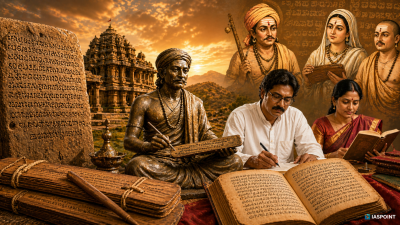
Kannada literature, one of the oldest living languages in India, boasts a rich heritage spanning over 1,500 years. Recognized as a Classical Language by the Government of India in 2008, its evolution is categorized into three distinct phases: Old Kannada (Halegannada), Middle Kannada (Nadugannada), and Modern Kannada (Hosagannada).
The Pre-Classical and Classical Foundations (Up to 10th Century)
The earliest documented evidence of Kannada writing is the Halmidi Inscription (450 CE). However, the formal literary tradition began with works on grammar and poetics.
Kavirajamarga and Early Pioneers
- Kavirajamarga (850 CE): Attributed to the Rashtrakuta King Amoghavarsha I, it is the earliest available literary work in Kannada. It serves as a treatise on poetics, rhetoric, and grammar, providing a glimpse into the cultural geography of the Kannada-speaking region.
- Vaddaradhane (9th Century): Written by Shivakotiacharya, this is the earliest extant prose work in Kannada, containing 19 stories based on Jain mythology and ethics.
The Golden Age: The “Three Gems” of Kannada Literature
The 10th century, under the patronage of the Rashtrakutas and Western Chalukyas, is considered the “Golden Age.” This era was dominated by Jain writers who perfected the Champu style (a mix of prose and poetry).
The Ratnatraya (Three Gems)
| Poet | Major Works | Significance |
| Pampa | Adipurana, Vikramarjuna Vijaya (Pampa Bharata) | Known as Adikavi. He blended Jain philosophy with Indian epics. |
| Ponna | Shantipurana | Honored with the title Kavichakravarti (Emperor among poets). |
| Ranna | Ajitapurana, Gada Yuddha | Master of the “Gada Yuddha,” depicting the duel between Bhima and Duryodhana. |
The Medieval Period: Socio-Religious Movements (12th – 15th Century)
This period saw a shift from court-centric Jain literature to mass-oriented literature driven by the Veerashaiva and Haridasa movements.
Vachana Sahitya (12th Century)
The Vachana movement, led by Basavanna, Allama Prabhu, and Akka Mahadevi, revolutionized literature by using simple Kannada to preach social equality.
- Vachanas: Short rhythmic prose pieces ending with a signature phrase (Ankitanama) of the poet’s chosen deity.
- Key Contribution: It rejected the caste system and promoted the dignity of labor (Kayaka).
Haridasa Sahitya and Dasa Sahitya
The Bhakti movement in Karnataka saw the rise of Vaishnava saint-poets who composed devotional songs called Kirtanas.
- Purandara Dasa: Known as the Pitamaha (Grandfather) of Carnatic Music.
- Kanakadasa: Famous for works like Ramadhanya Charitre, which used the allegory of grains to critique class distinctions.
Literary Patronage under Vijayanagara and Mysore Kingdoms
The Vijayanagara Empire (14th–16th century) was a melting pot of Sanskrit and Kannada scholarship.
- Kumaravyasa: Authored the Karnata Bharata Kathamanjari (popularly known as Gadugina Bharata). It was written in the Bhamini Shatpadi meter and remains the most popular version of the Mahabharata in Kannada.
- Ratnakaravarni: Wrote Bharatesha Vaibhava, a masterpiece in the Sangatya meter, balancing spiritual and worldly themes.
The Modern Era: Hosagannada (19th Century – Present)
Influenced by the English Romantic movement and the Indian National Movement, modern Kannada literature branched into several genres.
Major Literary Movements
- Navodaya (Renaissance): Transitioned to lyrical poetry and short stories. Key figure: B.M. Srikanthayya (English Geethagalu).
- Pragatisheela (Progressive): Focused on social realism and the plight of the downtrodden. Led by A.N. Krishna Rao (Anakru).
- Navya (Modernist): Explored human psychology and existentialism. Key figures: Gopalakrishna Adiga, U.R. Ananthamurthy.
- Dalit and Bandaya: Focused on protest literature and the experiences of marginalized communities.
Facts and Trivia for UPSC Prelims
- Jnanpith Awards: Kannada has received 8 Jnanpith Awards, the second-highest for any Indian language (after Hindi).
- Recipients include: Kuvempu, D.R. Bendre, Shivaram Karanth, Masti Venkatesha Iyengar, V.K. Gokak, U.R. Ananthamurthy, Girish Karnad, and Chandrashekhara Kambara.
- Kuvempu: The first Kannada writer to receive the Jnanpith. He authored the epic Sri Ramayana Darshanam and the state anthem Jaya Bharata Jananiya Tanujate.
- First Printing: The first printed Kannada book was a translation of the Bible (1817) by William Carey at the Serampore Mission.
- Sarvajna: A medieval poet famous for his Tripadi (three-line) poems, covering ethics and social wisdom.
Summary of Literary Forms
- Champu: Mixed prose and verse (Old Kannada).
- Shatpadi: Six-line stanza (Medieval Kannada).
- Tripadi: Three-line stanza (Folk and Sarvajna).
- Sangatya: Compositions meant to be sung with a musical instrument.