
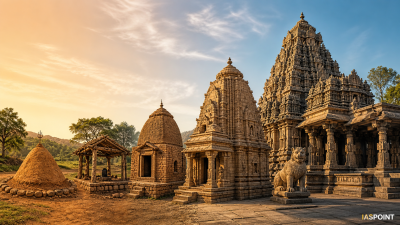
The Hindu temple, or Devalaya, evolved over two millennia from simple open-air mounds to the complex, multi-storied stone edifices seen across India. This architectural journey is categorized by the transition from perishable materials (wood, clay) to permanent stone, the emergence of specific regional styles, and the perfection of structural engineering.
The Five Stages of Temple Evolution (Gupta Era)
The Gupta period (4th–6th century CE) was the “Crucible of Temple Architecture,” where the basic elements were standardized across five developmental phases.
- Stage I: Characterized by flat-roofed, square temples with shallow pillars and a low platform. Example: Temple 17 at Sanchi.
- Stage II: Similar to Stage I but built on higher platforms (Upapitha). Some examples featured a covered ambulatory passage (Pradakshina Patha) around the sanctum. Example: Parvati Temple at Nachna Kuthara.
- Stage III: The most significant shift, where the flat roof was replaced by a curvilinear tower called a Shikhara. The Panchayatana layout emerged here (one main shrine with four subsidiary shrines). Example: Dashavatara Temple, Deogarh.
- Stage IV: Temples became more rectangular, featuring a barrel-vaulted roof. Example: Ter Temple (Maharashtra).
- Stage V: Introduced circular temples with shallow rectangular projections. Example: Maniyar Math, Rajgir.
Core Architectural Components of a Hindu Temple
Regardless of style, almost all Hindu temples share these fundamental structural elements:
- Garbhagriha: The “Womb House,” a cave-like sanctum housing the main deity. It is always a square chamber.
- Mandapa: The entrance porch or pillared hall where devotees gather for prayers.
- Shikhara / Vimana: The mountain-like spire over the Garbhagriha. In North India, it is called Shikhara; in South India, it is called Vimana.
- Amalaka: A stone disc with ridges on top of the Shikhara (North Indian style).
- Kalasha: The topmost point of the temple, often a golden or stone pot.
- Antarala: A vestibule or small transition space between the Garbhagriha and the Mandapa.
- Jagati: The raised platform on which the temple is constructed.
The Nagara Style (North Indian School)
Developed between the 7th and 14th centuries, the Nagara style is characterized by the absence of boundary walls and the presence of multiple Shikharas.
Distinctive Features
- Panchayatana Layout: The main shrine is surrounded by four smaller shrines.
- Shikhara Shapes:
- Rekha-Prasada: Square base with walls curving inward to a point.
- Phamsana: Broader base, shorter height, composed of several slabs rising upwards.
- Valabhi: Rectangular base with a wagon-vaulted roof.
- River Goddesses: Images of Ganga and Yamuna are carved at the entrance of the Garbhagriha.
Sub-Schools of Nagara Style
| Sub-School | Region | Key Features | Notable Example |
| Odisha School | Odisha | Exterior is lavishly carved; interior is plain. Shikharas are called Deuls. | Lingaraja Temple, Konark Sun Temple |
| Khajuraho School | Central India | Built by Chandelas. High focus on erotic sculptures and interior carvings. | Kandariya Mahadev Temple |
| Solanki School | Gujarat/Rajasthan | Built by Solanki rulers. Use of step-tanks (Surya-kund) and lack of carvings on inner walls. | Modhera Sun Temple |
The Dravida Style (South Indian School)
Perfected under the Pallavas, Cholas, Pandyas, and Vijayanagara rulers, this style is known for its monumental gateways and massive enclosures.
Distinctive Features
- Vimana: A pyramid-shaped tower with several stories (talas) instead of the curvilinear North Indian Shikhara.
- Gopuram: Massive, highly decorated entrance gateways that often dwarf the main temple tower.
- Dvarapalas: Fierce “Door Guardians” replace the river goddesses seen in the North.
- Water Tanks: A large ritual water tank (Temple Tank) is located within the enclosure.
- Pillared Halls: Thousands of pillars with intricate carvings (Kalyana Mandapa).
Major Dynastic Contributions
- Pallavas: Pioneered rock-cut Rathas (Mahabalipuram) and structural temples (Shore Temple).
- Cholas: Reached the zenith of Dravidian architecture. Example: Brihadisvara Temple, Thanjavur (the Vimana’s shadow never falls on the ground at noon).
- Vijayanagara: Introduced the Amman Shrine and secular themes in carvings. Example: Vittala Temple, Hampi.
The Vesara Style (Hybrid School)
The Vesara style emerged in the Deccan region under the Chalukyas of Badami, Rashtrakutas, and Hoysalas. It represents a synthesis of Nagara and Dravida elements.
Distinctive Features
- Shape: Combines the Nagara Shikhara with the Dravida Vimana.
- Stellate Plan: Many temples (Hoysala) are built on a star-shaped platform, providing more surface area for carvings.
- Intricate Polish: Hoysala temples utilized soft soapstone (Chloritic Schist), allowing for jewelry-like precision in stone carving.
- Examples: Lad Khan Temple (Aihole), Kailashnath Temple (Ellora), and Hoysaleswara Temple (Halebidu).
Comparative Overview: Nagara vs. Dravida
| Feature | Nagara Style | Dravida Style |
| Tower Shape | Curvilinear (Shikhara) | Pyramidal (Vimana) |
| Gateways | Generally modest | Grand and towering (Gopurams) |
| Boundary Walls | Mostly absent | Essential and fortified |
| Water Tank | Not necessarily within temple | Usually found inside the complex |
| Pedestal | High platform (Jagati) | Built on the ground level or low base |
Key Facts and Trivia for UPSC Aspirants
- Nagara’s Evolution: The earliest Nagara temple with a Shikhara is the Dashavatara Temple at Deogarh (UP).
- Sun Temples: There are three major Sun Temples in India: Konark (Odisha), Modhera (Gujarat), and Martand (Kashmir).
- Monolithic Marvel: The Kailasa Temple at Ellora (Cave 16) is a Dravidian style temple located in North-Western India, carved out of a single rock from top to bottom.
- The Chola Shikhara: Unlike Nagara temples where the Shikhara is a single block, the Chola Vimana is made of multiple receding tiers.
- Erotic Art: Only about 10% of sculptures at Khajuraho are erotic; the rest depict daily life, war, and spiritual themes.
- Nandis: In Dravidian temples, a massive monolithic Nandi (bull) is always placed facing the main sanctum.