
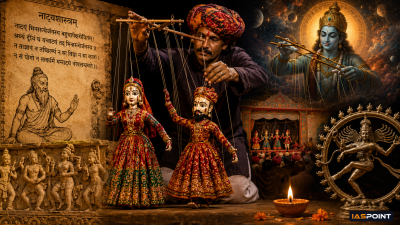
The theoretical framework of Indian puppetry is deeply rooted in ancient Indian aesthetics and philosophy. It is not merely considered a folk art but is viewed as a precursor to classical Indian drama, embodying the concept of the “cosmic puppet” directed by a divine creator.
Connection with Natya Shastra and Classical Drama
The relationship between puppetry and Sanskrit theater is foundational to Indian performance theory.
- The Concept of Sutradhara: In classical Sanskrit drama, the stage manager is called the Sutradhara (literally “the holder of strings”). This terminology strongly suggests that the techniques of string manipulation in puppetry served as the structural template for human theater.
- The Sutra-prota: Ancient texts describe the universe as Sutra-prota (strung on a thread), where the Supreme Being is the puppeteer and living beings are the puppets.
- Vatsyayana’s Kamasutra: This 4th-century CE text lists Pratimala (mechanical dolls) as one of the 64 arts (kalas) that a refined person should master.
- Mahabharata and Bhagavad Gita: These epics use puppet metaphors to explain the concept of Maya (illusion) and Karma, where the human body is a puppet controlled by the three Gunas (qualities).
Categorization and Theoretical Taxonomy
Indian puppetry is classified based on the physics of manipulation, which dictates the narrative style and the visual grammar of the performance.
| Category | Technical Basis | Theoretical Focus | Key Examples |
| Sutradhara (String) | Tension and gravity | Stylized, fluid movement | Kathputli, Gombeyatta |
| Chhaya (Shadow) | Light and optics | Symbolism and flat iconography | Tholu Bommalata, Ravanachhaya |
| Yantra (Rod) | Leverage and verticality | Power and grand gestures | Putul Nautch, Yampuri |
| Hasta (Glove) | Dexterity and intimacy | Rhythmic interaction | Pavakoothu |
The Aesthetic Principles of Puppet Construction
The creation of a puppet follows specific iconographic rules similar to temple sculpture (Shilpa Shastra).
- Symbolism in Color: The colors used on puppets are rarely realistic; they are symbolic. In forms like Pavakoothu, colors follow the Kathakali code: Green (Pacha) for virtuous characters, Red (Katti) for those with vices, and Black (Kari) for demonic figures.
- Anatomical Distortion: Puppets often feature exaggerated features—large eyes for divine gaze and lack of legs in Kathputli to emphasize the “floating” nature of the spiritual world.
- Material Significance: The choice of wood (usually light wood like Gular or Teak) and leather (goat or deer) is governed by regional availability and ritual purity.
Ritualistic and Spiritual Underpinnings
In the Indian tradition, a puppet is not a “dead object” but a vessel for a deity or a spirit during the performance.
- Aparigraha and Prana Pratishtha: Before a performance, a ritual similar to the consecration of an idol (Prana Pratishtha) is often performed to “awaken” the puppet.
- Auspicious Beginnings: Most traditional puppet shows begin with an invocation to Lord Ganesha, the remover of obstacles.
- The Screen as a Veil: In shadow puppetry, the white screen represents the boundary between the material world and the spiritual world, while the lamp represents the soul or divine knowledge.
Socio-Educational Theory: The Vidushaka and Social Critique
The theory of the “Fool” or Vidushaka is central to the narrative structure of Indian puppetry.
- Democratization of Knowledge: Puppetry served as a “Fifth Veda,” making complex metaphysical concepts accessible to the illiterate masses through humor and vernacular languages.
- The Jester’s Freedom: The puppet of the jester (e.g., Hanuman in shadow plays or the local village idiot) has the “theatrical license” to criticize local kings, social injustices, and corruption without fear of retribution, acting as a social safety valve.
Trivia for UPSC Prelims
- First Literary Reference: The Tamil classic Silappadikaram (2nd Century CE) contains the earliest clear literary mention of marionettes.
- Regional Epics: While the Ramayana and Mahabharata are universal, specific regions use local texts; for example, Ravanachhaya in Odisha specifically follows the Bichitra Ramayana.
- The Ashokan Era: Some historians believe Emperor Ashoka used puppeteers as “Dhamma Mahamattas” to propagate Buddhist teachings across his empire.
- The Sangeet Natak Akademi: This is the nodal agency under the Ministry of Culture that oversees the preservation of these traditional units through its “Puppetry Section.”