
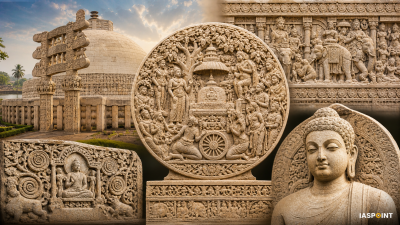
The Amaravati School (2nd Century BCE – 3rd Century CE) represents the indigenous southern tradition of Indian sculpture. Developed in the Vengi region between the lower valleys of the Krishna and Godavari rivers, it flourished under the patronage of the Satavahana Dynasty and later the Ikshvaku Kings. Unlike the individualistic statues of the North, Amaravati is renowned for its “Narrative Art,” transforming the Great Stupa (Mahachaitya) into a visual encyclopedia of Buddhist lore.
Geographic and Artistic Context
- Regional Centers: While Amaravati was the primary hub, other significant sites included Nagarjunakonda, Jaggayyapeta, Goli, and Ghantasala.
- Material: The school is synonymous with the use of White Marble (physically white limestone), which allowed for intricate, deep-cut carvings and a luminous finish.
- Religious Affiliation: Though predominantly Buddhist, the school remained purely indigenous, showing no influence from the Greco-Roman styles of the Northwest.
Distinctive Features of Amaravati Sculpture
The Amaravati style is celebrated for its dynamism, emotional expressiveness, and “crowded” compositions that capture the vibrancy of life.
- Narrative Medallions: The most characteristic feature is the use of circular reliefs or “medallions” on the railings (vedika) and slabs, depicting complex Jataka stories in a sequential, cinematic manner.
- Physical Idealism: The figures are typically slender, long-limbed, and characterized by a sense of movement. The “Tribhanga” (triple-bend) posture is frequently employed to denote grace and fluid motion.
- Emotional Depth: Sculptures go beyond mere anatomical accuracy to depict intense human emotions—devotion, anger, sorrow, and joy—often in the same panel.
- Horror Vacui: The compositions are densely packed with figures (monks, devotees, animals, and celestial beings), leaving very little empty space, which reflects the chaotic beauty of nature and society.
The Evolution of Buddha’s Iconography
Amaravati represents a unique transitional phase in the representation of the Buddha.
- Aniconic to Iconic: Early Amaravati art represented Buddha through symbols (Footprints, Bodhi Tree, Empty Throne). However, as Mahayana influence grew, human representations of the Buddha became common, though they remained integrated into narrative scenes rather than standing as isolated cult images.
- Ayaka Pillars: A feature unique to the Andhra stupas. These are five square pillars projecting from the drum (medhi) at the four cardinal points. They symbolize the five major events in Buddha’s life: Birth, Renunciation, Enlightenment, First Sermon, and Mahaparinirvana.
Comparison: Amaravati vs. North Indian Schools
| Feature | Amaravati School | Mathura School | Gandhara School |
| Patronage | Satavahanas & Ikshvakus | Kushanas | Kushanas |
| Primary Material | White Marble (Limestone) | Spotted Red Sandstone | Blue-Grey Schist / Stucco |
| Focus | Narrative & Group Scenes | Individual Statues | Individual Statues |
| Body Type | Slender, lithe, elongated | Fleshy and robust | Muscular and athletic |
| Emotion | High expressive vitality | Smiling and peaceful | Spiritual and somber |
| Key Location | Krishna-Godavari Delta | Yamuna Valley | Northwest Frontier |
Notable Masterpieces and Themes
- The Taming of Nalagiri: A famous relief depicting the Buddha subduing a wild elephant sent by Devadatta. It showcases the school’s ability to depict panic and calm simultaneously.
- The Interpretation of Maya’s Dream: Narrative panels depicting Queen Maya dreaming of a white elephant, symbolizing the conception of Siddhartha.
- Casing Slabs: The dome of the stupa was covered with “Purnaghata” (overflowing vase) motifs and depictions of the stupa itself, providing historians with a visual record of what the architecture looked like originally.
Technical Trivia for UPSC Prelims
- Southward Expansion: The Amaravati style significantly influenced the art of Southeast Asia, particularly the Buddhist sculptures found in Sri Lanka, Thailand, and Indonesia.
- Transition of Power: While the Satavahanas initiated the style, the Ikshvakus at Nagarjunakonda brought it to its final, most ornate stage in the 3rd century CE.
- Discovery: The site was first brought to light by Colonel Colin Mackenzie in 1797. Many of its finest carvings, known as the “Elliot Marbles,” are now housed in the British Museum.
- Secular Life: Amaravati sculptures provide the richest source of information regarding the dress, jewelry, furniture, and city layouts of the Satavahana period.