
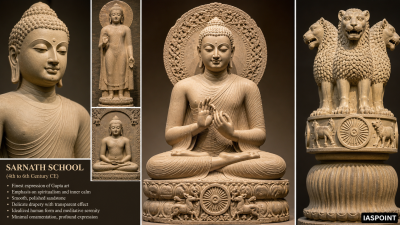
The Sarnath School (4th to 6th Century CE) represents the zenith of the Gupta “Golden Age” in Indian sculpture. Situated near Varanasi, where the Buddha delivered his first sermon, this school moved away from the robust, sensual realism of the Mathura and Kushana traditions toward a style defined by “spiritualism” and “inner calm.” It is considered the most refined expression of the Indian classical ideal, stripping away excessive ornamentation to focus on the luminous quality of the human form.
Distinctive Stylistic Features
The Sarnath school is characterized by an ethereal grace that distinguishes it from its contemporaries in Mathura and Gandhara.
- Use of Material: Sarnath sculptures exclusively utilized Chunar Sandstone, a cream or buff-colored fine-grained stone that allowed for delicate carving and a smooth, almost metallic finish.
- Transparent Drapery: A hallmark of this school is the “wet drapery” effect. The robes are carved with such subtlety that they appear transparent, clinging to the body without any visible fold lines. This is a significant departure from the stringy folds of the Mathura school.
- The Meditative Gaze: Faces are characterized by half-closed eyes (Padmapalasha), symbolizing Dhyana (inward meditation). The expressions are serene, detached, and compassionate.
- Elaborate Halos: While the body of the sculpture remained simple, the Prabhamandala (halo) became highly decorative. It often featured concentric circles of floral patterns, creepers, and beaded borders.
- Snail-Shell Curls: The Buddha is depicted with small, clockwise “snail-shell” curls, which became the standardized iconographic feature for Buddhist art across Asia.
The Iconic Sarnath Seated Buddha
The most celebrated masterpiece of this school is the Dharmachakra-Pravartana Buddha, which serves as a definitive model for Gupta art.
- The Mudra: The Buddha is shown in the Dharmachakra Mudra, symbolizing the “Turning of the Wheel of Law.”
- Iconographic Details:
- The pedestal features a wheel (Chakra) flanked by two deer, representing the Deer Park (Isipatana) at Sarnath.
- Five disciples and a woman with a child are depicted on the base, representing the first congregation.
- The backrest is adorned with Makaras (mythical sea creatures) and Shardulas (leogryphs).
Comparative Analysis: Sarnath vs. Mathura (Gupta Period)
| Feature | Sarnath School | Mathura School (Gupta Phase) |
| Material | Chunar Sandstone (Buff/Cream) | Spotted Red Sandstone |
| Drapery | Plain, transparent, no folds | Diaphanous with string-like folds |
| Halo | Exceedingly ornate and large | Ornate but smaller than Sarnath |
| Physicality | Slender, graceful, and ethereal | Robust, fleshy, and grounded |
| Focus | Inner spiritual bliss | Physical vitality and divinity |
Religious and Secular Scope
While Sarnath was primarily a Buddhist center, the school’s aesthetic principles influenced Brahmanical and Jain art in the surrounding regions.
- Buddhist Imagery: Focused on the life of Buddha and various Bodhisattvas like Avalokiteshvara and Manjusri.
- Brahmanical Influence: The refinement of Sarnath is visible in the depictions of deities like Vishnu and Shiva found in the nearby Gangetic plains, emphasizing the “Sattvic” (pure) quality of the gods.
- Jain Tirthankaras: Sarnath-style Tirthankara images are noted for their rigid Kayotsarga (standing) or Dhyana (seated) postures, characterized by a smooth, unadorned torso and a deep sense of stillness.
Technical Trivia and Prelims Facts
- The Sarnath Canon: The proportions established at Sarnath became the standard “Canon of Proportions” for Buddhist art in Southeast Asia, particularly in the Dvaravati art of Thailand.
- Absence of Muscularity: Unlike the Gandhara school, Sarnath artists consciously avoided depicting muscles or veins, believing that the “Inner Prana” (breath) smoothed out the physical exterior.
- Ushnisha and Urna: The cranial bump (Ushnisha) is prominent, but the Urna (dot on the forehead) is often absent in Sarnath sculptures, marking a stylistic shift.
- Discovery: Most Sarnath masterpieces were unearthed during excavations at the Dhamekh Stupa and Chaukhandi Stupa complexes.
- The Lion Capital: Though the famous Lion Capital is Mauryan, the Sarnath School of the Gupta period occupied the same sacred space, representing a thousand-year continuity of artistic excellence at the site.
Influence and Legacy
The Sarnath school marked the end of the experimental phase of Indian sculpture. By achieving a perfect balance between the physical and the spiritual, it provided a blueprint for the medieval schools that followed. Its influence traveled via the Silk Road to China and through maritime routes to Indonesia, where the classic “Buddha Image” remains heavily indebted to the Sarnath prototype.
Last Modified: May 5, 2026