

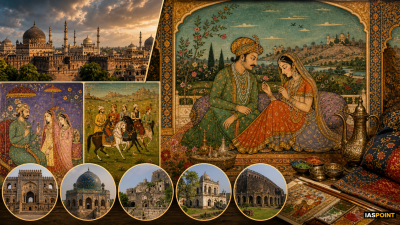
The Deccan Schools of Painting flourished in the plateau region of Southern India between the 16th and 19th centuries. Developing independently from the Mughal School, these traditions were fostered by the five successor states of the Bahmani Kingdom: Ahmadnagar, Bijapur, Golconda, Bidar, and Berar. The Deccani style is a sophisticated synthesis of indigenous South Indian traditions, Vijayanagara mural art, and strong influences from Safavid Persia, Turkey, and later, the Mughal court.
Core Characteristics of Deccani Art
The Deccani style is distinct for its intense sensuality, imaginative color palettes, and preoccupation with the “supernatural” or “dreamlike” qualities of the landscape.
- Vibrant Color Palette: Extensive use of gold and silver, along with “deeper” and more varied blues, greens, and violets compared to the Mughal school.
- Treatment of Landscape: Backgrounds often feature stylized, lush vegetation, colorful flowery meadows, and high horizons.
- Stylized Human Figures: Men and women are depicted with elongated bodies, sharp features, and traditional Deccani costumes like the dhoti or the peshwaz (high-waisted gowns).
- Persian Influence: The influence of the Safavid school is evident in the treatment of clouds, rocky outcrops, and the lyrical quality of the line.
The Major Schools and Regional Centers
| School | Primary Patronage | Landmark Manuscripts/Paintings | Distinctive Features |
| Ahmadnagar | Nizam Shahi Dynasty | Tarif-i-Hussain Shahi | Features Persian-style costumes and Central Indian “Chaurapanchasika” aesthetics. |
| Bijapur | Adil Shahi Dynasty | Nujum-ul-Ulum (Stars of Sciences) | High use of gold; focus on animals (elephants) and cosmic symbolism. |
| Golconda | Qutb Shahi Dynasty | Diwan-i-Hafiz, Tuzuk-i-Asafiya | Richly decorated borders; focus on courtly pomp and tall, slender figures. |
| Hyderabad | Asaf Jahi Dynasty | Ragamala Series | A later evolution (18th century) blending Deccani traditions with Mughal finesse. |
Ahmadnagar School (Nizam Shahi)
The earliest of the Deccani schools, it reached its zenith under Hussain Nizam Shah I.
- Tarif-i-Hussain Shahi: This manuscript (c. 1565) celebrates the Sultan’s victories, including the Battle of Talikota. It is famous for depicting women in the traditional dhoti with a sash, reflecting indigenous South Indian influence.
- Stylistic Traits: The school is noted for its use of “high horizons” and a palette dominated by warm tones like red and yellow.
Bijapur School (Adil Shahi)
Bijapur emerged as the most prolific center of Deccani art, particularly under Ibrahim Adil Shah II (r. 1580–1627), who was a great musician and poet (author of Kitab-i-Nauras).
- Nujum-ul-Ulum (1570): An encyclopedia of magic and sorcery containing 876 miniatures. It depicts various stars, planets, and the “Throne of Prosperity,” a classic Deccani motif.
- Ibrahim Adil Shah II as Patron: He was often depicted playing the Veena or surrounded by musicians, reflecting his title Jagat Guru. His portraits are known for their mystical and somber mood.
- Flora and Fauna: Bijapur artists were masters at depicting elephants with high anatomical precision and spiritual energy.
Golconda School (Qutb Shahi)
Based in the Hyderabad region, this school flourished under the Qutb Shahi rulers and later continued under the Nizams of Hyderabad.
- Persian Connection: Due to direct maritime trade with Persia, the Safavid influence is most pronounced here. The use of gold and elaborate, decorative margins (Hashiyas) is a hallmark.
- The “Tall Figure” Canon: Figures in Golconda paintings are notably taller and more slender than those in other Deccani schools.
- Key Themes: Royal processions, hunting scenes, and romantic depictions of court dancers and musicians.
Comparison: Deccani vs. Mughal School
While contemporary to each other, the two schools differed fundamentally in their artistic philosophy.
| Feature | Mughal School | Deccani School |
| Philosophy | Realistic, historical, and naturalistic. | Romantic, imaginative, and mystical. |
| Colors | Sober and realistic tones. | Brilliant, vivid, and unconventional colors. |
| Atmosphere | Courtly and documentary. | Poetic and dreamlike. |
| Influence | Predominantly Persian and European. | Synthesis of Persian, Turkish, and South Indian. |
The Ragamala and Baramasa Themes
Deccani artists excelled in the visual representation of musical modes (Ragamala) and the twelve months (Baramasa).
- Ragamala Paintings: These series depict different “Ragas” and “Raginis” as human personas. For example, Raga Hindola or Ragini Todi are common subjects, often shown in lush, romanticized Deccan landscapes.
- Cultural Synthesis: These paintings represent the harmonious blending of Persian painting techniques with Indian musical and literary concepts.
Fact-File and Trivia for UPSC Prelims
- Kitab-i-Nauras: A collection of songs in Dakhni Urdu composed by Ibrahim Adil Shah II, which deeply influenced the thematic content of Bijapur paintings.
- European Influence: In the later stages (17th century), Deccani artists at Bijapur and Golconda began incorporating European perspective and globe motifs, likely due to contact with Portuguese and Dutch traders.
- The “Deccani Diction”: The school is famous for its “Dakhni” aesthetics—a unique mix of Arabic, Persian, and local Deccani languages and motifs.
- Farrukh Beg: A famous Mughal artist who spent several years at the court of Bijapur, acting as a bridge between the Mughal and Deccani styles.
- Lapis Lazuli: The Deccani schools used an exceptionally high grade of Lapis Lazuli, resulting in the distinct “Deccani Blue” that has remained vibrant for centuries.
Legacy and Impact
The Deccan Schools played a crucial role in preserving the aesthetic traditions of the South after the fall of Vijayanagara. Following the Mughal conquest of the Deccan (under Aurangzeb), many Deccani artists migrated to the hill states of Northern India, significantly influencing the birth of the Pahari School (particularly Basohli and Guler). Today, these paintings are regarded as some of the most innovative and expressive examples of pre-modern Indian art.
Last Modified: May 4, 2026