
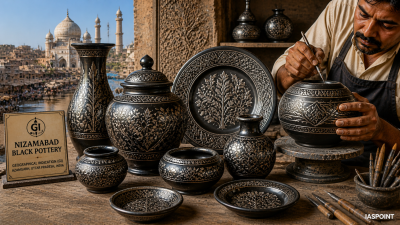
Nizamabad Black Pottery is a unique craft from the Azamgarh district of Uttar Pradesh, distinguished by its dark, lustrous body and intricate silver-colored engravings. This pottery tradition is a rare example of a “clay-based” art form that mimics the appearance of expensive metalwork, specifically Bidriware from the Deccan. Due to its unique geographical origin and specialized technique, it was granted the Geographical Indication (GI) Tag in 2015.
Historical Roots and Persian Influence
The origins of Nizamabad’s black pottery are linked to the migration of artisans during the Mughal era.
- Kutch to Azamgarh Migration: Historical accounts suggest that the craft was brought to Nizamabad by potters from the Kutch region of Gujarat during the reign of Emperor Aurangzeb.
- Evolution of Style: While the Gujarati influence provided the foundation for the terracotta shapes, the distinct black finish and silver-like inlay were developed locally to cater to the aesthetic tastes of the North Indian aristocracy.
The Technical Process: From Clay to Metallic Luster
The production of Nizamabad pottery involves specific chemical reactions during the firing process that differ from standard terracotta.
Material and Shaping
- Local Clay: The artisans use a fine-textured local clay found in the ponds of Azamgarh.
- Wheel Work: The articles are mostly wheel-turned. The walls of the vessels are kept relatively thin to maintain an elegant, metallic appearance.
Achieving the Signature Black Color
- Smoke Firing (Reducing Atmosphere): The pottery is fired in a closed kiln (bhatti) using cow dung and sawdust. By restricting the oxygen supply, the carbon-rich smoke is absorbed into the clay body, turning it deep black throughout.
- Kabiz Slip: Before firing, a special slip called Kabiz—made from soil, bamboo leaves, and certain barks—is applied to provide a smooth, polished surface that enhances the final sheen.
Silver-Mercury Inlay Technique
- Etching: Once the pottery is fired and cooled, geometric and floral patterns are etched onto the black surface using sharp needles.
- The Amalgam: A mixture of zinc, tin, and mercury (sometimes referred to as silver powder) is rubbed into the grooves. This creates a striking contrast between the jet-black ceramic and the shimmering silver lines.
Artistic Features and Common Motifs
The designs on Nizamabad pottery are predominantly inspired by nature and Islamic geometric art.
- Floral Patterns: Intricate vines, creepers (bel), and flower buds are the most common motifs.
- Geometric Precision: Symmetrical lines and circles are used to frame the floral centerpieces.
- Common Forms: The craft is seen in functional and decorative items such as Surahis (long-necked water pots), hookahs, vases, plates, and ornamental lamps.
Comparative Study: Nizamabad vs. Bidriware
| Feature | Nizamabad Black Pottery | Bidriware (Deccan) |
| Base Material | Clay (Ceramic) | Zinc and Copper Alloy (Metal) |
| Coloring Agent | Smoke (Carbon) absorption | Copper Sulphate and Soil paste |
| Inlay Material | Zinc-Tin-Mercury Amalgam | Pure Silver or Gold wires |
| Weight | Lightweight | Heavy (Metallic) |
| Cost | Affordable/Mass market | Luxury/Expensive |
360° Archaeological and Cultural Significance
- Mimicry in Art: Nizamabad pottery is a prime example of “material substitution” in Indian heritage, where potters used affordable clay to replicate the aesthetics of the elite’s metal vessels.
- Livelihood: The craft is concentrated in the Nizamabad town of Azamgarh, involving hundreds of families who have preserved the technique through oral tradition and apprenticeship.
- Export Potential: Due to its sophisticated appearance, Nizamabad pottery has a high demand in international markets, particularly for interior decor and high-end boutiques.
Facts and Trivia for UPSC Prelims
- GI Tag Status: Registered in 2015 (Class 21 – Household or kitchen utensils and containers).
- The Mercury Factor: In the traditional process, mercury was used to help the tin/zinc powder stick to the etched grooves, though modern artisans are exploring safer adhesives for food-grade items.
- Comparison with NBPW: While it shares a “black” color with the ancient Northern Black Polished Ware (NBPW), Nizamabad pottery is a medieval/modern tradition with an added silver-inlay component that NBPW lacked.
- Cultural Symbiosis: The craft represents a blend of Gujarati clay-shaping techniques, Persian decorative motifs, and local Azamgarh chemical knowledge.