
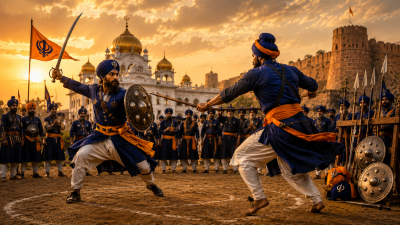
The martial heritage of the Punjab region is characterized by a transition from the ancient, lethal science of Shastar Vidya to the popularized, instructional sport known as Gatka. These traditions emerged as a direct response to the socio-political climate of the 16th and 17th centuries, evolving into a spiritual and physical discipline for the Sikh community.
Shastar Vidya: The Science of Weapons
Shastar Vidya is the precursor to Gatka and represents the comprehensive “Science of Weapons.” It is a complete combat system that incorporates unarmed combat, weaponry, and tactical warfare.
- Philosophical Roots: It is deeply rooted in the concept of the Sant-Sipahi (Saint-Soldier), a philosophy formalized by Guru Hargobind Ji (the sixth Sikh Guru) after the martyrdom of Guru Arjan Dev Ji.
- Akal Sena: Guru Hargobind Ji established the first Sikh standing army and donned two swords: Piri (spiritual authority) and Miri (temporal/martial authority).
- Tactical Focus: Unlike the stylized movements of Gatka, Shastar Vidya focuses on efficiency, utilizing “low-profile” footwork and strikes to vital points to neutralize multiple opponents quickly.
Gatka: The Modern Instructional Art
Gatka is the standardized, performance-oriented version of Sikh martial arts that gained prominence during the British colonial period. The name is derived from the Gatka stick, a wooden stave used for practice.
- Origin of the Term: “Gatka” refers to the wooden stick used in training, which is equipped with a leather hilt (Soti).
- The Golden Age: The art reached its zenith under Guru Gobind Singh Ji, the tenth Guru, who founded the Khalsa in 1699. He mandated the practice of martial arts to ensure the community could defend against oppression.
- The Nihang Sect: The Nihang Sikhs (Akalis) are the traditional custodians of this art form. Known as “The Immortals,” they maintain the original dress, weaponry, and rigorous training schedules of the 17th-century Khalsa.
Core Weapons and Equipment
The arsenal used in Shastar Vidya and Gatka is diverse, ranging from basic wooden staves to complex multi-functional steel weapons.
| Weapon Name | Description | Strategic Use |
| Talwar | The curved single-edged saber. | Primary weapon for slashing and parrying. |
| Khanda | Double-edged straight sword. | Used for heavy hacking; symbolizes the “Creative Power of God.” |
| Chakram | A circular, sharpened steel throwing ring. | Used for long-range engagement; can be worn on the turban (Dastar). |
| Katar | A punch dagger with an H-shaped handle. | Designed for piercing armor in close-quarter combat. |
| Tegh | A heavy, curved sword often used by executioners or for powerful swings. | Relies on momentum and weight. |
| Dhal | A circular shield made of steel or buffalo hide. | Vital for defense against arrows and sword strikes. |
| Baghnakh | “Tiger Claws” made of steel. | Concealed weapon for surprise attacks. |
The Five Components of Gatka Training
Traditional training in Gatka follows a specific pedagogical structure:
- Pantra: The foundation of all movements; it refers to the complex footwork and rhythmic patterns used to maintain balance and agility.
- Soti: Training with the wooden stick to master the basic six-strike and parry sequence.
- Fari: Training with a small leather shield to coordinate defensive and offensive maneuvers.
- Shastar: The transition from wooden tools to live steel weapons.
- Jung-e-Azadi: Mock battles and sparring sessions to test the practitioner’s reflexes.
Historical Suppression and Cultural Resilience
The trajectory of Gatka was significantly altered by British intervention in the 19th century.
- Post-Anglo-Sikh Wars: After the annexation of Punjab in 1849, the British authorities banned the carrying of weapons and the practice of Shastar Vidya to prevent further Sikh uprisings.
- Transition to Sport: To preserve the tradition, the martial practice was “toned down” into a ceremonial and sporting format, which led to the birth of modern Gatka. It became a staple of religious processions (Nagar Kirtans) and festivals like Hola Mohalla.
- Hola Mohalla: Established by Guru Gobind Singh Ji at Anandpur Sahib, this festival serves as a massive annual display of Sikh martial prowess, featuring simulated battles, tent pegging, and Gatka competitions.
Fact File for UPSC Aspirants
- Khelo India Recognition: In 2021, the Government of India officially recognized Gatka as a competitive sport, including it in the Khelo India Youth Games to promote indigenous martial arts.
- The Panj Pyare Connection: The first five initiated Sikhs (Panj Pyare) were required to be proficient in the use of weapons, establishing martial training as a religious duty.
- Symbolism of the Khanda: The Sikh emblem (Khanda) consists of a double-edged sword in the center, a Chakkar (circle), and two single-edged swords (Miri and Piri) on the sides, representing the synthesis of spiritual and temporal power.
- Martial Centers: Anandpur Sahib and Damdama Sahib remain the primary historical centers for the study of traditional Shastar Vidya.
- Holistic Health: The practice is often paired with Naam Simran (meditation) and a strict diet to ensure the practitioner possesses both mental clarity and physical endurance.