
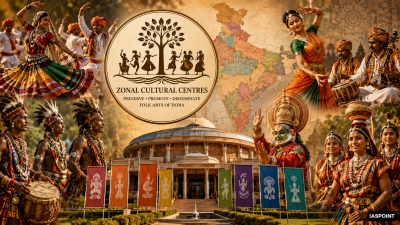
The Zonal Cultural Centres (ZCCs) are a group of seven autonomous organizations established by the Government of India to preserve, promote, and disseminate the traditional folk arts of the country. Conceptualized in 1985 and operationalized between 1985 and 1987, these centres function under the administrative control of the Ministry of Culture. Their primary objective is to strengthen the “cultural bonds” between states and to ensure that people from different regions have access to the diverse heritage of India, particularly the folk and tribal arts that do not receive adequate patronage from the commercial sector.
Geographical Distribution and Headquarters
India is divided into seven cultural zones, each headed by a ZCC. The Governor of the state where the headquarters is located serves as the ex-officio Chairman of that particular ZCC.
| Name of the ZCC | Headquarters | Participating States and Union Territories |
| North Zone (NZCC) | Patiala, Punjab | Punjab, Haryana, Himachal Pradesh, Jammu & Kashmir, Ladakh, Rajasthan, Chandigarh |
| North Central (NCZCC) | Prayagraj, UP | Uttar Pradesh, Madhya Pradesh, Bihar, Rajasthan, Haryana, Delhi, Uttarakhand |
| South Zone (SZCC) | Thanjavur, TN | Tamil Nadu, Andhra Pradesh, Telangana, Karnataka, Kerala, Puducherry, Lakshadweep, Andaman & Nicobar |
| South Central (SCZCC) | Nagpur, Maharashtra | Maharashtra, Madhya Pradesh, Chhattisgarh, Andhra Pradesh, Telangana, Karnataka, Goa |
| East Zone (EZCC) | Kolkata, WB | West Bengal, Bihar, Jharkhand, Odisha, Assam, Tripura, Manipur, Sikkim, Andaman & Nicobar |
| West Zone (WZCC) | Udaipur, Rajasthan | Rajasthan, Gujarat, Maharashtra, Goa, Daman & Diu, Dadra & Nagar Haveli |
| North East (NEZCC) | Dimapur, Nagaland | Assam, Meghalaya, Manipur, Mizoram, Nagaland, Arunachal Pradesh, Tripura, Sikkim |
Core Mandate and Functional Scope
The ZCCs operate on the principle of “territorial functionalism,” ensuring that cultural activities are not confined to urban elite spaces but reach the grassroots.
- Preservation of Endangered Arts: Actively identifying and documenting folk and tribal art forms that are on the verge of extinction.
- Inter-Zonal Exchange: Organizing the Octave festival (for North East culture) and Chalo Loktak to encourage artists from one zone to perform in another.
- Guru-Shishya Parampara: Implementing schemes where veteran masters (Gurus) train youngsters (Shishyas) in rare art forms to ensure the continuity of oral and performative traditions.
- Documentation: Creating a digital repository of folk songs, dance notations, and indigenous craft techniques.
Major Schemes Implemented by ZCCs
To achieve their 360-degree cultural mandate, the ZCCs implement several flagship schemes funded by the Central Government.
National Cultural Exchange Programme (NCEP)
This is the backbone of ZCC activities. Under NCEP, various festivals, workshops, and exhibitions are organized. It facilitates the movement of artists from their home zones to other parts of India, promoting the concept of “Ek Bharat Shreshtha Bharat.”
Shilpgram Scheme
ZCCs maintain “Shilpgrams” (Craft Villages) to provide a platform for rural artisans to showcase and sell their crafts directly to consumers. The most famous is the Udaipur Shilpgram (WZCC) and the Surajkund Mela participation. These villages are designed to replicate the traditional architectural styles of the participating states.
Theatre Rejuvenation Scheme
To promote theatre beyond metropolitan cities, this scheme provides financial assistance to theatre groups and individual artists for stage shows, scriptwriting workshops, and children’s theatre festivals.
Significant Festivals and Initiatives
- Rashtriya Sanskriti Mahotsav (RSM): A flagship festival of the Ministry of Culture organized through ZCCs to showcase the “Mini India” through food, crafts, and performing arts.
- Maati Ke Rang: A mega cultural event organized to celebrate the indigenous flavors of various zones.
- Island Festival: Specifically focused on the cultural integration of the Andaman & Nicobar and Lakshadweep islands with the mainland.
Significance for UPSC Prelims
- Nature of Organization: They are Autonomous Bodies registered under the Societies Registration Act, 1860.
- Chairmanship: The Governor of the host state is always the Chairman, which is a unique administrative feature.
- Focus Area: Unlike the Sahitya Akademi or Sangeet Natak Akademi (which focus on classical forms), ZCCs focus primarily on Folk, Tribal, and Traditional arts.
- Funding: Primarily through “Grant-in-Aid” from the Ministry of Culture and contributions from member states.
- Cultural Overlap: Notice that some states (like Rajasthan, Madhya Pradesh, and Maharashtra) are members of multiple ZCCs. This is to ensure that different cultural pockets within a single state are represented appropriately (e.g., Eastern Maharashtra in SCZCC and Western Maharashtra in WZCC).
Trivia and Key Facts
- The West Zone Cultural Centre (WZCC) manages the Bagore-ki-Haveli museum in Udaipur, which houses the world’s largest turban.
- The East Zone Cultural Centre (EZCC) is the only centre that manages a specialized “Srijani” Shilpgram in Santiniketan.
- The North East Zone Cultural Centre (NEZCC) plays a critical role in the “Look East/Act East” policy by using culture as a tool for soft diplomacy with neighboring regions.
- ZCCs are the implementing agencies for the Lalit Kala Akademi and Sangeet Natak Akademi outreach programmes in rural areas.