
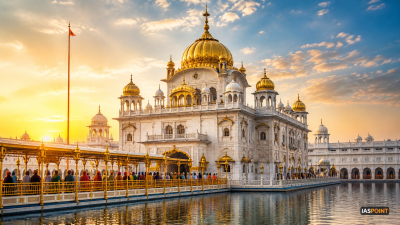
Sikh architecture is a unique and vibrant school of Indian structural design that emerged primarily in the Punjab region. It is characterized by its progressive eclectic nature, drawing heavy inspiration from Mughal and Rajput styles while maintaining a distinct identity rooted in Sikh philosophy. The style is synonymous with the Gurdwara (the Gateway to the Guru), which serves not only as a place of worship but as a community hub symbolizing equality, humility, and openness.
Fundamental Architectural Characteristics
Sikh structures are easily identified by several repeating motifs and functional layouts designed to accommodate the Sikh way of life.
- The Golden Dome: Most Gurdwaras feature a central fluted or ribbed dome, often gilded with gold or covered in white marble, topped with an inverted lotus.
- Multiple Entrances: Traditionally, a Gurdwara features four doors (one on each side), signifying that the house of God is open to everyone regardless of caste, creed, or direction.
- Kiosks (Chhatris): Decorative small pavilions with domes (frequently used at the corners) borrowed from Rajput architecture.
- The Sarovar: A sacred water tank or pool located within the complex, used for ablutions and symbolizing spiritual purification.
- The Nishan Sahib: A tall flagpole covered in fabric and topped with a Khanda (Sikh emblem), marking the presence of a Gurdwara from a distance.
- Internal Layout: The focus is always on the Palki (palanquin) where the Guru Granth Sahib is seated, usually under a Chanani (canopy).
Key Components of a Gurdwara Complex
Unlike many other religious structures, Sikh architecture integrates social utility directly into the design.
- Langar Hall: A large community kitchen and dining hall where free meals are served to all visitors, representing the concept of Pangat (equality).
- Darshani Deori: A monumental gateway or entrance porch that leads to the main sanctum.
- Akal Takht: Traditionally located opposite the main shrine (specifically in the Golden Temple), it represents the seat of temporal authority.
The Pinnacle: Sri Harmandir Sahib (The Golden Temple)
The Harmandir Sahib in Amritsar serves as the definitive masterpiece of Sikh architecture, showcasing the evolution of the style.
- Foundation: The foundation stone was laid by a Sufi Saint, Mian Mir, highlighting the inclusive nature of the faith.
- Site Selection: Unlike Hindu temples built on high platforms, the Golden Temple was built at a lower level than the surrounding land, signifying humility.
- Gilding: The upper floors were covered with gold foil during the reign of Maharaja Ranjit Singh in the early 19th century.
- Artistry: The interior features extensive Frescoes (Mohra Kashi) and floral patterns made of Pietra Dura (Inlay work).
Evolution and Influences
Sikh architecture is often described as a “Mughal-Rajput Synthesis” but with functional adaptations.
| Feature | Influence Source | Sikh Adaptation |
| Domes | Mughal | Fluted/Ribbed design with inverted lotus finials. |
| Jharokhas | Rajput | Used extensively for ventilation and as aesthetic “window-seats.” |
| Foliated Arches | Mughal | Frequently used in the Darshani Deoris and sanctums. |
| Cenotaphs | Rajput | Reimagined as commemorative shrines for martyrs (Shaheed Ganj). |
| Basement | Indigenous | Usage of Tehkhana (cool underground rooms) for summer. |
Notable Examples of Sikh Architecture
- Takht Sri Keshgarh Sahib (Anandpur Sahib): Known as the birthplace of the Khalsa; it features a dominant white structure against the Shivalik hills.
- Gurdwara Bangla Sahib (Delhi): Notable for its massive golden dome and a large sarovar with medicinal properties.
- Gurdwara Hemkund Sahib (Uttarakhand): A rare example of a modern Sikh structure with a pentagonal design, built to withstand heavy snowfall at high altitudes.
- Fatehgarh Sahib: Known for its majestic wall and gateways, commemorating the sacrifice of the younger sons of Guru Gobind Singh.
Important Facts and Trivia for Prelims
- Maharaja Ranjit Singh’s Contribution: He was the primary patron who transformed Sikh architecture from humble brick structures to grand marble and gold monuments.
- Five Takhts: Architecture varies across the five seats of authority: Akal Takht (Amritsar), Keshgarh Sahib (Anandpur), Patna Sahib (Bihar), Hazur Sahib (Nanded), and Damdama Sahib (Talwandi Sabo).
- Frescoes: The walls of older Gurdwaras often feature “Gach” work (gypsum plaster carvings) and “Tukri” work (setting pieces of glass in gypsum).
- The Treasury: The Darshani Deori of the Golden Temple houses historic gates which some traditions link to the gates of Somnath, though this is a subject of historical debate.
- Bunga: These are residential or defensive towers built around the Harmandir Sahib by different Sikh misls (clans) to protect the shrine.