
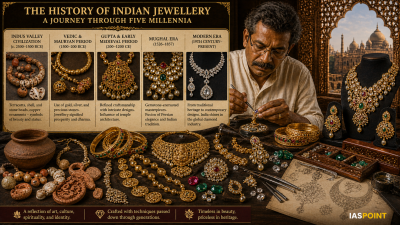
The history of Indian jewellery is a journey through five millennia, reflecting the aesthetic sensibilities and economic prosperity of various eras. It has evolved from the terracotta and shell ornaments of the Indus Valley to the gemstone-encrusted masterpieces of the Mughal era and the contemporary high-end diamond industry.
- Indus Valley Civilization: The earliest evidence comes from Harappa and Mohenjo-Daro, where beads of semi-precious stones (carnelian, agate, turquoise), copper, and gold were used. The famous “Dancing Girl” figurine wears a series of bangles on her arm, indicating the antiquity of the ornament.
- Ancient Period: Texts like the Artha Shastra mention the state’s control over gold and silver smithy. The Kushana and Gupta periods introduced sophisticated metalworking techniques and the use of large gemstones.
- Mughal Influence: The Mughals brought Persian techniques, notably the Kundan and Meenakari styles. They introduced the concept of setting stones in gold without a claw (Kundan) and decorating the reverse side with enamel (Meenakari).
- Colonial and Modern Era: European influence introduced faceted diamond cutting and platinum settings. Post-independence, India has emerged as a global hub for diamond cutting and polishing, particularly in Surat.
Regional Clusters and Traditional Jewellery Styles
India’s jewellery landscape is characterized by diverse regional specializations, each dictated by local motifs, religious beliefs, and material availability.
Temple Jewellery (South India)
Originating in the Chola and Pandya dynasties, this jewellery was originally intended to adorn deities.
- Features: Predominantly made of unrefined gold, featuring motifs of gods, goddesses (especially Lakshmi), bells, and lotus flowers.
- Nagercoil (TN): The primary hub for authentic Temple jewellery made of silver dipped in 24-carat gold.
Kundan and Meenakari (Rajasthan)
- Kundan: The oldest form of jewellery made in India. It involves setting highly refined gold (Kundan) into a framework. Jaipur is the global center for this craft.
- Meenakari: The art of enamelling metal surfaces with vibrant colors. The “reverse” of a Kundan piece is often Meenakari, making it a double-sided masterpiece.
Filigree and Tarkashi (Odisha and Telangana)
- Cuttack (Odisha): Famous for Chandi Tarkashi, where silver wires are beaten and drawn into extremely thin threads to create delicate lace-like patterns.
- Karimnagar (Telangana): Also a major center for silver filigree, often creating utility items like perfume containers (Attardans) and trays.
Tribal and Bead Jewellery
- Dhokra (Central India): Using the lost-wax casting technique, tribes in Chhattisgarh and Odisha create primitive-style brass and bell-metal jewellery.
- Naga Jewellery: Known for using bone, shells, beads, and animal claws to signify warrior status and tribal identity.
- Pachchikari (Gujarat): A style that mimics the look of Kundan but uses glass or semi-precious stones, traditionally made in the Kutch region.
Specialized Styles and Their Origins
| Style Name | Primary Region | Material/Technique | Distinctive Feature |
| Thewa | Pratapgarh (Rajasthan) | Gold on Glass | Fusion of 23K gold film onto colored glass. |
| Bidriware | Bidar (Karnataka) | Zinc and Copper alloy | Silver inlay work on a blackened metal base. |
| Jadau | Gujarat/Rajasthan | Gold and Gemstones | The process of embedding stones into heated gold. |
| Lac Jewellery | Jaipur (Rajasthan) | Resin (Lac) | Inlaid with glass beads; traditionally worn by married women. |
| Pawa | Maharashtra | Gold | Traditional Maharashtrian nose-ring (Nath) and Thushi necklaces. |
| Toda Jewellery | Nilgiris (TN) | Silver | Unique circular designs inspired by tribal embroidery. |
Technical Classification of Indian Jewellery Arts
- Repoussé: A metalworking technique where a malleable metal is ornamented or shaped by hammering from the reverse side to create a design in low relief.
- Inlay Work: The process of inserting pieces of contrasting material (precious stones or different metals) into depressions in a base metal.
- Granulation: A technique where the surface of a jewel is covered in tiny spheres or granules of precious metal.
- Gemology: India has been the sole source of diamonds in the world for nearly 2,000 years (until the discovery of Brazilian mines), with the Golconda mines producing famous stones like the Koh-i-Noor and the Hope Diamond.
Geographical Indication (GI) Tags in Jewellery
Several Indian jewellery crafts are protected under the GI Act to preserve their heritage and prevent counterfeiting:
- Silver Filigree of Cuttack (Odisha)
- Thewa Art Work (Rajasthan)
- Temple Jewellery of Nagercoil (Tamil Nadu)
- Silver Filigree of Karimnagar (Telangana)
- Bidriware (Karnataka) – though primarily for vessels, it includes jewellery.
Institutional Framework and Economic Significance
Jewellery is a vital sector of the Indian economy, contributing significantly to the GDP and employment.
- GJEPC (Gem & Jewellery Export Promotion Council): Established by the Ministry of Commerce and Industry to promote Indian gems and jewellery in international markets.
- BIS Hallmarking: Mandatory hallmarking for gold jewellery was implemented to ensure purity (usually 14K, 18K, or 22K) and protect consumers.
- Special Economic Zones (SEZs): Hubs like SEEPZ (Mumbai) and Surat are dedicated to the manufacturing and export of high-value jewellery.
- Surat Diamond Bourse (SDB): The world’s largest office space dedicated to the diamond industry, cementing India’s position as a global leader in diamond processing.
Facts and Trivia for UPSC Aspirants
- The Navaratna: A symbolic arrangement of nine gems representing the nine celestial bodies (Grahas) in Indian astrology. The arrangement is always fixed, with the Ruby (Sun) in the center.
- Diamond Hub: 11 out of every 12 diamonds set in jewellery worldwide are cut and polished in India, primarily in Surat.
- Spiritual Significance: Traditional Indian jewellery is not just aesthetic; for instance, the Mangalsutra signifies marital status, while the Maang Tikka is believed to control the heat of the body at the “Ajna Chakra” (third eye).
- Gold Consumption: India is consistently one of the largest consumers of gold in the world, viewing it as “Stri Dhan” (wealth belonging to a woman) and a secure form of investment.
- Thewa Art Secret: For centuries, the technique of Thewa (gold on glass) was a closely guarded secret passed only from father to son in the Rajsoni family of Pratapgarh.