
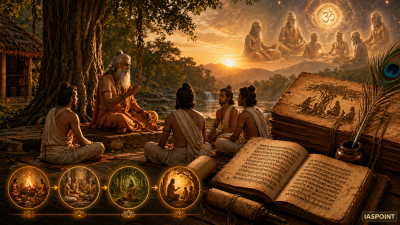
The Upanishads represent the Jnana-kanda (knowledge section) of the Vedas and are collectively known as Vedanta (the end of the Vedas). Historically, they mark a transition from the ritualistic focus of the Brahmanas to internal spiritual experience and metaphysical inquiry. The term “Upanishad” is derived from the Sanskrit roots Upa (near), Ni (down), and Sad (to sit), signifying sitting down near a teacher to receive confidential, transcendental knowledge.
The Core Pillars: Brahman and Atman
The central theme of Upanishadic philosophy is the nature of reality and the relationship between the individual and the cosmos.
- Brahman (The Universal Soul): The Upanishads define Brahman as the ultimate, infinite, and changeless reality that is the source of all existence. It is described as Sat-Chit-Ananda (Truth-Consciousness-Bliss).
- Atman (The Individual Soul): This is the inner self of the human being. A core tenet of Upanishadic thought is that the Atman is eternal, indestructible, and distinct from the physical body and mind.
- The Identity Principle: The most profound realization in these texts is the fundamental identity of Atman and Brahman. This is expressed through the Mahavakyas (Great Sayings).
| Mahavakya | Source Upanishad | Meaning |
| Tat Tvam Asi | Chandogya Upanishad | “That Thou Art” (You are that Brahman). |
| Aham Brahmasmi | Brihadaranyaka Upanishad | “I am Brahman.” |
| Prajnanam Brahma | Aitareya Upanishad | “Consciousness is Brahman.” |
| Ayam Atma Brahma | Mandukya Upanishad | “This Self is Brahman.” |
Concept of Maya and Vidya
The Upanishads introduce the mechanisms of perception and ignorance that govern the material world.
- Maya: This is the illusory power that makes the singular Brahman appear as a world of many diverse forms. It is not “non-existence” but rather a “relative reality” that hides the absolute truth.
- Vidya vs. Avidya: Avidya (Ignorance) is the cause of attachment to the material world and the cycle of rebirth. Vidya (Higher Knowledge) is the spiritual insight that leads to the realization of the Self and liberation.
The Doctrine of Samsara, Karma, and Moksha
The Upanishads provide the first systematic explanation of the cycle of life and death in Indian thought.
- Karma: The law of causality where every action (Karma) produces a result (Phala). It determines the quality of future lives.
- Samsara: The continuous cycle of birth, death, and rebirth. The soul migrates from one body to another based on its accumulated desires and actions.
- Moksha: The ultimate goal of human life. It is the liberation from Samsara. Moksha is achieved through the realization of the oneness of Atman and Brahman, leading to the permanent cessation of suffering.
The Four States of Consciousness (Avasthas)
The Mandukya Upanishad provides a psychological analysis of consciousness, mapping it to the sacred syllable AUM.
- Jagrat (Waking): Awareness of the external world (represented by the letter ‘A’).
- Svapna (Dreaming): Awareness of the internal mental world (represented by the letter ‘U’).
- Sushupti (Deep Sleep): A state of bliss where there is no desire or dream, yet consciousness remains latent (represented by the letter ‘M’).
- Turiya (The Fourth): Pure consciousness that underlies and transcends the other three states. It is the state of the Atman.
Classification and Major Upanishads
While there are traditionally 108 Upanishads (as per the Muktika canon), the Mukhya Upanishads (Principal Upanishads) are the most significant as they were commented upon by Shankaracharya.
Key Philosophical Contributions of Specific Upanishads
- Brihadaranyaka Upanishad: The oldest and largest; contains the Pancha-Agni vidya (doctrine of five fires) and the dialogue between Yajnavalkya and Maitreyi on the immortality of the soul.
- Katha Upanishad: Uses the story of the young boy Nachiketa and Yama (God of Death) to explain the nature of the soul and the importance of choosing the “good” (Sreya) over the “pleasant” (Preya).
- Isha Upanishad: Focuses on the unity of the divine and the world, emphasizing that one should enjoy the world through renunciation.
- Mundaka Upanishad: Introduces the famous national motto of India, Satyamev Jayate (Truth alone triumphs), and the metaphor of two birds on a single tree (the witnessing soul and the experiencing soul).
Essential Trivia for Aspirants
- Dara Shikoh: The Mughal prince Dara Shikoh translated 50 Upanishads into Persian under the title Sirr-i-Akbar (The Greatest Mystery), which later introduced Upanishadic thought to the Western world.
- Prasthanatrayi: The Upanishads form one-third of the Prasthanatrayi (the three points of departure for Hindu philosophy), the other two being the Bhagavad Gita and the Brahma Sutras.
- Shreyas and Preyas: A recurring ethical theme in the Upanishads, where Shreyas refers to the ultimate spiritual good and Preyas refers to immediate sensory pleasure.