
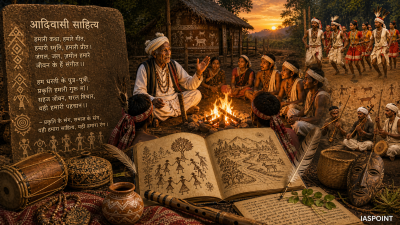
Tribal literature, often referred to as Adivasi Sahitya, constitutes the foundational layer of Indian literary heritage. Unlike the written traditions of Sanskrit or Persian, tribal literature has predominantly been an oral tradition (Vachika), preserved through songs, folklore, and community rituals. It reflects a worldview centered on the symbiotic relationship between humans and nature, distinct from the anthropocentric themes of mainstream literature.
Characteristics of Tribal Oral Traditions
Tribal literature is not merely a collection of stories but a repository of ethnic history, ecological wisdom, and social laws.
- Orality and Collectivity: Most tribal languages did not historically use scripts. Knowledge was passed down through Ghotuls (traditional youth dormitories) or community elders.
- Nature-Centric Worldview: Themes revolve around forest deities, hills, rivers, and animals, reflecting an organic connection with the environment.
- Resistance and Identity: Modern tribal literature focuses heavily on the “Literature of Resistance,” documenting the struggle against colonial exploitation and post-colonial displacement.
- Linguistic Diversity: It spans various language families, including Austro-Asiatic (Munda, Santali), Tibeto-Burman (Naga, Mizo), and Dravidian (Gond, Kui).
Major Regional Tribal Literary Traditions
North-East Indian Traditions
The “Seven Sisters” possess a rich oral heritage that has transitioned into written form primarily using the Roman script due to missionary influence.
- The Nagas: The Tenyidie literature of the Angami Nagas and the folk epics of the Ao Nagas are central. Contemporary writers like Temsula Ao and Easterine Kire have brought Naga folklore to global prominence.
- The Khasis: Known for the “Phawar,” a form of rhyming couplets used in archery competitions and festivals.
- The Mizos: Boast a vast collection of Hlado (hunting chants) and Mizo Bawh Hla (war cries).
Central and East Indian Traditions
This belt represents the Munda and Gondi linguistic groups, often characterized by “Santal” and “Gond” folklore.
- Santali Literature: The Santals have a robust literary tradition. The invention of the Ol Chiki script by Pandit Raghunath Murmu in 1925 was a watershed moment.
- Munda Literature: Features the Sososbonga, a long liturgical poem recited during the harvest festival to explain the origin of the world.
- Gondi Literature: Rich in Pandwani (not to be confused with the Chhattisgarhi folk form), which involves the narration of the deeds of Gond heroes.
Key Literary Works and Authors in Adivasi Sahitya
| Author | Tribe/Language | Key Work/Contribution |
| Pandit Raghunath Murmu | Santali | Created the Ol Chiki script; wrote Bidu Chandan. |
| L.S. Ramamirtham | Gondi/Tamil | Explored tribal mysticism and cultural ethos. |
| Susheela Samad | Mundari | One of the earliest female tribal editors (Chandni magazine, 1950s). |
| Nirmala Putul | Santali | Famous for Nagade ki Tarah Bajte Shabd, focusing on tribal women’s struggles. |
| Easterine Kire | Naga | When the River Sleeps; winner of the Hindu Literary Prize. |
| Ram Dayal Munda | Mundari | Adi Dharam; a pivotal work on tribal identity and philosophy. |
Modern Transitions: From Oral to Written
The transition of tribal literature into written scripts has been a political and cultural act of self-assertion.
- Script Innovation: While many use Devanagari, Roman, or regional scripts (Odia, Bengali), tribes have developed indigenous scripts like Ol Chiki (Santali), Warang Chiti (Ho), and Tolong Siki (Kurukh).
- The Role of Magazines: Publications like Adivasi (Ranchi) and journals by the Bhasha Research and Publication Centre have provided platforms for tribal voices.
- Adivasi Yatayat: A contemporary movement emphasizing the mobility and evolving identity of tribal people in urban spaces.
Important Facts and Trivia for UPSC
- Sahitya Akademi: The Akademi now recognizes several tribal languages, including Santali and Bodo, under the 8th Schedule of the Constitution.
- The People’s Linguistic Survey of India (PLSI): Led by G.N. Devy, it has documented hundreds of tribal languages, many of which are on the verge of extinction.
- Verrier Elwin: A British-born Indian anthropologist whose works like The Muria and their Ghotul and The Baiga are essential for understanding tribal oral histories.
- Bodo Literature: Included in the 8th Schedule in 2003, it has a sophisticated written tradition using the Devanagari script.
- Adi Dharam: A term often used in tribal literature to describe the primordial, indigenous religious and ethical system of the Adivasis.
Challenges Facing Tribal Literature
Despite its richness, tribal literature faces systemic hurdles. The dominance of “scheduled languages” often leads to the marginalization of non-scheduled tribal dialects. Furthermore, the loss of tribal lands often correlates with the loss of the specific vocabulary related to local flora and fauna, leading to “linguistic erosion.” The modern tribal writer often navigates the tension between preserving the purity of oral myths and addressing contemporary issues like mining, displacement, and state-citizen conflicts.
Last Modified: May 1, 2026