
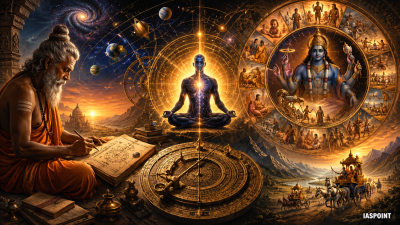
In Indian thought, Kala (Time) is not merely a linear progression but a multidimensional entity. It is viewed through two primary lenses: the Absolute (Nishkala), which is eternal and unchanging, and the Relative (Sakala), which governs the phenomenal world through cycles of birth, growth, and decay. Ancient Indian texts, particularly the Surya Siddhanta and various Puranas, provide a sophisticated mathematical framework for time reckoning that ranges from microseconds to billions of years.
Classification of Time: Murta and Amurta
Ancient Indian astronomers divided time into two broad categories based on perceptibility:
- Amurta (Unmanifested): Sub-atomic time scales that are too minute for human perception.
- Murta (Manifested): Observable time used for daily activities, rituals, and astronomical calculations, starting from the Prana (the time taken for one breath).
Units of Time Reckoning: From Micro to Macro
The precision of ancient Indian time-measurement is reflected in the hierarchical units found in the Siddhantas.
Micro-Units of Time
| Unit | Equivalent / Definition |
| Truti | The smallest unit; approx. 1/33,750th of a second. |
| Nimesha | The time taken for an eye blink. |
| Kastha | Equivalent to 15 Nimeshas. |
| Kala | Equivalent to 30 Kasthas (approx. 1.6 minutes). |
| Muhurta | 30 Kalas or 48 minutes. A day-night cycle consists of 30 Muhurtas. |
Macro-Units (The Puranic Timeline)
Indian cosmology operates on a cyclical model known as Kalachakra.
- Chaturyuga (Maha Yuga): A cycle of four Yugas totaling 4,320,000 years.
- Satya Yuga: 1,728,000 years (Age of Truth).
- Treta Yuga: 1,296,000 years.
- Dvapara Yuga: 864,000 years.
- Kali Yuga: 432,000 years (The current age).
- Manvantara: A period ruled by a specific Manu. One Manvantara equals 71 Chaturyugas.
- Kalpa: A “Day of Brahma,” consisting of 14 Manvantaras (approx. 4.32 billion years).
The Solar and Lunar Systems of Calculation
India primarily uses a Luni-Solar system, balancing the moon’s phases with the sun’s tropical position to ensure seasonal alignment.
Lunar Reckoning (Chandramana)
- Tithi: A lunar day defined by the 12-degree separation between the sun and moon.
- Paksha: A fortnight. Shukla Paksha (Bright/Waxing) and Krishna Paksha (Dark/Waning).
- Masa (Month): Consists of two Pakshas. Named after the Nakshatra (Constellation) in which the full moon occurs.
Solar Reckoning (Sauramana)
- Sankranti: The entry of the Sun into a new Zodiac sign (Rashi). Makar Sankranti marks the transition into Capricorn.
- Ayana: A six-month period. Uttarayana (Northward movement) and Dakshinayana (Southward movement).
Important Eras (Samvats) of India
India has historically used several eras to record time, many of which remain in use for religious and official purposes.
- Vikrama Samvat (57 BCE): Commemorates King Vikramaditya’s victory over the Shakas. It follows a lunar calendar and starts after the New Moon in the month of Chaitra.
- Saka Samvat (78 CE): Believed to be started by King Kanishka. It is the basis of the Indian National Calendar (adopted in 1957).
- Kali Era (3102 BCE): Traditionally reckoned from the end of the Mahabharata War or the departure of Krishna.
- Gupta Era (319-320 CE): Established by Chandragupta I at the beginning of the Gupta Dynasty.
The Indian National Calendar (Saka Era)
Following the recommendations of the Calendar Reform Committee (1952) headed by Meghnad Saha, the Government of India adopted a standardized calendar for official use.
- Epoch: Starts in 78 CE.
- First Month: Chaitra (starts on March 22, or March 21 in leap years).
- Structure: Has a fixed number of days for each month (e.g., Chaitra has 30 days, while Vaisakha to Bhadra have 31 days).
Ritualistic Significance: Panchangam
The Panchangam is the traditional Hindu almanac used to determine auspicious timings (Shubha Muhurta). It is based on five (Pancha) elements (Angas):
- Vara: The day of the week (seven-day cycle).
- Tithi: The lunar day.
- Nakshatra: The stellar mansion where the moon resides (27 in total).
- Yoga: A mathematical relationship between the sun and moon’s longitude.
- Karana: Half of a Tithi.
Fact Files for Prelims
- Vedanga Jyotisha: The earliest Indian text on astronomy and time reckoning, attributed to Lagadha.
- Adhik Masa: An intercalary lunar month added every 32.5 months to synchronize the lunar calendar with the solar year.
- Zero Hour of Creation: According to the Surya Siddhanta, time measurement began at the sunrise of Lanka (on the equator) on the first day of the bright half of Chaitra.
- Jantar Mantar: Built by Maharaja Jai Singh II of Jaipur, these are architectural manifestations of the Indian concept of Kala, designed to measure time and celestial movements with precision.