
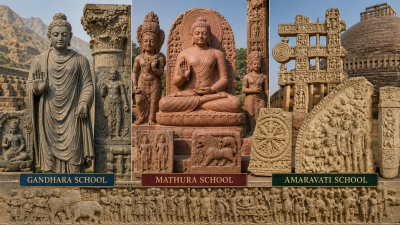
The collapse of the Mauryan Empire led to the rise of regional powers such as the Shungas, Kanvas, Kushanas, and Satavahanas. This era marked a shift from the monolithic, state-sponsored court art of the Mauryas to a more localized, diverse, and religiously driven sculptural tradition. While the Mauryan period was dominated by animal capitals and pillars, the Post-Mauryan phase saw the emergence of the three distinct schools of art—Gandhara, Mathura, and Amaravati—and the beginning of anthropomorphic representations of the Buddha.
The Shunga and Kanva Period: The Art of Reliefs
During the Shunga period, sculpture was primarily integrated into the architecture of Stupas, specifically on the vedikas (railings) and toranas (gateways).
- Bharhut Stupa (Madhya Pradesh): The reliefs here are known for their “narrative art.” They depict Jataka stories and scenes from the life of Buddha. A characteristic feature is the “flatness” of the figures, though they show a high degree of detail in jewelry and drapery.
- Sanchi Stupa (Gateway Phase): While the main structure is Ashokan, the intricate carvings on the four gateways were added during the Satavahana/Shunga transition. These carvings are more three-dimensional than those at Bharhut and depict themes like the “Great Departure” and the “Siege of Kushinagar.”
- Shalabhanjika Motif: This period popularized the figure of a woman holding a branch of a Sal tree, symbolizing fertility and prosperity.
The Gandhara School: Indo-Greek Synthesis
Flourishing in the northwestern frontiers (modern-day Pakistan and Afghanistan), the Gandhara school is a unique blend of Greco-Roman techniques and Buddhist themes. It is often referred to as the Greco-Buddhist school.
- Chronology and Patronage: Primarily flourished under the Kushanas, especially during the reign of Kanishka (1st – 3rd Century CE).
- Material: Early sculptures used Bluish-Grey Schist stone; later works utilized Stucco (plaster).
- Key Characteristics:
- Anatomical Accuracy: Focus on muscularity and physical beauty influenced by Apollo-like features.
- Drapery: Thick, heavy folds arranged in a Roman style (Toga).
- Features: Curly hair, elongated ears, a sharp nose, and sometimes a mustache.
- Symbolism: The Buddha is often shown with a halo (Prabhamandala) and in various Mudras (gestures).
The Mathura School: Indigenous Development
Centered around Mathura (Uttar Pradesh), this school was entirely indigenous and did not rely on foreign models. It was a melting pot of three religions: Buddhism, Jainism, and Brahmanism.
- Material: Distinctive Spotted Red Sandstone.
- Key Characteristics:
- Physical Form: Figures are fleshy and robust with a smiling face. The Buddha is depicted with a shaven head (Ushnisha) and a protruding belly.
- Drapery: Transparent, thin muslin-like clothing that clings to the body.
- Religious Diversity: Produced the first images of Tirthankaras (Jainism), Vishnu, Shiva, and Surya (Brahmanism), alongside the Buddha.
- Yaksha Influence: The iconography of the Buddha was heavily inspired by the earlier massive Yaksha statues of the Mauryan era.
The Amaravati School: The Southern Tradition
Developed in the Vengi region (Andhra Pradesh) under the patronage of the Satavahanas and later the Ikshvakus, this school focused on the decoration of the Mahachaitya at Amaravati.
- Material: White Marble or White Limestone.
- Narrative Focus: Unlike the Gandhara and Mathura schools which focused on individual statues, Amaravati is famous for “Narrative Medallions.” These circular reliefs depict complex stories from the Jatakas.
- Key Characteristics:
- Dynamic Movement: Figures are shown in action, often in lithe, slender, and elongated forms.
- Emotional Depth: The sculptures express intense human emotions—joy, sorrow, and devotion.
- Tribhanga Posture: Frequent use of the “triple-bend” body posture to denote grace.
Comparative Analysis of Gandhara, Mathura, and Amaravati Schools
| Feature | Gandhara School | Mathura School | Amaravati School |
| Primary Region | Modern Peshawar & Punjab | Mathura, Sonkh, Kankali Tila | Krishna-Godavari Valley |
| Material Used | Blue-Grey Schist / Stucco | Spotted Red Sandstone | White Marble / Limestone |
| Religious Influence | Primarily Buddhist | Buddhist, Jain, & Hindu | Primarily Buddhist |
| Foreign Influence | Greco-Roman / Hellenistic | Purely Indigenous | Purely Indigenous |
| Buddha’s Appearance | Spiritual, wavy hair, bearded | Delightful, shaven head, fleshy | Narrative-centric depictions |
| Patronage | Kushana Dynasty | Kushana Dynasty | Satavahana & Ikshvaku |
Key Sculptural Terms and Trivia for Prelims
- Ushnisha: The cranial bump on the Buddha’s head representing spiritual wisdom.
- Urna: The circular dot or tuft of hair between the eyebrows.
- Abhaya Mudra: The gesture of fearlessness, most common in Mathura sculptures.
- Dharmachakra Mudra: The gesture of preaching or turning the wheel of law.
- Jataka Stories: Tales of the previous births of the Buddha; a central theme in Post-Mauryan relief art.
- Kanishka Statue: A famous headless statue of King Kanishka found at Mathura, showing him in central Asian dress (long coat and boots), highlighting the fusion of cultures.
- Ayaka Pillars: Unique to the Amaravati school; these were five pillars placed at the cardinal points of the Stupa representing five major events in Buddha’s life.
Rock-Cut Sculpture and Viharas
The Post-Mauryan period also saw the expansion of rock-cut caves in Western India, notably at Karle, Bhaja, Kanheri, and Junnar.
- Karle Chaitya: Features massive monolithic pillars with “Dampati” (couples) and animal figures on the capitals.
- Udayagiri and Khandagiri (Odisha): Carved under King Kharavela of the Mahameghavahana dynasty. These caves contain secular and religious reliefs, including the famous “Manchapuri Cave” and “Rani Gumpha.”