
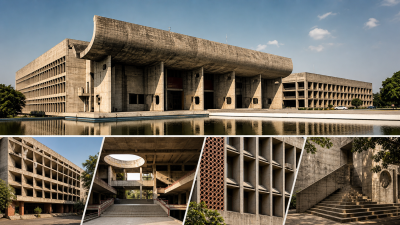
Brutalist architecture, a sub-set of the Modernist movement, flourished in India between the 1950s and 1980s. Characterized by “Béton brut” (raw concrete), the style emphasized structural honesty, monumental scales, and functionalism. For a newly independent India, Brutalism represented a radical break from colonial ornamentation, embodying the “Nehruvian Vision” of a scientific, industrial, and egalitarian society. While often perceived as harsh, Indian Brutalism was uniquely adapted to the tropical climate through deep recesses, heavy thermal mass, and innovative sun-shading devices.
Core Characteristics of Indian Brutalism
Brutalist structures in India are identified by their uncompromising use of materials and geometric boldness.
- Exposed Concrete (Béton Brut): Leaving the texture of the wooden formwork imprinted on the concrete surface to celebrate the construction process.
- Geometric Fortification: Use of massive, repetitive shapes such as cubes, cylinders, and triangles to create a sense of permanence and strength.
- Brise-Soleil: Permanent architectural sun-shading elements, like deep concrete fins or honeycombs, to protect interiors from the harsh Indian sun while allowing natural ventilation.
- Monolithic Scale: Structures often appear as a single, massive sculpture carved from stone or concrete, conveying the power of the state and its institutions.
- Functional Interiority: Large internal atriums and ramps designed to facilitate the movement of people in public and educational buildings.
Pioneers and Philosophical Underpinnings
The movement was spearheaded by international masters and the first generation of Indian architects trained under them.
- Le Corbusier: The progenitor of the style in India. His work in Chandigarh utilized raw concrete to create “temples of democracy.”
- Louis Kahn: Brought a spiritual dimension to Brutalism, using geometric voids and massive brick-and-concrete combinations to play with light and shadow.
- The Indian “Trio”: Architects like Achyut Kanvinde, Raj Rewal, and B.V. Doshi adapted the harsh European Brutalist style to local sensibilities, incorporating Indian concepts of courtyards and modularity.
Landmark Brutalist Structures in India
These buildings are quintessential examples of the 360° application of Brutalist principles in the Indian context.
The Capitol Complex, Chandigarh (Le Corbusier)
A UNESCO World Heritage site, it is the purest expression of Brutalism in Asia.
- The Secretariat: A long, horizontal slab with a complex pattern of windows and sun-shades.
- The Palace of Assembly: Features a dramatic hyperboloid dome and a massive concrete portico.
- The High Court: Notable for its double roof (to provide a parasol effect) and three giant brightly colored concrete pillars.
Indian Institute of Management (IIM), Ahmedabad (Louis Kahn)
A masterpiece of “Brick Brutalism,” where the structural honesty of brick is combined with the monumentality of concrete.
- Circular Openings: Massive circular cut-outs in façade walls act as thermal buffers and create dramatic light wells.
- Symmetry: The layout follows a monastic rigour, emphasizing the pursuit of knowledge.
The Hall of Nations, Delhi (Raj Rewal)
Constructed in 1972 to mark 25 years of independence, this was a global engineering marvel.
- Space Frame Structure: It was the world’s first large-scale space-frame structure built in reinforced concrete rather than steel, due to the high cost of steel at the time.
- Jali Inspiration: The triangular structural grid was a modernist interpretation of the traditional Indian stone lattice.
Siri Fort Auditorium and Asian Games Village, Delhi (Raj Rewal)
Built for the 1982 Asian Games, these structures showcase the use of pre-cast concrete and exposed grit finishes to create a cohesive urban “village” feel.
Comparison: European Brutalism vs. Indian Brutalism
| Feature | European Brutalism | Indian Brutalism |
| Climate Response | Designed to retain heat; small windows. | Designed for cooling; deep fins and voids. |
| Materials | Primarily Concrete and Steel. | Concrete often combined with local Brick. |
| Symbolism | Social housing and welfare state. | Nation-building and institutional identity. |
| Light Usage | Grey, flat light exposure. | Strong shadows and “chased” sunlight. |
Evolution into “Critical Regionalism”
By the late 1970s, Brutalism in India evolved. Architects felt that pure concrete was too alien, leading to the integration of local materials.
- B.V. Doshi’s Sangath: His office in Ahmedabad uses Brutalist vaulted forms but covers them in “China Mosaic” (broken white ceramic tiles) to reflect heat and soften the concrete aesthetic.
- Charles Correa’s LIC Building, Delhi: A Brutalist frame that utilizes large glass voids and a central “void” to manage the urban microclimate.
Decline and Contemporary Status
The popularity of Brutalism waned in the late 1980s due to maintenance challenges; exposed concrete in humid climates often develops “black streaks” (fungal growth) and carbonation.
- Controversial Demolitions: The demolition of the Hall of Nations in 2017 sparked a global debate on the protection of “Modern Heritage” in India.
- Adaptive Reuse: Many Brutalist university campuses, such as IIT Kanpur and JNU, are now being studied for their highly efficient passive cooling designs.
Facts and Trivia for UPSC Aspirants
- The Term: “Brutalism” does not come from the word “brutal,” but from the French term béton brut, meaning raw concrete.
- First Brutalist Architect: Achyut Kanvinde is often credited with introducing functionalism to India with the Ahmedabad Textile Industry’s Research Association (ATIRA) building.
- The Modulor: Le Corbusier used a human-centric scale called the “Modulor” to decide the height and proportions of his Brutalist structures in Chandigarh.
- Passive Cooling: Many Brutalist buildings in India are so thermally efficient that they require significantly less air conditioning than modern glass-facade skyscrapers.
- Cement as Progress: In the 1950s, the use of cement was a matter of national pride, representing the growth of India’s indigenous industrial base.