
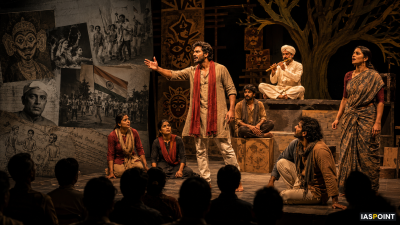
Modern Indian theatre represents a departure from both the stylized classical Sanskrit drama and the commercial “Masala” format of Parsi theatre. It emerged as an intellectual response to the colonial encounter, the Indian independence movement, and the post-Independence search for a distinct national identity. This era is characterized by the “Theatre of Roots” movement, which attempted to marry Western realistic techniques with indigenous folk traditions.
The Role of the National School of Drama (NSD)
Established in 1959 as a constituent unit of the Sangeet Natak Akademi, the NSD became an autonomous body in 1975. It is the premier institution for theatrical training in India and has been the vanguard of the “Nationalist” aesthetic in performing arts.
- Ebrahim Alkazi Era (1962–1977): Often called the “Architect of Modern Indian Theatre,” Alkazi introduced technical discipline, rigorous training, and the use of monumental architectural sites (like Purana Qila) for staging plays like Andha Yug.
- The Repertory Company: Founded within NSD to provide a professional platform for graduates, it has been instrumental in taking high-quality theatre to various corners of the country.
- Bharat Rang Mahotsav (BRM): Established in 1999, it is the flagship international theatre festival of NSD and is considered the largest theatre festival in Asia.
The “Theatre of Roots” Movement
Post-independence, Indian directors felt that Western “Proscenium” theatre (the box stage) was insufficient to capture Indian sensibilities. This led to a movement where modern themes were explored through folk forms.
- Synthesis of Styles: Directors utilized the Sutradhara from Sanskrit drama, the music of Nautanki, and the masks of Chhau to tell modern political stories.
- Key Objective: To decolonize the Indian stage and create a “National” theatre that was neither purely traditional nor entirely Western.
Pioneers of Modern Indian Theatre
| Personality | Contribution/Style | Notable Works |
| Ebrahim Alkazi | Introduced realism and grand scenography; focused on Greek tragedies and Indian epics. | Andha Yug, Ashadh Ka Ek Din, Tughlaq. |
| B.V. Karanth | A pioneer of the “Theatre of Roots”; specialized in using folk music and movement. | Hayavadana, Sattavara Neralu. |
| Habib Tanvir | Founded Naya Theatre; worked extensively with tribal actors from Chhattisgarh. | Charandas Chor, Agra Bazar. |
| Badal Sircar | Developed the “Third Theatre”—a minimalist, anti-proscenium, street-theatre style. | Ebong Indrajit, Basi Khabar. |
| K.N. Panikkar | Blended classical Sanskrit techniques with Kerala’s traditional arts like Koodiyattam. | Madhyamavyayoga, Urubhanga. |
| Vijay Tendulkar | Leading figure in Marathi theatre; known for harsh social realism and political critique. | Ghashiram Kotwal, Sakharam Binder. |
| Girish Karnad | Used myths and history to comment on contemporary existential issues. | Yayati, Tughlaq, Hayavadana. |
Key Institutions and Movements
Indian People’s Theatre Association (IPTA)
Founded in 1943, IPTA was the cultural wing of the left-wing movement in India. It aimed to use theatre as a tool for social awakening and anti-imperialism.
- Impact: It brought theatre out of the elite halls to the peasants and workers.
- Key Figures: Bijon Bhattacharya (Nabanna), Prithviraj Kapoor, and Balraj Sahni.
The Third Theatre
Propounded by Badal Sircar, this was a reaction against both the expensive “First Theatre” (commercial) and the state-funded “Second Theatre” (proscenium).
- Features: Minimalist costumes, no expensive lighting, and performance in found spaces like parks or community halls to ensure direct performer-audience intimacy.
Landmark Plays of Modern India
- Andha Yug (Dharmvir Bharati): An exploration of the aftermath of the Mahabharata war, serving as an allegory for the trauma of the Partition.
- Tughlaq (Girish Karnad): A historical play about the 14th-century Sultan, widely interpreted as a critique of the disillusionment following the Nehruvian era.
- Ghashiram Kotwal (Vijay Tendulkar): Used the Dashavatar folk form and traditional music to critique the abuse of power and political decadence.
- Hayavadana (Girish Karnad): Employed the Yakshagana tradition to explore the theme of human incompleteness and identity.
UPSC Fact File: Technicals and Trivia
- Sangeet Natak Akademi: The apex body for performing arts in India, established in 1953. It confers the most prestigious awards for theatrical excellence.
- First Modern Play: Many scholars consider Belgachia Natyashala’s production of Sarmistha (by Michael Madhusudan Dutt) as a starting point for modern Indian drama in the 19th century.
- Zonal Cultural Centres (ZCCs): Established by the Government to promote regional theatre and folk arts, often collaborating with NSD for national-level festivals.
- The “Naya Theatre” Philosophy: Habib Tanvir’s insistence on using Chhattisgarhi dialect and folk performers challenged the “standard” Hindi/Urdu dominance in national theatre.
- UNESCO Recognition: While folk forms are recognized, the Koodiyattam school of Kerala is often studied in modern contexts as a surviving link to the oldest continuous theatre tradition in the world.