
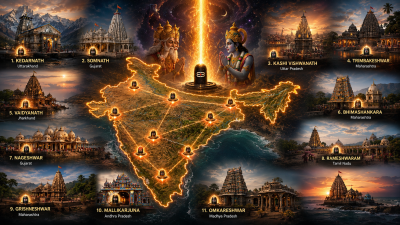
In the sacred geography of India, the Jyotirlinga (meaning “Linga of Light”) represents the supreme, formless reality of Shiva. Unlike regular Shiva Lingas, which are man-made or established by sages, the twelve Jyotirlingas are considered Swayambhu (self-manifested), where Shiva appeared as a fiery column of light (Jyoti) to settle a dispute between Brahma and Vishnu regarding supremacy. This circuit forms a pan-Indian spiritual network that integrates diverse geographical regions—from the Himalayas to the southern coasts—into a unified cultural landscape.
The Twelve Jyotirlingas: Geographic and Mythological Distribution
The Jyotirlinga circuit is strategically spread across the Indian subcontinent, marking significant ecological and historical zones.
| Name of Jyotirlinga | Location (District & State) | Geographic Feature | Unique Significance |
| Somnath | Veraval, Gujarat | Saurashtra Coast | The “Eternal Shrine”; historically destroyed and rebuilt seven times. |
| Mallikarjuna | Srisailam, Andhra Pradesh | Nallamala Hills | Known as the “Kailash of the South”; associated with both Shiva and Shakti. |
| Mahakaleshwar | Ujjain, Madhya Pradesh | Banks of Kshipra River | The only Dakshinamukhi (south-facing) Jyotirlinga; signifies Shiva as the Lord of Time. |
| Omkareshwar | Khandwa, Madhya Pradesh | Narmada River Island | The island is naturally shaped like the sacred symbol ‘Om’. |
| Kedarnath | Rudraprayag, Uttarakhand | Garhwal Himalayas | The highest of the twelve; part of the Panch Kedar and Chota Char Dham. |
| Bhimashankar | Pune, Maharashtra | Sahyadri Mountains | Source of the Bhima River; famous for Nagara style architecture. |
| Vishwanath | Varanasi, Uttar Pradesh | Banks of Ganga | The spiritual capital of India; believed to be the point where the first Jyotirlinga manifested. |
| Trimbakeshwar | Nashik, Maharashtra | Brahmagiri Hills | Source of the Godavari River; features a unique three-faced Linga (Brahma, Vishnu, Mahesh). |
| Baidyanath | Deoghar, Jharkhand | Santhal Parganas | Associated with Ravana’s penance; also considered a Shakti Peetha. |
| Nageshwar | Dwarka, Gujarat | Coastal Gujarat | Mentioned in the Shiva Purana as ‘Darukavana’; signifies protection from poisons. |
| Rameshwaram | Ramanathapuram, Tamil Nadu | Pamban Island | Established by Lord Rama; the southernmost pillar of the Char Dham. |
| Grishneshwar | Aurangabad, Maharashtra | Near Ellora Caves | The last Jyotirlinga; built by Ahilyabai Holkar in the 18th century. |
Architectural Styles and Cultural Heritage
The Jyotirlinga temples are repositories of India’s evolving architectural genius, showcasing a transition from ancient stone structures to Maratha-led reconstructions.
- Nagara Style: Dominant in the northern and western shrines like Somnath and Vishwanath, characterized by beehive-shaped curvilinear towers (Shikharas).
- Dravidian Style: Seen prominently in Rameshwaram and Mallikarjuna, featuring massive gateways (Gopurams) and extensive pillared corridors (Prakarams). Rameshwaram boasts the longest temple corridor in the world.
- Bhumija Style: Observed in the Trimbakeshwar and Grishneshwar temples, a subtype of Nagara architecture prevalent in the Malwa and Deccan regions.
- Maratha Influence: Due to historical Islamic invasions, many Jyotirlingas were restored by the Marathas, particularly under Rani Ahilyabai Holkar, who rebuilt the Kashi Vishwanath and Grishneshwar temples.
Ritualistic and Philosophical Significance
The pilgrimage to these twelve sites is not merely a physical journey but a ritual mapping of the “Self” onto the “Cosmos.”
- Bhasma Aarti (Ujjain): A unique ritual at Mahakaleshwar where the deity is smeared with sacred ash, symbolizing the ultimate reality of death and regeneration.
- Kanwar Yatra: A seasonal pilgrimage where devotees carry water from the Ganga (often from Haridwar or Sultanganj) to offer at the Jyotirlingas, particularly Baidyanath and Vishwanath.
- The Axis Mundi: Conceptually, the Jyotirlinga represents the vertical axis that connects the underworld (Patala), the earth (Bhuloka), and the heavens (Swarga).
The Circuit as a Tool for National Integration
The distribution of Jyotirlingas played a crucial role in the “Cultural Circumambulation” of India.
- Linguistic Convergence: The circuit forces a North Indian pilgrim to travel to the Dravidian heartland (Rameshwaram) and a Southern devotee to traverse the Indo-Gangetic plains (Kashi) and the Himalayas (Kedarnath).
- Hydrological Links: Many Jyotirlingas are located at the origins or banks of India’s most sacred rivers (Ganga, Narmada, Godavari, Kshipra, and Bhima), intertwining water ecology with spiritual sanctity.
Fact File for UPSC Aspirants
- Pancha-Bhoota Stalams vs. Jyotirlingas: While Jyotirlingas represent the formless Shiva, the Pancha-Bhoota Stalams (all in South India) represent Shiva through the five elements: Earth (Kanchipuram), Water (Thiruvanaikaval), Fire (Arunachala), Air (Kalahasti), and Ether (Chidambaram).
- UNESCO Connection: The Grishneshwar Jyotirlinga is located in close proximity to the UNESCO World Heritage site of Ellora Caves, specifically Cave 16 (Kailasa Temple), which is the world’s largest monolithic structure dedicated to Shiva.
- The Dwarka Double-Sanctity: Dwarka is unique as it hosts both a Jyotirlinga (Nageshwar) and is one of the four cardinal Char Dhams established by Adi Shankara.
- Sapta-Puri Integration: Varanasi (Vishwanath), Ujjain (Mahakaleshwar), and Dwarka (Nageshwar) are part of both the Jyotirlinga circuit and the Sapta-Puri (seven most holy cities).
Trivia: The ‘Half’ Jyotirlinga
In some regional traditions, the Pashupatinath Temple in Kathmandu, Nepal, is considered the “head” of the Kedarnath Jyotirlinga, completing the spiritual anatomy of the Himalayan Shiva. Devotees often believe that a pilgrimage to Kedarnath is incomplete without visiting Pashupatinath.
Last Modified: May 7, 2026