
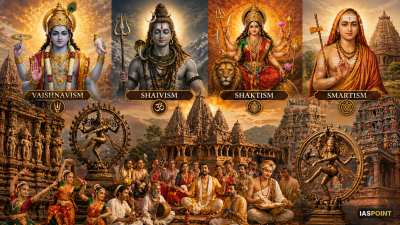
In the study of Indian Art, Culture, and Heritage, Hinduism is categorized as a mosaic of diverse traditions rather than a monolithic entity. The evolution of various sects—primarily Vaishnavism, Shaivism, Shaktism, and Smartism—has dictated the trajectory of Indian temple architecture, iconography, and the Bhakti movement.
Classification of Major Hindu Sects
Hinduism is broadly divided into four major denominations based on the principal deity worshipped and the specific philosophical texts followed.
| Sect | Principal Deity | Primary Scriptures | Key Philosophies |
| Vaishnavism | Vishnu and his Avatars | Vishnu Purana, Bhagavad Gita, Bhagavata Purana | Bhakti, Prapatti (Surrender), Dashavatara |
| Shaivism | Shiva | Shiva Purana, Agamas, Tirumurai | Yoga, Asceticism, Monism |
| Shaktism | Devi (The Divine Mother) | Devi Mahatmya, Devi-Bhagavata Purana, Tantras | Shaktiman-Shakti, Kundalini Yoga |
| Smartism | Five Deities (Panchayatana) | Smritis, Sutras, Upanishads | Advaita (Non-dualism) |
Vaishnavism: The Tradition of Avatars
Vaishnavism emphasizes the preservation of the universe through the incarnations of Vishnu. It became a dominant force through the Alvars of South India and later the Bhakti saints of the North.
The Dashavatara (Ten Incarnations)
The concept of Avataravada (descent of God) is central to Vaishnava iconography:
- Matsya (Fish): Symbolizes the rescue of the Vedas and Manu from the deluge.
- Kurma (Tortoise): Supported Mount Mandara during the Samudra Manthan (Churning of the Ocean).
- Varaha (Boar): Rescued Earth (Bhudevi) from the demon Hiranyaksha.
- Narasimha (Half-man, Half-lion): Defeated the demon Hiranyakashipu.
- Vamana (Dwarf): Subdued King Bali to restore Indra’s authority.
- Parashurama (Warrior with Axe): Cleansed the earth of corrupt Kshatriyas.
- Rama: The ideal man (Maryada Purushottama); central to the Ramayana.
- Krishna: The divine teacher of the Bhagavad Gita.
- Buddha/Balarama: Varying across traditions; Buddha is often included to integrate Buddhist followers.
- Kalki: The future avatar expected to end the Kali Yuga.
Prominent Vaishnava Sub-sects
- Sri Sampradaya: Founded by Ramanujacharya; follows Vishishtadvaita (Qualified Monism).
- Brahma Sampradaya: Associated with Madhvacharya; follows Dvaita (Dualism).
- Rudram Sampradaya: Founded by Vallabhacharya; promotes Pushtimarg (Path of Grace).
- Kumara Sampradaya: Founded by Nimbarka; follows Dvaitadvaita (Dualistic Non-dualism).
- Gaudiya Vaishnavism: Founded by Chaitanya Mahaprabhu; emphasizes Sankirtana and the worship of Radha-Krishna.
Shaivism: The Path of the Ascetic
Shaivism is one of the oldest traditions, with roots tracing back to the Pashupati seal of the Indus Valley Civilization. It focuses on Shiva as the Supreme Reality, often represented as the Lingam.
Major Shaivite Sub-sects
- Pashupata: The oldest known Shaivite sect, founded by Lakulisa. They practiced extreme asceticism and “unorthodox” rituals to detach from the world.
- Shaiva Siddhanta: Prevalent in South India; it provides a systematic philosophy of Pati (Lord), Pashu (Soul), and Pasha (Bondage).
- Kashmir Shaivism: A monistic (Advaita) tradition known as Trika philosophy, focusing on the recognition (Pratyabhijna) of one’s inherent divinity.
- Lingayatism (Virashaivism): Founded by Basavanna in the 12th century (Karnataka). They reject caste distinctions and Vedic rituals, wearing a small Linga in a pendant (Ishtalinga).
- Kapalika and Kalamukha: Tantric ascetic groups; the Kapalikas were known for carrying a human skull (Kapala) as a symbolic bowl.
Shaktism: The Cult of the Mother Goddess
Shaktism views the female creative power (Shakti) as the primordial energy. It is deeply intertwined with Tantric practices.
Forms and Manifestations
- Soumya (Mild) Forms: Lakshmi, Saraswati, Parvati.
- Ugra (Fierce) Forms: Kali, Durga, Chandi.
- The Four Shakti Peethas: According to tradition, parts of Sati’s body fell at 51 locations, with four being major (Adi Shakti Peethas): Vimalamai (Puri), Tara Tarini (Berhampur), Kamakhya (Guwahati), and Kalighat (Kolkata).
- Siddhantika and Non-Siddhantika: Divisions within Tantric Shaktism based on the adherence to Vedic norms versus esoteric rituals.
Smartism: The Synthesis of Five Deities
Smartism is based on the Smritis and was revitalized by Adi Shankara. It is characterized by its non-sectarian approach.
- Panchayatana Puja: The simultaneous worship of five deities—Shiva, Vishnu, Ganesha, Surya, and Durga. One deity is placed in the center as the preferred deity (Ishta-Devata), while the others surround it.
- Philosophy: It follows the Advaita Vedanta of Adi Shankara, emphasizing the oneness of the individual soul (Atman) and the Supreme Brahman.
Key Historical and Philosophical Trivia for UPSC
- The Alvars and Nayanars: The Alvars (12 saints) were Vaishnavites, and the Nayanars (63 saints) were Shaivites. Their hymns (Divya Prabandham and Tevaram) formed the foundation of the South Indian Bhakti movement.
- Harihara: A composite iconographic representation of Vishnu (Hari) and Shiva (Hara), symbolizing the unity of the two major sects.
- Shanmatas: Adi Shankara is credited with establishing the “Six Systems of Worship,” which included the four major sects plus the worship of Ganesha (Ganapatya) and Surya (Saura).
- Agamas: These are non-Vedic scriptures considered authoritative by Shaivites, Vaishnavites, and Shaktas for temple rituals and yoga.
- The Kapila School: While Samkhya is an independent philosophy, its concepts of Purusha and Prakriti heavily influenced the theological structure of Shaktism.