
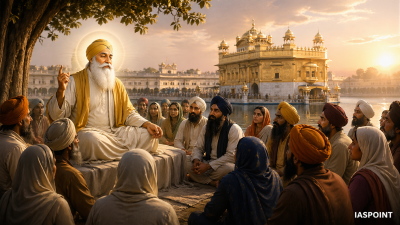
Sikh philosophy is a monotheistic, revolutionary school of Indian thought that emerged in the 15th century CE. Founded by Guru Nanak Dev, it represents a synthesis of spiritual liberation and social activism. It rejects the Varna system, idol worship, and asceticism, advocating for a life of a “Gurmukh” (God-oriented person) within the household.
Concept of God: Ik Onkar
The core of Sikhism is the belief in a single, universal, and formless Supreme Reality.
- Nirgun and Sargun: God is both Nirgun (without attributes, absolute) and Sargun (with attributes, manifest in creation).
- Mool Mantar: The fundamental creed of Sikhism, defining God as Ik Onkar (One God), Satnam (Truth is His Name), Karta Purakh (The Creator), Nirbhau (Without Fear), Nirvair (Without Enmity), Akal Murat (Timeless Entity), Ajuni (Beyond Birth and Death), and Saibhang (Self-Existent).
- Hukam: The belief that the entire universe operates under the Divine Will or Divine Command.
The Goal of Life: Mukti and Gurmat
Sikhism defines the purpose of human birth as the realization of God and the cessation of the cycle of birth and rebirth.
- Haumai (The Ego): Identified as the greatest barrier between the soul and God. It manifests through five vices: Kam (Lust), Krodh (Wrath), Lobh (Greed), Moh (Attachment), and Ahankar (Pride).
- Sahaj: A state of spiritual poise and equilibrium achieved through the remembrance of the Divine Name (Nam Simran).
- Mukti (Liberation): Unlike some traditions that seek liberation after death, Sikhism promotes the concept of Jivan Mukti—achieving spiritual freedom while still alive and active in society.
Ethical Pillars and Social Philosophy
The Sikh way of life is structured around three primary pillars that ensure spiritual growth alongside social responsibility.
| Pillar | Concept | Practical Application |
| Naam Japo | Meditating on God’s Name | Constant mindfulness and recitation of the Divine Name to purify the mind. |
| Kirat Karo | Honest Labour | Earning one’s livelihood through hard, honest work without exploitation. |
| Vand Chakko | Sharing with Others | Sharing the fruits of one’s labor with the needy; the basis of the Langar system. |
Concept of the Guru
The Guru is central to Sikhism as the “Voice of God” and the “Divine Light.”
- The Ten Gurus: The lineage from Guru Nanak Dev to Guru Gobind Singh.
- Guru Granth Sahib: The eternal living Guru. It is a compilation of the teachings of the Sikh Gurus and various Hindu and Muslim saints (Bhagats), such as Kabir, Namdev, and Baba Farid, showcasing the pluralistic nature of Sikh philosophy.
- Guru Panth: The concept of the community as the physical embodiment of the Guru.
The Khalsa and the Five Ks
Established by Guru Gobind Singh in 1699, the Khalsa Panth transformed the Sikh community into a “Saint-Soldier” order. Members are required to wear five articles of faith, known as the Five Ks:
- Kesh: Uncut hair, symbolizing acceptance of God’s will and holiness.
- Kangha: A wooden comb, symbolizing cleanliness and a disciplined life.
- Kara: An iron bracelet, symbolizing an unbreakable bond with God and restraint.
- Kachera: Cotton undergarments, symbolizing high moral character and agility.
- Kirpan: A ceremonial sword, symbolizing the duty to protect the weak and fight against injustice.
Socio-Religious Institutions
- Sangat: A holy congregation where everyone sits together as equals to listen to the Guru’s word.
- Pangat: The practice of sitting in a row to consume Langar (free community kitchen), which effectively abolished caste distinctions.
- Seva: Selfless service, considered essential for dissolving the ego (Haumai).
- Dasvandh: The practice of donating one-tenth of one’s income to the community and charitable causes.
Important Facts for UPSC Prelims
- Adi Granth: The first rendition of the holy scripture compiled by Guru Arjan Dev in 1604.
- Gurmukhi: The script used for writing the Punjabi language, standardized by Guru Angad Dev.
- Anand Karaj: The Sikh marriage ceremony, emphasizing a spiritual union.
- Takhts: There are five temporal seats of authority in Sikhism: Akal Takht (Amritsar), Takht Sri Damdama Sahib (Talwandi Sabo), Takht Sri Keshgarh Sahib (Anandpur), Takht Sri Hazur Sahib (Nanded), and Takht Sri Patna Sahib (Bihar).
- Miri and Piri: Introduced by Guru Hargobind, symbolizing the blend of temporal (Miri) and spiritual (Piri) authority.
- Zafarnama: The “Letter of Victory” written by Guru Gobind Singh to the Mughal Emperor Aurangzeb, detailing the ethical foundations of war.